Does Music Help You Study? The 1989 Experiment That Settles It
Whether music helps or hurts your studying depends on what you are studying. A classic memory experiment explains the split, and it turns the vague "it depends" into a rule you can actually use.
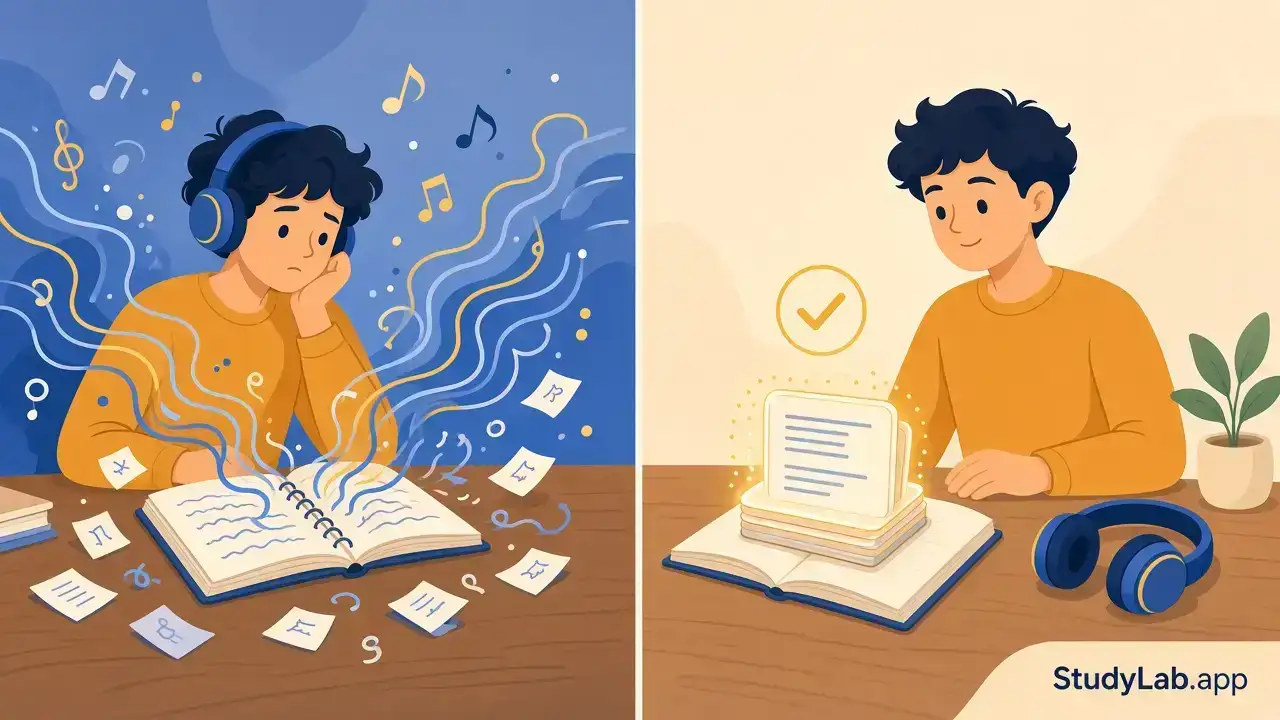
Half the study advice on the internet says music kills your concentration. The other half swears by three-hour lo-fi playlists. Both sides sound confident, and you're stuck in the middle wondering if your playlist is quietly costing you marks.
Here's what almost nobody in that argument mentions. Psychologists have been running controlled experiments on this exact question since the 1980s, and the results aren't vague at all. Music affects different kinds of studying completely differently. Once you see the split, you can stop asking "does music help you study?" and start asking the better question, which is "does music hurt this task?"
The Experiment That Started It
In 1989, memory researchers Pierre Salamé and Alan Baddeley ran a simple test. People had to remember sequences of nine digits they saw on a screen, while the room played either vocal music, instrumental music, or nothing at all.
Both kinds of music made recall worse than silence, and vocal music was the worst offender. In a follow-up with well-practised participants, singing still wrecked performance while instrumental music barely differed from silence. A third experiment added noise that rose and fell like speech, and that noise did nothing. Quiet hiss, no problem. Actual words, big problem.
This became part of a broader finding with a usefully honest name, the irrelevant sound effect. Sound you are not even listening to still damages your ability to hold ordered verbal information in your head. You don't get to opt out by ignoring the music. The disruption happens whether you attend to it or not.
Why Lyrics Hit Harder Than Beats
When you memorise anything verbal, like a list, a definition, or a formula's steps, your brain keeps it alive in a short-term speech buffer. Psychologists call it the phonological loop. It's the inner voice repeating "mitochondria, ribosome, Golgi" while you scribble.
That buffer processes speech automatically. Lyrics are speech. So the words of a song walk straight into the machinery you're using to rehearse, and the two fight for the same space. Your study material usually loses, because the song is catchier.
Researchers still argue about the exact mechanism, and the honest version is worth a sentence. A rival account, backed by Dylan Jones and colleagues, showed that any sound that keeps changing, including tones and instrumental music, disrupts ordered recall somewhat, not just speech. The two camps disagree about why. But notice what they agree on. Sound that changes a lot disrupts verbal memory, speech and singing disrupt it most, and steady predictable sound disrupts it least. That's enough to build a rule on.
Something related shows up in reverse with the production effect, where saying material out loud makes it stick better precisely because your speech system got involved on purpose. Reading out loud helps you remember more for the same underlying reason lyrics hurt. That channel is powerful, so you want it working for you, not against you.
Which Study Tasks Music Hurts, Task by Task
Memorising and rote learning
Worst case for music. Vocab, anatomy, dates, formulas, anything you'd put on a flashcard runs through the exact buffer lyrics invade. Study this in silence, or at most with quiet, steady instrumental sound.
Reading dense material
Nearly as bad. Reading comprehension involves inner speech too, and a 2024 experiment in Frontiers in Psychology had 90 college students read passages with pop music, and comprehension dropped compared with silence. The drop was biggest when the lyrics were in the same language as the text. Students who always studied with music were hurt less than the rest, but "hurt less" is still hurt. If the text is hard, the playlist waits.
Writing essays
Mixed. Drafting sentences uses your verbal system, so lyrics interfere here too, though less catastrophically than pure memorisation. Instrumental music is usually fine, and if it keeps you in the chair for a full writing session, that trade can be worth it.
Maths and problem sets
Least affected. Once you're manipulating symbols and working procedures rather than holding words in order, the verbal buffer matters less. Plenty of students genuinely do fine solving problems to music. If the problem is wordy or brand new, drop the volume until you've understood it.
Boring, repetitive work
Music helps. Copying diagrams, organising notes, formatting references. When the task needs persistence rather than memory, music lifts mood and keeps you going, and mood is not nothing. A miserable student who quits after 20 silent minutes learns less than a happy one who does 90 with a soundtrack of movie scores.
What About the Mozart Effect?
You've probably heard that classical music makes you smarter. That entire industry traces back to a one-page 1993 paper in Nature, where college students did slightly better on a spatial reasoning task for a few minutes after listening to a Mozart sonata. Not while studying. Not on memory. A brief bump, on one narrow skill, lasting maybe a quarter of an hour.
Then other labs tried to repeat it. A meta-analysis of nearly 40 studies with over 3,000 participants, memorably titled "Mozart effect, Shmozart effect", found the remaining effect was small, short-lived, strongly inflated by publication bias, and nothing to do with Mozart in particular. Later work on the same question suggests anything mildly enjoyable that perks you up produces a similar temporary lift. Mozart won't hurt your studying, mostly because it has no lyrics. It just isn't magic.
Lo-fi beats sit in the same drawer. There's no good evidence the genre does anything special for learning. It works for people because it's instrumental, repetitive and predictable, which is exactly the profile the irrelevant sound effect punishes least. The same goes for binaural beats, where the research on cognition is thin and all over the place. If a "focus frequency" playlist feels nice, that's a fine reason to play it. Just don't pay extra for the science.
One genuine exception deserves its own line. A 2020 study in Psychiatry Research had preadolescents with and without ADHD read under four sound conditions, and music improved reading comprehension in the ADHD group while making the non-ADHD group worse. It's one study of 50 kids, so hold it loosely. But if you have ADHD and swear you focus better with sound on, you're not imagining it, and the silence-is-always-best rule may simply not be yours.
So What Should You Actually Play?
If you want one rule, it's this. Match the music to how verbal the task is.
- Memorising or hard reading: silence, or steady instrumental sound at low volume. Film scores, ambient, lo-fi, classical. Nothing with words, nothing that surprises you.
- Problem sets and practice questions: instrumental is fine. Familiar beats new, because new music pulls attention.
- Grinding, formatting, reviewing old material: play whatever keeps you working. Yes, even the stuff with lyrics.
- Any task, any time you notice you've replayed a song in your head instead of the material: that's your signal. Mute it for the rest of the session.
Two supporting moves make the rule easier to follow. First, control the environment before you negotiate with it, which is the whole argument of digital minimalism for students. A phone queued up with music is also a phone queued up with everything else. Second, remember that where and how you study gets encoded along with the material. Your exam hall will be silent. Doing at least your final reviews in silence means the conditions at recall time match the conditions at practice time.
And be suspicious of your own preferences here. The research on learning styles taught us that what feels effective and what is effective come apart all the time. Music makes studying feel better. Feeling better is real, and worth something. It's just not the same as remembering more.
Test It on Yourself Tonight
You don't have to take a 1989 digit experiment's word for it. Run the comparison on your own material. Pick two similar chunks of whatever you're studying this week. Learn one with your usual playlist, one in silence, and quiz yourself on both tomorrow without looking at your notes.
The quiz is the part people skip, because rereading both chunks feels equivalent. Testing is what exposes the difference. If making the questions is the barrier, StudyLab can generate a quiz from each chapter in a few seconds, which turns this whole experiment into a ten-minute check.
Most people who try it find exactly what the lab studies predict. The lyric-backed chunk feels the same while studying and comes back patchier the next day.
FAQ
Is it better to study with music or in silence?
For memorising and difficult reading, silence wins, with quiet instrumental music a close second. For problem-solving and routine work, music costs little and can help you stay at the desk longer. The more verbal the task, the quieter you should go.
Why can I focus better with music than in silence?
Sometimes you genuinely can. Music blocks out worse noise, like a loud flatmate or a busy café, and steady instrumental sound is far less disruptive than unpredictable speech. Music also lifts mood and makes long sessions bearable. And if you have ADHD, there's early evidence the calculation flips in your favour. The trap is only when "I focus better" really means "it feels better", which is exactly what the research warns feeling and learning aren't the same.
Does listening to classical music while studying make you smarter?
No. The original Mozart effect was a brief boost on one spatial task after listening, and a meta-analysis of nearly 40 studies found it small, temporary and not specific to Mozart. Classical music is a decent study choice only because it usually has no lyrics.
What music is best for studying?
Instrumental, familiar, steady and quiet. Film scores, ambient, classical and lo-fi all fit. The genre matters far less than three properties, namely no words, no surprises, and low volume.
Should I listen to music during online lectures or while taking practice tests?
No to both. A lecture is speech, so music competes with it directly. And practice tests should mimic exam conditions, which for almost everyone means silence. Save the playlist for the break between sessions.
The Playlist Isn't the Enemy. The Timing Is.
Music while studying isn't a yes-or-no question and never was. Lyrics fight your verbal memory, so the flashcard-and-textbook part of your evening belongs to silence or quiet instrumentals, and the problem sets and busywork can keep the soundtrack. Run the two-chunk test once this week and you'll have your own data instead of the internet's opinions.
And when you sit down for the silent half, make it count. Upload the chapter to StudyLab, generate a quiz, and spend those quiet minutes testing yourself instead of rereading. Silence plus retrieval beats noise plus highlighting by more than any playlist can claw back.