Elaborative Interrogation: The Study Technique That Asks Why (And Actually Works)
Forget re-reading. Elaborative interrogation is the science-backed study technique that actually improves retention. Here is how to use it starting tonight.
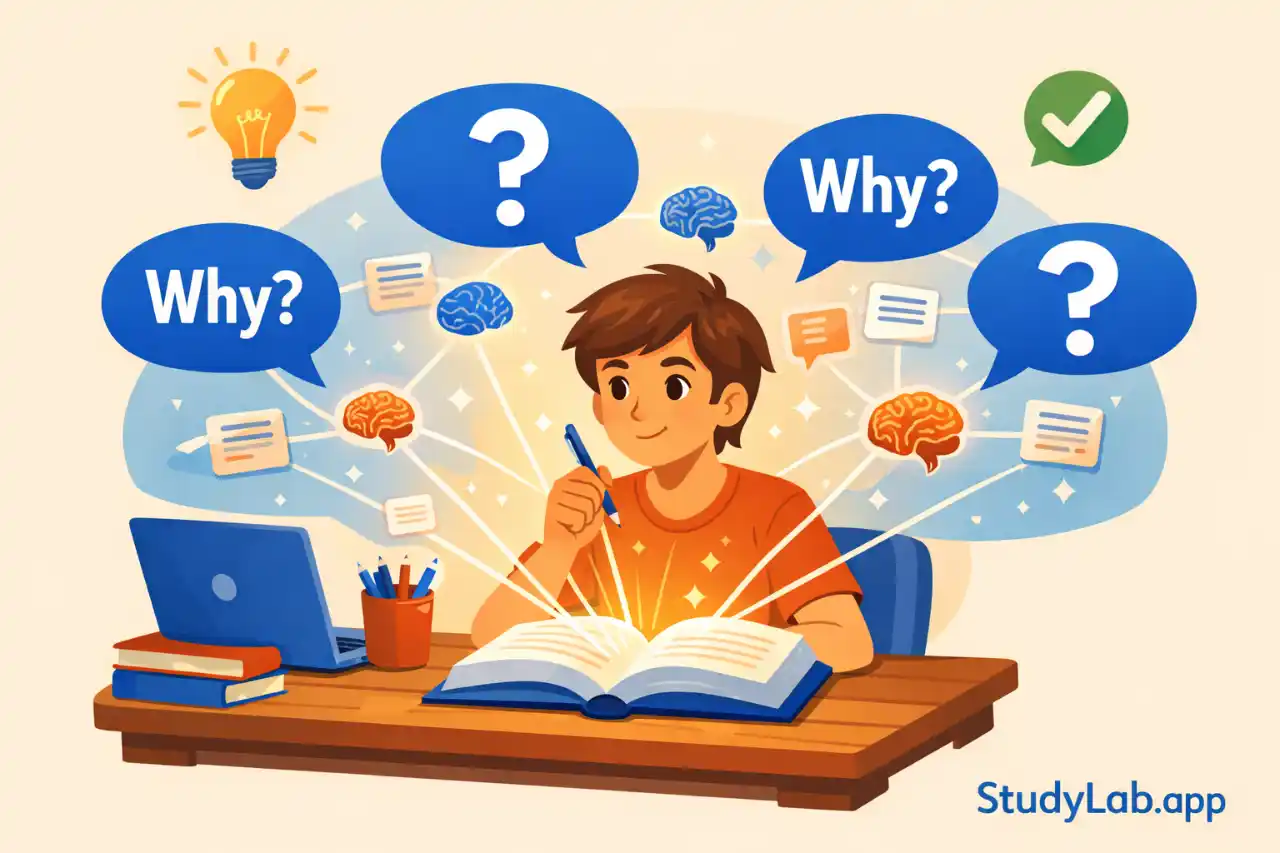
You're re-reading your notes for the third time. You highlighted half the page. It feels like studying. But if you've ever blanked on an exam for material you "definitely covered," here's the uncomfortable truth: re-reading and highlighting are among the least effective study techniques that exist. Researchers rate them as low utility. Yet most students rely on them every single session.
Elaborative interrogation is one of the techniques researchers actually rate as effective. It's not complicated, it doesn't require any special tools, and you can start using it tonight. But almost no one talks about it, which means almost no one is using it.
Here's what it is, why it works, and how to do it starting with your very next study session.
What Is Elaborative Interrogation?
Elaborative interrogation is a study technique that involves asking yourself why a fact or concept is true, then generating an explanation for it in your own words.
That's it. That's the whole technique.
Instead of reading a fact and moving on, you pause and ask: "Why does this happen?" or "Why is this true?" or "How does this connect to what I already know?" Then you actually try to answer it.
In one of the most widely cited reviews of study techniques ever conducted, researchers at Kent State and Duke University analyzed hundreds of studies and rated 10 common strategies by effectiveness. Re-reading and highlighting? Low utility. Elaborative interrogation? Rated moderate utility, with consistent evidence that it improves retention compared to passive reading.
The key word there is consistent. Across multiple studies, students who asked themselves why-questions while studying recalled more than students who simply read or highlighted the same material.
Why Does Asking "Why?" Work So Well?
Your brain doesn't store isolated facts. It builds networks. When you learn something new, your brain looks for existing knowledge to connect it to. The more connections it can make, the more pathways there are to retrieve that memory later.
Passive reading doesn't build those connections. You're receiving information, not processing it. Elaborative interrogation forces you to do something different: it makes you actively integrate what you're learning with what you already know.
There's also another mechanism at work. When you try to answer a "why" question, you have to search your memory for related information. That retrieval process itself strengthens the memory. It's similar to what makes active recall so effective. The act of trying to retrieve something makes it stickier.
And here's the part most students don't realize: even an imperfect answer helps. In a study by Pressley and colleagues, students who tried to explain a fact (even when their explanation wasn't entirely accurate) still showed significantly better recall on a final test than students who just read the same material. The brain doesn't need a perfect answer. It needs the effort of searching for one.
How to Use Elaborative Interrogation: Step by Step
Step 1: Read a chunk of material
Don't try to apply this to an entire textbook chapter at once. Read a section, a paragraph, or a few key facts. Then stop.
A few sentences is plenty.
Step 2: Identify the fact or concept
State what you just read in your own words. "Mitosis produces two identical daughter cells." "The Great Depression was triggered by the 1929 stock market crash." "Supply and demand determines price in a free market." Short, clear, in your own words.
Step 3: Ask the "why" question
Now ask: why is this true? You can vary the question based on what you're studying:
- Why does this happen?
- Why does this make sense?
- How does this connect to what I already know?
- Why would this be true in this situation but not another?
Don't just ask. Sit with it for a moment.
Step 4: Generate your explanation
Answer it. Out loud, in writing, or in your head. Use your existing knowledge to explain why the fact is true. Draw connections. Make it yours.
This is where the learning happens. You're not just receiving information anymore. You're building it into what you already know.
Step 5: Check yourself
Go back to your notes or textbook and see if your explanation holds up. Fill in any gaps. Correct any misconceptions.
This step matters. The goal isn't to guess and move on. It's to actively search, then verify.
What Does This Look Like for Real Subjects?
Elaborative interrogation works across any content-heavy subject. Here's what it looks like in practice.
Biology: You read that the cell membrane is selectively permeable. Instead of moving on, you ask: Why would a cell membrane need to control what enters and exits? You think about what you know about cells needing specific nutrients and expelling waste products. Now the fact has context. It makes sense.
History: You read that the Treaty of Versailles imposed heavy reparations on Germany after World War I. You ask: Why would the Allied powers want to financially punish Germany so severely? You think through war costs, public anger, and political pressure back home. Suddenly this isn't just a fact to memorize. It's a decision that makes sense in context.
Math: You're learning a new formula. Instead of memorizing it, ask: Where does this formula come from? Why does it produce the right answer? Understanding the logic makes the formula far easier to remember. It also helps you apply it correctly when the exam throws a problem at you from an unexpected angle.
This is where elaborative interrogation really shines: it works best when you already have some background knowledge on a topic. It's not the right tool for day one of a completely new subject. But once you've got the basics, it's one of the most effective ways to deepen understanding fast.
How to Get Started Tonight
Pick one subject you're studying this week. Open your notes to the first section. Read two or three facts or concepts. Then close your notes and ask yourself: Why is this true? How does this connect to what I already know?
Write your answer down. It doesn't need to be perfect. A few sentences is enough. Then open your notes and check how you did.
Do that for 20 minutes. That's elaborative interrogation. That's the whole thing.
If you want to take it further, combining elaborative interrogation with spaced repetition is a genuinely powerful pairing. Use elaboration when you first encounter material to build understanding, and spaced repetition to lock it in over time. The Feynman Technique takes it a step further. If you can explain a concept simply enough for a 10-year-old to understand it, you actually understand it. Elaborative interrogation is a great first step toward that level of mastery.
Common Mistakes to Avoid
Asking without answering. The question is a prompt. The work happens when you actually try to generate an explanation. Don't read the question and skip straight to your notes.
Using it on totally unfamiliar material. Elaborative interrogation works because it connects new facts to existing knowledge. If you're completely new to a topic, build the basics first, then come back to it.
Using it for everything. It's most powerful for factual content: processes, causes, mechanisms, relationships. For pure procedural skills (like practising calculus problems), active retrieval and repetition are better fits.
Stopping at surface-level whys. "Why is the sky blue?" "Because of light scattering." Push deeper: Why does light scatter that way? What is it about the wavelength of blue light specifically? The richer your explanation, the stronger the memory.
FAQ
What is elaborative interrogation in simple terms? It's a study technique where you stop after reading a fact and ask yourself "why is this true?" then try to explain it using what you already know. It's basically turning passive reading into active thinking.
How is elaborative interrogation different from active recall? Active recall is about retrieving information from memory. It means testing yourself without looking at your notes. Elaborative interrogation is about explaining why a fact is true, not just recalling what it is. They're complementary. You can read more about how active recall works here.
When does elaborative interrogation work best? It works best when you already have some background knowledge on the topic. It's also most effective for factual, conceptual material: biology, history, economics, psychology. Any subject where "why" questions have meaningful answers.
Can I combine it with other study techniques? Yes, and you should. It pairs well with interleaved practice, spaced repetition, and active recall. For a broader look at what the research says actually works, this guide to evidence-based study strategies is worth a read.
How much time does it add to a study session? Not much. Research suggests the time cost is relatively small. It's almost certainly more efficient than re-reading the same material three times hoping something sticks.
Start Asking Better Questions
Re-reading feels productive. Highlighting feels productive. But feeling like studying and actually learning are two different things.
Elaborative interrogation is one of the simplest shifts you can make. Ask why. Generate an explanation. Check yourself. That's it.
Pick up your notes tonight. Find one fact. Ask yourself why it's true.
That's how it starts.
Ready to go deeper? Upload your study materials to StudyLab and get AI-generated quiz questions, including the kind of "why" and "how" questions that push you to think, not just recall. Start testing yourself in seconds.