The Illusion of Competence: Why Rereading Feels Like Studying (But Fails You)
The illusion of competence is why you feel ready then blank on the exam. Here is how your brain confuses familiarity with mastery, and how to fix it before test day.
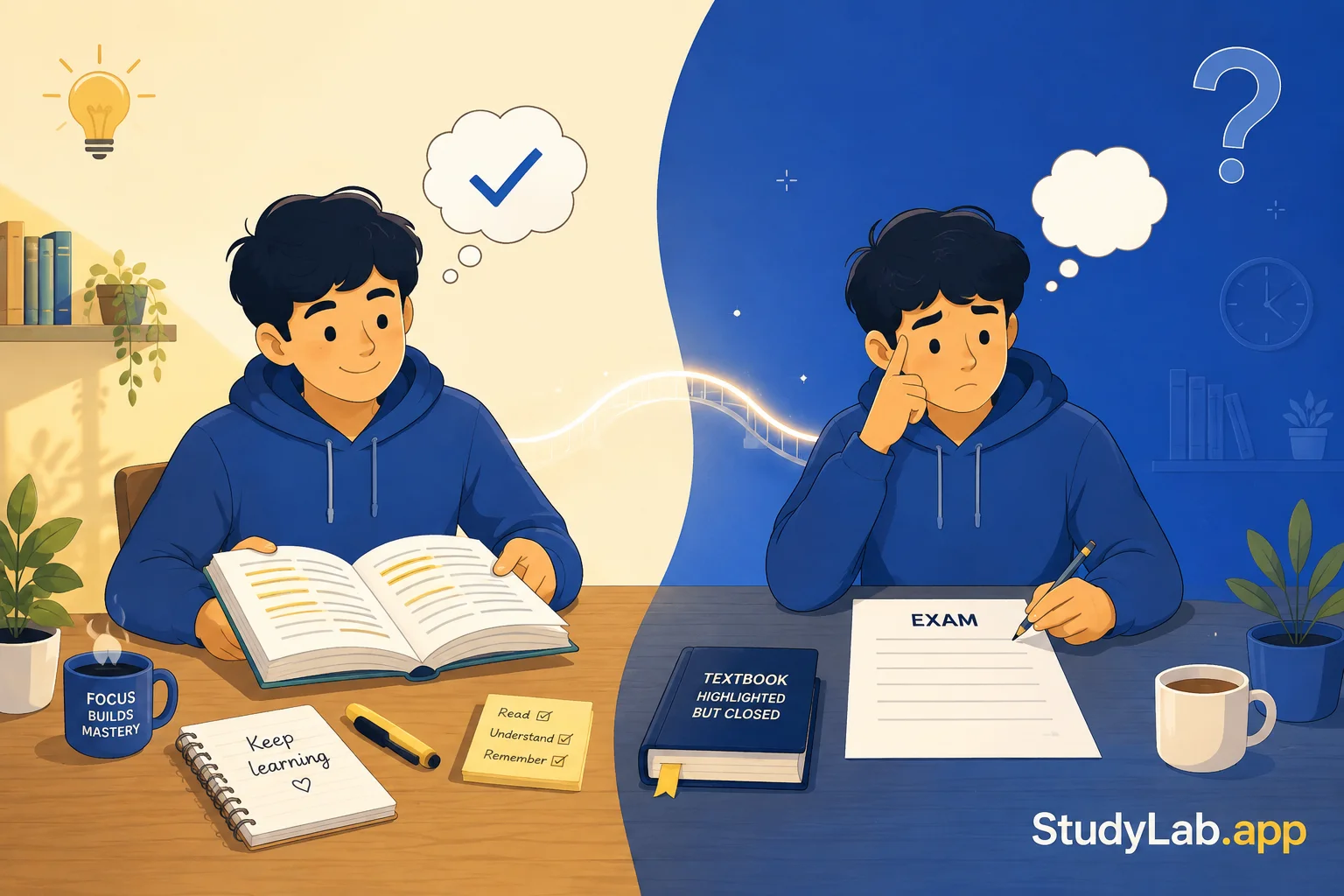
You read the chapter. Then you read it again. You highlighted the important parts, went over your notes one more time, and closed the book feeling ready. Then the exam hit, and half of it was just gone. You knew this. You were sure you knew this. So what happened?
You ran into the illusion of competence. It's the gap between feeling like you know something and actually being able to recall it, and it's probably the single most common reason smart students bomb exams they studied hard for. The scary part is how convincing it is. Your brain hands you a warm feeling of "got it" that has almost nothing to do with whether you can produce the answer when it counts.
Here's how it works, why your brain does it, and how to catch yourself before the exam does it for you.
What is the illusion of competence?
The illusion of competence is when you mistake familiarity for mastery. You've seen the material enough times that it feels easy, and your brain reads that ease as "I know this." But recognizing something and recalling it are two different skills.
Think about the difference between following GPS directions and actually knowing the route. With the GPS talking, every turn feels obvious. You feel like you know the way. Then one day the app dies, and you realize you were never navigating at all. You were just reacting to prompts. Rereading your notes is the GPS. The exam is the dead phone.
Recognition is easy. You see a term you've read five times, it looks familiar, and that familiarity feels like knowledge. Recall is hard. It's pulling the answer out of an empty page with no cues. Exams mostly test recall. Your rereading mostly builds recognition. That mismatch is the whole trap.
Cognitive scientists also call this the fluency illusion. When information is easy to process, your brain tags that smoothness as understanding. The smoother your notes feel on the fifth read, the more convinced you are that you've learned them, and the less true it actually is.
Why does your brain fall for it?
Because feeling like you know something and knowing it produce almost the same sensation from the inside. And there's a landmark study that shows just how badly this fools people.
In 2008, researchers Jeffrey Karpicke and Henry Roediger ran an experiment published in Science. Students learned 40 Swahili-English word pairs. After a student got a pair right once, it was sorted into different groups. Some pairs they kept restudying, others they kept getting tested on. A week later, the difference was huge. The students who kept testing themselves recalled about 80% of the pairs. The ones who kept restudying recalled roughly a third.
Now the part that matters for the illusion. When asked to predict how they'd do, students in both groups guessed about the same, around 50%. Their confidence had no connection to their actual performance. The restudy group felt just as ready and remembered half as much. As the researchers put it, even university students seem to have no idea this is happening.
That's the illusion in a nutshell. Restudying feels productive. It builds that comfortable sense of familiarity. But once you can already recall something, reading it again adds almost nothing, while your confidence keeps climbing anyway.
How to beat the illusion of competence
The fix is simple to say and uncomfortable to do. Stop testing whether you recognize the material and start testing whether you can produce it. Close the book and see what actually comes out.
A few concrete ways to force recall instead of recognition:
- Close everything and write down all you remember about a topic from a blank page. This is the blurting method, and the blank page is brutally honest about what you don't know.
- Turn your notes into questions and answer them from memory, which is the core of active recall.
- Explain the concept out loud as if you're teaching it, then check where you got stuck.
- Space these self-tests out over days with spaced repetition, so you're recalling after you've started to forget, which is where the real learning happens.
The discomfort is the point. When self-testing feels harder than rereading, that's not a sign you're studying wrong. That's the feeling of actual learning. It's why researchers group these methods under desirable difficulties. The struggle to retrieve is what builds durable memory.
If making questions from your notes is the annoying part that keeps you rereading instead, StudyLab can turn your PDF or notes into a quiz automatically, so you get instant recall practice without the prep.
The traps that keep you fooled
Highlighting is the biggest one. It feels active, but it's mostly decoration. You're marking what looks important, not testing whether you can retrieve it. Same with rereading and copying notes word for word. All three raise familiarity and confidence while leaving recall untouched.
Another trap is judging your readiness by recognition-style review. Flipping through flashcards and thinking "yep, know that, know that" only checks recognition. Cover the answer first. If you can't say it before you flip, you don't know it yet.
Then there's the multiple-choice trap. Acing practice questions where the answer is on screen can leave you flat-footed on an essay exam that demands recall from scratch. Match your practice to how you'll actually be tested.
FAQ
What is the illusion of competence in studying?
It's mistaking familiarity with material for the ability to recall it. Rereading and highlighting make information feel easy and known, but that feeling doesn't mean you can produce the answer on a test without cues.
Why do I forget everything on the exam even though I studied?
Most likely you studied by recognition (rereading, highlighting) instead of recall (self-testing). Those build a feeling of knowing without building the retrieval skill the exam actually measures.
Is rereading a waste of time?
One careful read to understand the material is useful. Reading the same notes over and over after that adds very little. Research shows repeated studying barely improves recall once you can already produce the answer, while self-testing keeps paying off.
How do I know if I actually know something?
Close the book and try to explain it or write it out from memory. If it comes out clear and complete, you know it. If you freeze or need to peek, you've found a gap that recognition was hiding.
What should I do instead of rereading?
Self-test. Blurt everything you remember onto a blank page, quiz yourself with questions, or teach the concept out loud. Then reread only the parts you couldn't recall.
Stop trusting the feeling, start testing it
The feeling of knowing is a liar. The only way to find out what you actually know is to close the book and try to produce it, before the exam produces it for you. Pick one topic you feel confident about right now and test yourself on it cold. If you'd rather not build the questions by hand, upload your notes to StudyLab and let it generate a quiz, then find out what you really know while there's still time to fix it.