Implementation Intentions: The "If-Then" Trick That Makes You Actually Study
You planned to study tonight. You did not. The problem is not laziness, it is that a vague goal has nothing to trigger it. Implementation intentions fix that with one if-then sentence.
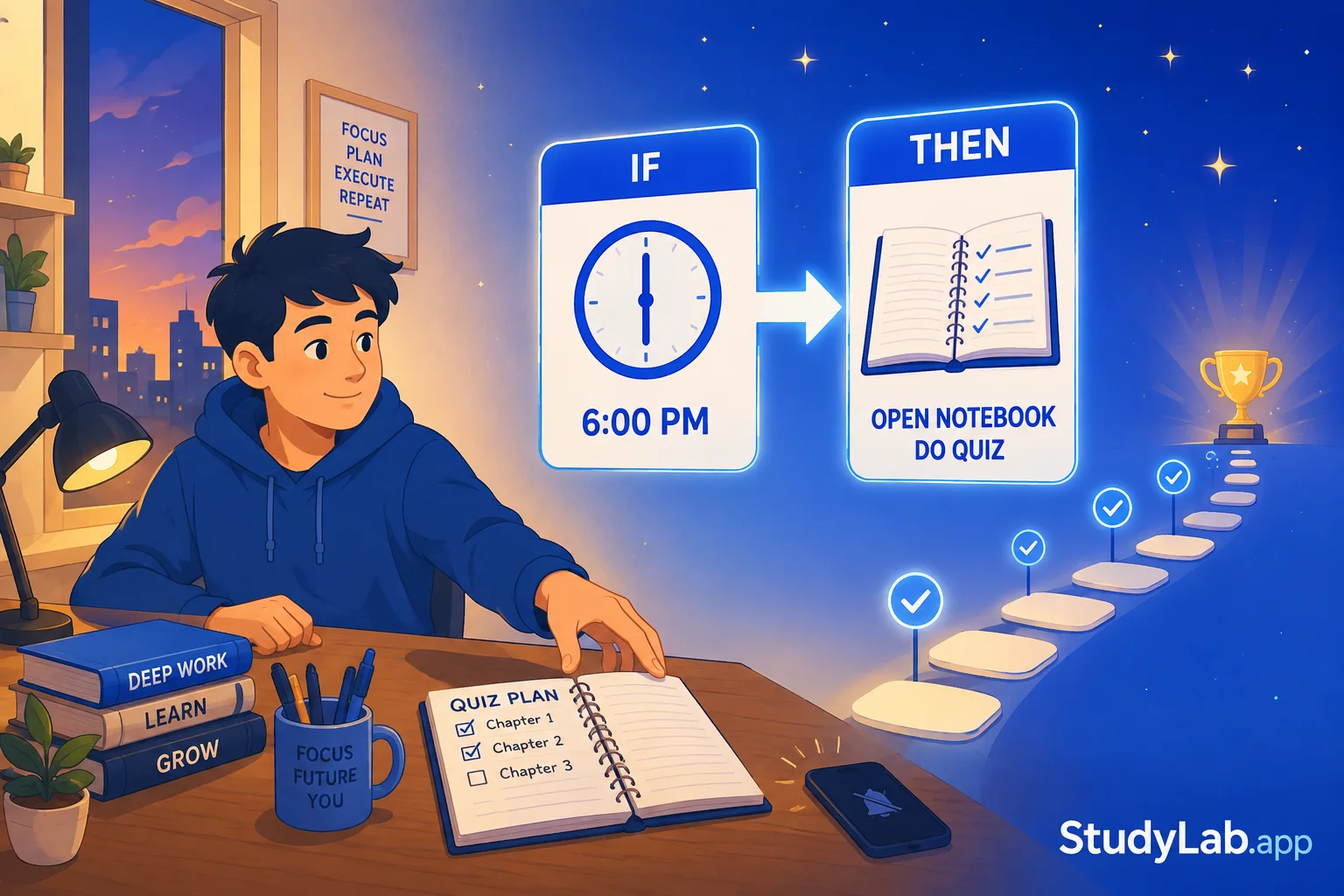
You told yourself you'd study tonight. It's now 10 PM, you've reorganized your desk twice, watched half a documentary, and somehow the notes are still closed.
That's not laziness. It's a planning problem. "I'll study tonight" is a wish, not a plan, and wishes have nothing to trigger them. The moment you'd actually start never gets defined, so it never arrives.
Implementation intentions fix exactly this. They're one of the most tested tools in behavior-change research, they take about ten seconds to make, and they work by removing the single hardest part of studying: deciding to start.
What Are Implementation Intentions?
Implementation intentions are specific if-then plans that connect a situation to an action. The formula is simple: "If [situation], then I will [action]."
The idea comes from psychologist Peter Gollwitzer, who drew a sharp line between two kinds of plans. A goal intention is what you want: "I want to do well on my chem exam." An implementation intention is exactly when, where, and how you'll act on it: "If it's 4 PM and I'm back from class, then I'll sit down and do 20 practice problems."
See the difference? The goal names a destination. The implementation intention builds the road. One floats in your head as a good idea. The other has a trigger attached, so when the moment shows up, the action is already decided.
Some examples for studying:
- If I finish dinner, then I'll review my biology flashcards for 15 minutes.
- If it's Sunday morning, then I'll plan my study schedule for the week.
- If I sit down at my desk, then I'll put my phone in the other room.
- If I feel the urge to check my phone mid-study, then I'll write down the thought and keep going.
That last one matters. Good if-then plans handle obstacles, not just start times.
Why Do If-Then Plans Work So Well?
The reason is almost mechanical. When you pre-decide your response to a specific cue, you hand that decision off to the situation instead of to your willpower.
Normally, studying requires you to notice the right moment, weigh it against everything else you could do, overcome the pull of easier options, and then choose to begin. Every one of those steps is a chance to bail. An implementation intention collapses all of that. The cue arrives (it's 4 PM, you're at your desk), and the action fires with far less internal debate. You've moved the decision from the tired, tempted version of you to the calm version who made the plan in advance.
A large 2006 review by Gollwitzer and Paschal Sheeran, pulling together many studies across health, academics, and everyday goals, found that implementation intentions had a strong effect on whether people actually followed through, well beyond just setting a goal. The technique keeps showing up as one of the more reliable ways to close the gap between intending to do something and doing it.
This is why it pairs so naturally with methods you might already use. The Pomodoro Technique becomes far stickier when you bolt an if-then trigger to it: "If it's 7 PM, then I start one Pomodoro." The technique gives you the work block. The implementation intention gets you into the chair.
How to Write an Implementation Intention That Actually Sticks
A weak if-then plan is vague. A strong one is almost annoyingly specific. Here's how to build the good kind.
1. Start with a real goal. Know what you're actually trying to do this week. "Get through chapter 7" or "finish the problem set." If your week feels shapeless, our guide to time management for students helps you map it out first. The plan needs a destination before it can build a road.
2. Pick a concrete cue. The "if" should be a specific, unmistakable moment. Not "when I have time" (that moment never comes) but "when I finish lunch" or "when I get home at 5." Tie it to something that reliably happens in your day.
3. Attach one specific action. The "then" should be small and clearly defined. "Then I'll study" is too fuzzy. "Then I'll do 10 recall questions on the nervous system" tells you exactly what to do, so there's no second decision to make.
4. Plan for the obstacle too. Think about what usually derails you, and write an if-then for it. "If I notice I'm reaching for my phone, then I'll move it to another room." Naming the temptation in advance takes away its surprise.
5. Say it or write it down. A plan you've actually committed to on paper (or out loud) is stronger than one that stayed a vague thought. Make it real.
Here's the whole thing combined for studying: "If it's 6 PM and I've eaten, then I'll upload today's lecture notes to StudyLab, take a 15-minute quiz on them, and review what I missed." The trigger is concrete, the action is a specific piece of active recall, and the tool is the pre-committed response, so when 6 PM hits, there's nothing left to decide.
The Honest Caveats
Implementation intentions are powerful, but they're not a cure-all, and the research is refreshingly honest about the limits.
For one, they don't automatically fix procrastination. A few studies specifically testing whether if-then plans reduce procrastination found little to no effect on their own. So if chronic procrastination is your real issue, an if-then plan is a helpful piece, not the whole solution, and it works best alongside the broader habits we cover in our guide to beating procrastination.
There's also a stronger version worth knowing about. Researchers found that pairing if-then plans with a technique called mental contrasting boosts their power. Mental contrasting means vividly picturing the good outcome you want, then honestly facing the obstacle in your way, before you write the plan. Combined, the two (a method called MCII) have helped people follow through in situations where plain if-then plans fell short, including bedtime procrastination, which wrecks plenty of study schedules.
And like any tool, it fades if you never revisit it. A plan you made once and forgot won't fire. The students who benefit most keep their if-then plans visible and refresh them each week.
Common Mistakes to Avoid
Vague cues. "If I get a chance" isn't a trigger. Anchor the "if" to a specific time or a concrete event that actually happens.
Giant actions. "Then I'll study for four hours" is intimidating and easy to skip. Make the "then" small enough that starting feels easy. Momentum handles the rest.
Only planning the start. Half your derailments happen mid-session. Write if-then plans for the obstacles (phone, noise, fatigue), not just the beginning.
Setting it and forgetting it. Review your plans weekly. A stale if-then plan quietly stops working because the cue no longer matches your actual routine.
FAQ
What is an implementation intention in simple terms?
It's a specific if-then plan that links a situation to an action, like "If it's 4 PM, then I'll start my math homework." Instead of just hoping you'll get around to a task, you pre-decide exactly when and where you'll do it, which makes you far more likely to follow through.
How are implementation intentions different from goals?
A goal is what you want ("do well on the exam"). An implementation intention is the plan for acting on it ("if it's 5 PM, then I'll do 20 practice questions"). Goals give direction, but they don't tell you when to move. Implementation intentions attach the action to a trigger, so it actually happens.
Do implementation intentions help with procrastination?
They can help, but the research is mixed on procrastination specifically. Some studies found plain if-then plans didn't reduce procrastination much on their own. They work best as one part of a bigger approach, and pairing them with mental contrasting (picturing the goal and the obstacle first) tends to make them more effective.
How many implementation intentions should I make?
Start with one or two, not twenty. Pick your most important study goal for the week and write a clear if-then plan for it, plus one for your biggest obstacle. Too many plans at once get forgotten. A couple of well-placed ones you actually follow beat a long list you ignore.
Can I use implementation intentions for things other than starting to study?
Yes. They work for obstacles ("if my phone buzzes, then I leave it face down"), for switching tasks, for sticking to breaks, and for daily habits like sleep. Anywhere there's a gap between what you intend and what you do, an if-then plan can help close it.
Do I have to write them down?
You don't have to, but it helps. Committing the plan to paper or saying it out loud makes it more concrete and more likely to stick than a vague thought. Many students keep their weekly if-then plans on a sticky note where they study.
Write One If-Then Plan Right Now
Don't overhaul your whole system tonight. Just pick the one study task you keep putting off, and write a single sentence: "If [specific moment], then I will [specific small action]."
Make the action easy to start and tie it to something concrete. For example: "If it's 6 PM and I've eaten, then I'll upload my notes to StudyLab and take one short quiz." Then let the clock, not your motivation, be the thing that gets you started.