Your Mind Went Blank Mid-Exam: What to Do in the Next 60 Seconds
A blank mid-exam feels like the knowledge has been deleted. It has not. This is a 60-second script for the moment it happens, built from the research on stress, retrieval cues and the tip-of-the-tongue state.
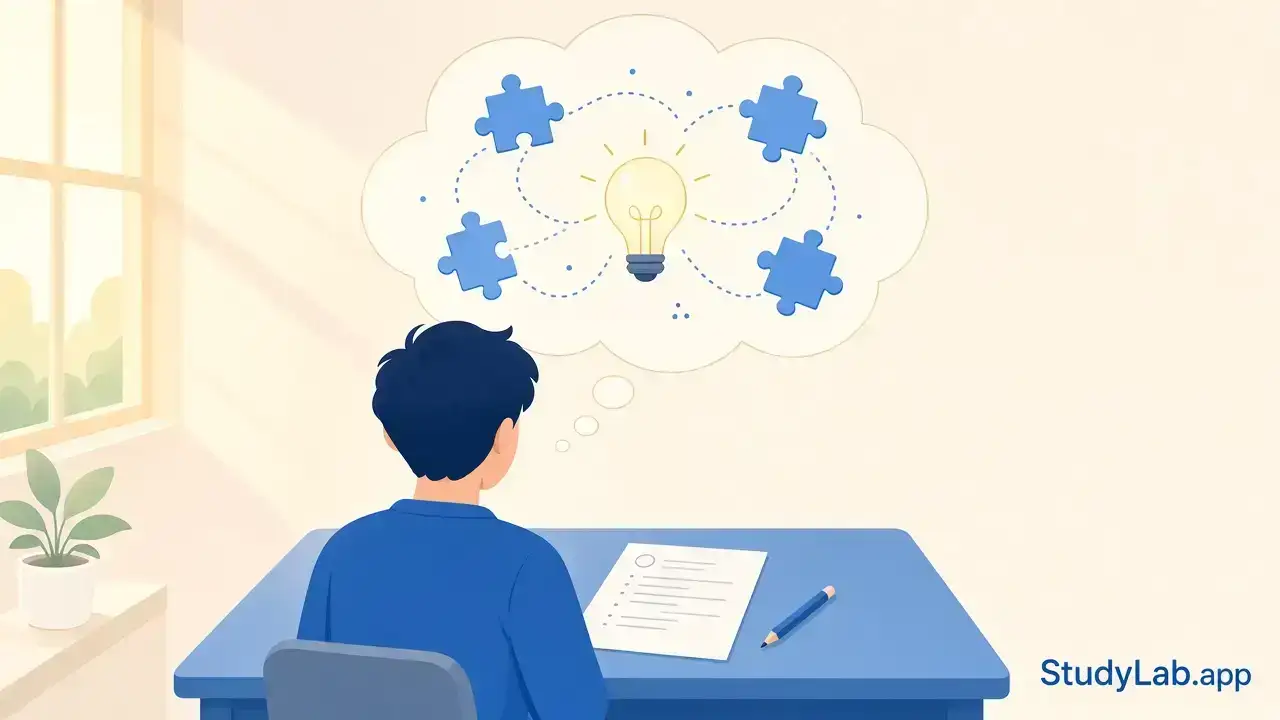
You read question four. You know this. You made a flashcard for it, you explained it to your roommate, you got it right on the practice quiz on Tuesday. And now there's nothing. The page looks like it's written in a language you almost speak, your heart's going, and the clock in the corner hasn't stopped.
Your mind went blank during an exam. It happens to people who studied properly, and it happens more on the exams that matter.
A blank usually isn't a missing memory. It's a memory you can't get to right now, and there are specific moves that improve the odds of getting to it. This post is only about the next 60 seconds, the stretch between "oh no" and either writing the answer or moving on with your head clear.
Why your mind goes blank when you studied
Two things are happening at once.
First, your prefrontal cortex, the front part of your brain that holds things in mind and pulls up what you need, is unusually sensitive to stress. In a 2009 review in Nature Reviews Neuroscience, Yale neuroscientist Amy Arnsten wrote that even quite mild stress, when it feels out of your control, can cause a rapid and dramatic loss of prefrontal abilities. The chemicals your body releases under pressure weaken the connections that keep a thought active.
Second, worry takes up room. Sian Beilock and Thomas Carr showed in 2005 that pressure hurts performance by eating into working memory, your brain's small mental notepad. The irony is that the students with the most working memory were the ones who choked. (We went through that study properly in the post on why you score lower on the real exam than on practice tests.)
So a blank is a stressed brain, with a notepad full of worry, trying to find one specific memory. The answer is still stored. The search is failing.
That changes what you should do. Trying harder to "just remember" makes the stress worse and fills the notepad further. What works is lowering the pressure a notch and giving the search better starting points.
The 60-second recovery script
Seconds 0 to 10: stop staring and put the pen down
Staring at the question and rereading it for the sixth time is the natural reaction, and it's the one that keeps you stuck. Every reread is another round of "I should know this," which is exactly the worry that's eating your working memory.
Take your eyes off the question. Put the pen down. Look at your desk or out of the window for a moment.
Seconds 10 to 25: two slow breaths
Breathe in through your nose, then let the breath out slowly, more slowly than it came in. Do it twice.
A 2018 systematic review of 15 studies, published in Frontiers in Human Neuroscience, found that slow breathing (under 10 breaths a minute) was linked to more relaxation and less anxiety and arousal in healthy adults. Two breaths won't erase exam stress. They're just the fastest brake you have that nobody in the room will notice. If you want a longer routine to practice beforehand, the box breathing method in our test anxiety guide is a good one.
Seconds 25 to 40: go back to where you learned it
Ask yourself where you were when you studied this. Which room, which page of your notes, what color you highlighted it in, whether it was on the left or right side of the lecture slide, what the example in class was.
This isn't a feel-good trick. In a 1979 experiment, psychologist Steven Smith found that people tested in a different room from where they learned recalled less. But when people in the new room spent a moment picturing the original room before recalling, the drop disappeared. Your memories are stored with the context they were learned in, and rebuilding that context in your head gives the search a new route in. (More on this in the post on context-dependent memory.)
Seconds 40 to 60: write fragments, not answers
Grab the pen again and write anything connected to the question in the margin or on scrap paper. A keyword. The first letter of a term you can almost see. A formula that sits next to this one in your notes. The name of the professor's example. Half a diagram.
This works with how the tip-of-the-tongue state behaves. In a classic 1966 study, Roger Brown and David McNeill put students into that "I know it, I can't say it" feeling and found they could often report pieces of the missing word, like its first letter or how many syllables it had, while the full word stayed out of reach. Partial access is real. Writing the pieces down gets them out of your overloaded working memory and onto paper, where each one can act as a cue for the next.
It's basically a tiny version of the blurting method, aimed at one question instead of a whole topic.
Still blank after 60 seconds? Move on, on purpose
If the fragments haven't turned into an answer, stop. Put a clear mark next to the question and go to the next one you can do.
This is the part students resist, because leaving a question feels like giving up. It isn't. Every other question on the paper is a set of cues. Terms, diagrams and worked examples in question nine might be exactly the fragment you needed for question four. And answering a couple of questions you know brings your stress down, which gives your prefrontal cortex a better shot when you return.
When you come back, look at your fragments first, before you reread the question.
What to do if the whole exam goes blank
Sometimes it's not one question. You flip the paper over and nothing looks familiar.
Run the same script, but at exam scale. Pen down, two slow breaths. Then skim the whole paper without trying to answer anything and find the single easiest question, even if it's worth two marks. Do that one first. Then the next easiest. You're not trying to be efficient here. You're trying to get your brain back into retrieval mode with something it can win.
Mistakes that keep you stuck
Rereading the question over and over. Every pass fills your notepad with more worry. Look away instead.
Telling yourself "I should know this." You probably do know it. Saying so just adds pressure. Switch to "what do I know that's near this?"
Writing nothing. On questions that give partial marks, a formula, a definition or the first step can earn points even if you never get the final answer. Your fragments might be worth something as they are.
Spending five minutes on one question. Time pressure makes the next blank more likely. One minute, then move.
FAQ
Why does my mind go blank during exams even though I studied?
Stress and worry temporarily make it harder for your brain to pull up information it has stored. Research on the prefrontal cortex shows even mild stress can impair it quickly. The memory is usually still there. Retrieval is what's failing.
Is going blank on a test a sign of test anxiety?
It can be, especially if it happens on most exams. An occasional blank on a hard question is normal. If blanks are regular and come with a racing heart, sweating or dread before exams, it's worth reading up on test anxiety and talking to your school's counseling service.
How do you remember something you forgot during a test?
Stop trying to force it, calm your body with a couple of slow breaths, picture where and how you learned it, and write down any related fragments. If nothing comes after about a minute, move on and come back later with fresh cues from the rest of the paper.
Can you prevent your mind from going blank?
You can make it less likely. Studying by testing yourself instead of rereading gives you practice pulling information out under effort, and taking timed practice exams makes the real pressure feel more familiar. It's also worth practicing this 60-second script during mock exams so it's automatic on the day.
Before your next exam
Write "pen down, breathe, where was I, fragments, move on" on a sticky note and practice it once on a timed quiz this week. It feels silly in a quiet room. It won't feel silly on the day.
And if you want more practice pulling answers out under a timer, you can upload your lecture notes to StudyLab and quiz yourself on them with a timer running before the real thing.