Mind Mapping for Students: How to Transform Complex Topics into Visual Study Guides
Struggling with dense textbooks? Unlock visual learning and master study organization. Learn how mind mapping and concept mapping turn complex topics into clear, memorable guides.
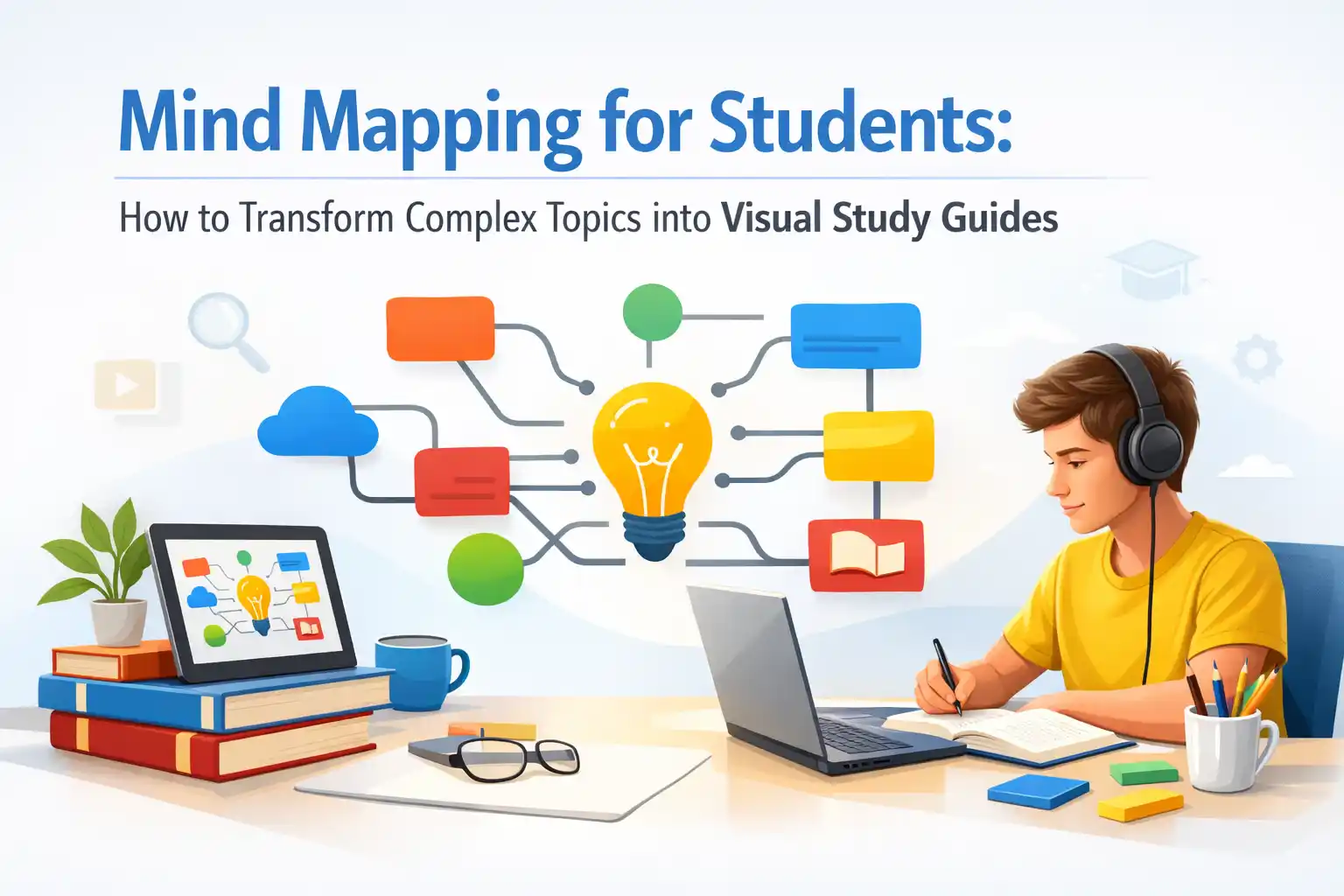
Ever stared at a 50-page textbook chapter wondering how you're supposed to remember any of it? You're not alone. Here's the thing: your brain doesn't naturally think in neat rows of text. It thinks in connections, images, and relationships. That's exactly why mind mapping has become such a powerful tool for visual learning and study organization.
I've seen students transform their entire approach to studying once they discover how to map out complex topics visually. Instead of rereading the same paragraphs over and over, they create visual study guides that actually stick. In this guide, I'll walk you through everything you need to know about concept mapping for academic success, from basic techniques to advanced strategies that'll change how you process information.
What Exactly Is Mind Mapping (And Why Does It Work)?
A mind map is essentially a visual representation of information that radiates outward from a central concept. Picture a tree: the trunk is your main topic, branches are subtopics, and smaller twigs are the details. Simple, right?
But here's where it gets interesting. Research on visual learning suggests that combining words with images can improve recall by up to 65% compared to text alone. Your brain is wired to process visual information faster than text. When you create a mind map, you're essentially speaking your brain's native language.
The magic happens because mind mapping engages both hemispheres of your brain simultaneously. The left side handles the words and logic, while the right side processes colors, images, and spatial relationships. Traditional note-taking? That's mostly a left-brain activity. You're leaving half your mental horsepower on the table.
The Science Behind Visual Study Guides
Let me get a bit nerdy for a second (I promise it's relevant). When you create connections between concepts visually, you're building what neuroscientists call "associative networks" in your memory. Each branch you draw strengthens neural pathways, making information easier to retrieve later.
Think about it this way: if someone asks you where your favorite coffee mug is, you probably don't recite a list of kitchen locations. You visualize your kitchen and mentally "see" where it sits. Mind mapping leverages this same visual memory system for academic content.
How to Create Your First Mind Map: A Step-by-Step Guide
Ready to give this a try? Grab a blank piece of paper (landscape orientation works best) or open a digital tool. Here's my tried-and-true process for building effective mind maps.
Step 1: Start With Your Central Concept
Write your main topic in the center of the page and draw a circle or box around it. Make it prominent. If you're mapping a chapter on the French Revolution, that goes right in the middle. Keep it to 2-3 words maximum.
Quick tip: use an image or symbol alongside the text if possible. A small drawing of the Eiffel Tower next to "French Revolution" creates a stronger memory hook than words alone.
Step 2: Add Your Main Branches
From your central concept, draw thick lines outward for each major subtopic. These are your primary branches. For our French Revolution example, you might have branches for Causes, Key Events, Major Figures, and Consequences.
Here's something I've found super helpful: use different colors for each main branch. Color-coding isn't just pretty; it helps your brain categorize and separate different types of information. When you're trying to recall who the key figures were, your brain can focus on "the green section" rather than scanning everything.
Step 3: Build Out Secondary Branches
Now add smaller branches extending from each main branch. These contain supporting details, examples, and specifics. Under "Causes," you might have branches for Economic Crisis, Social Inequality, and Enlightenment Ideas.
The key here is using keywords, not sentences. "Economic Crisis" works. "There was a major economic crisis in France" doesn't. Mind maps should be scannable at a glance.
Step 4: Add Connections and Cross-Links
This is where mind mapping really shines for study organization. Sometimes concepts on different branches relate to each other. Draw dotted lines between them. Maybe "Napoleon" under Key Figures connects to "Military Expansion" under Consequences.
These cross-connections are gold for exam preparation. Essay questions love asking you to connect different aspects of a topic, and you'll have already mapped those relationships visually.
Common Mind Mapping Mistakes (And How to Avoid Them)
I've watched plenty of students try mind mapping and give up because it "didn't work." Nine times out of ten, they're making one of these fixable mistakes.
Writing too much text. Your mind map isn't a transcript. If you're writing full sentences, you're doing it wrong. Stick to 1-4 words per branch. The brevity forces you to process and distill information rather than just copying it.
Making it too neat. Perfectionism kills creativity. Your first draft doesn't need to be Instagram-worthy. In fact, messy mind maps often work better because you're focused on the content rather than the aesthetics. You can always redraw a cleaner version later if needed.
Ignoring visual elements. A mind map with only text is missing half the point. Add small sketches, symbols, icons, or even emoji if you're working digitally. You don't need artistic talent; a stick figure works fine. The visual variety is what makes information memorable.
Starting without reviewing the material first. Don't try to mind map while reading for the first time. Skim the chapter first, identify the major sections and themes, then create your map. You need a bird's-eye view before you can effectively organize information visually.
Digital vs. Paper: Which Works Better for Visual Learning?
This is one of the most common questions I get, and honestly? The answer is "it depends."
The Case for Paper Mind Maps
There's something about the physical act of drawing that engages your brain differently. Studies on handwriting suggest that the motor activity involved in writing by hand improves memory encoding. Plus, paper offers unlimited creative freedom. No software limitations, no learning curve.
Paper works especially well for:
- Initial brainstorming sessions
- Subjects with lots of interconnected concepts
- Students who find digital tools distracting
- Creative topics where you want maximum flexibility
The Case for Digital Mind Maps
Digital tools offer some serious advantages, though. You can easily rearrange branches, add unlimited space, incorporate images from the web, and share your maps with study groups. Tools like MindMeister, Coggle, or even basic presentation software can work.
Digital shines when you need to:
- Collaborate with classmates
- Create polished maps for presentations
- Work with very large, complex topics
- Edit and update your maps frequently
My recommendation? Start with paper to learn the technique, then experiment with digital tools once you're comfortable with the process. Many students end up using both depending on the situation.
Mind Mapping for Different Types of Content
Not all subjects lend themselves to mind mapping in the same way. Let me break down some approaches for different academic contexts.
For Sciences and Technical Subjects
Concept mapping works brilliantly for sciences because so much of the content involves relationships and processes. When studying biology, for example, you can map how different body systems interact. For chemistry, map reaction types or element properties.
Pro tip: include formulas and diagrams as branch elements. A small labeled diagram of a cell membrane can anchor an entire biology branch more effectively than a dozen text keywords.
For Humanities and Social Sciences
These subjects often involve themes, perspectives, and arguments rather than concrete facts. Your mind map might organize different historians' interpretations of an event, or map the themes running through a novel.
I've found that color-coding by perspective works great here. Give each thinker or school of thought their own color, and patterns in the debate become visually obvious.
For Language Learning
Mind maps are fantastic for vocabulary acquisition. Put a theme (like "Kitchen" or "Travel") in the center, then branch out with related words, phrases, and example sentences. The visual grouping helps your brain store related vocabulary together.
Taking Mind Mapping to the Next Level
Once you've got the basics down, here are some advanced techniques to supercharge your visual study guides.
Create progressive maps. Make a simple map first, then redraw it from memory a few days later. Compare what you remembered to the original. This retrieval practice is one of the most effective study techniques backed by learning science.
Use mind maps for exam review. Before a test, create a master mind map that covers all the material. Then practice explaining each branch out loud. If you can talk through the entire map, you're ready.
Combine with active recall tools. Once you've created a mind map, turn key concepts into flashcards or quiz questions. Platforms like StudyLab.app can help you generate practice questions from your study materials, which pairs perfectly with visual mapping for comprehensive exam prep.
Map your maps. For really big topics (like an entire semester's material), create a meta-map where each branch represents a chapter or unit, with its own detailed sub-map. It's like having a visual table of contents for your knowledge.
Making Mind Mapping a Sustainable Habit
The students who get the most value from mind mapping are the ones who make it a regular practice, not just a last-minute exam strategy. Here's how to build the habit.
Start small. Don't try to map an entire textbook your first week. Map one lecture, one chapter, one concept. Get comfortable with the process before scaling up.
Schedule it. Treat mind mapping like any other study activity. Maybe you create maps every Sunday while reviewing the week's material, or spend 15 minutes after each lecture sketching key concepts.
Review your maps. A mind map you never look at again is a waste of time. Build map review into your study routine. Even a quick 2-minute scan keeps the neural pathways fresh.
Your Next Steps
Mind mapping isn't complicated, but it does take practice to master. Here's what I'd suggest:
- Start with a topic you're currently studying and create a simple mind map today. Don't worry about perfection.
- Experiment with colors, images, and different layouts to find what works for your brain.
- Use your maps as a foundation for deeper study, turning branches into quiz questions or discussion points.
The students who struggle most with complex topics are often the ones trying to learn through passive reading and highlighting. Mind mapping forces active engagement with material. You can't create an effective map without actually understanding how concepts relate to each other.
Give it an honest try for a few weeks. Most students who stick with visual learning techniques wonder why they didn't start sooner. Your brain already thinks in connections and images; mind mapping just puts that natural ability to work for your academic success.