The Synchrony Effect: Are Night Owls Worse Students, or Just Tested at the Wrong Time?
Your brain wakes up at 11 pm and the exam is at 8 am. Research on the synchrony effect shows night owls lose the most when they are tested early, not because they study late. Here is what the studies found and how to work with your body clock.
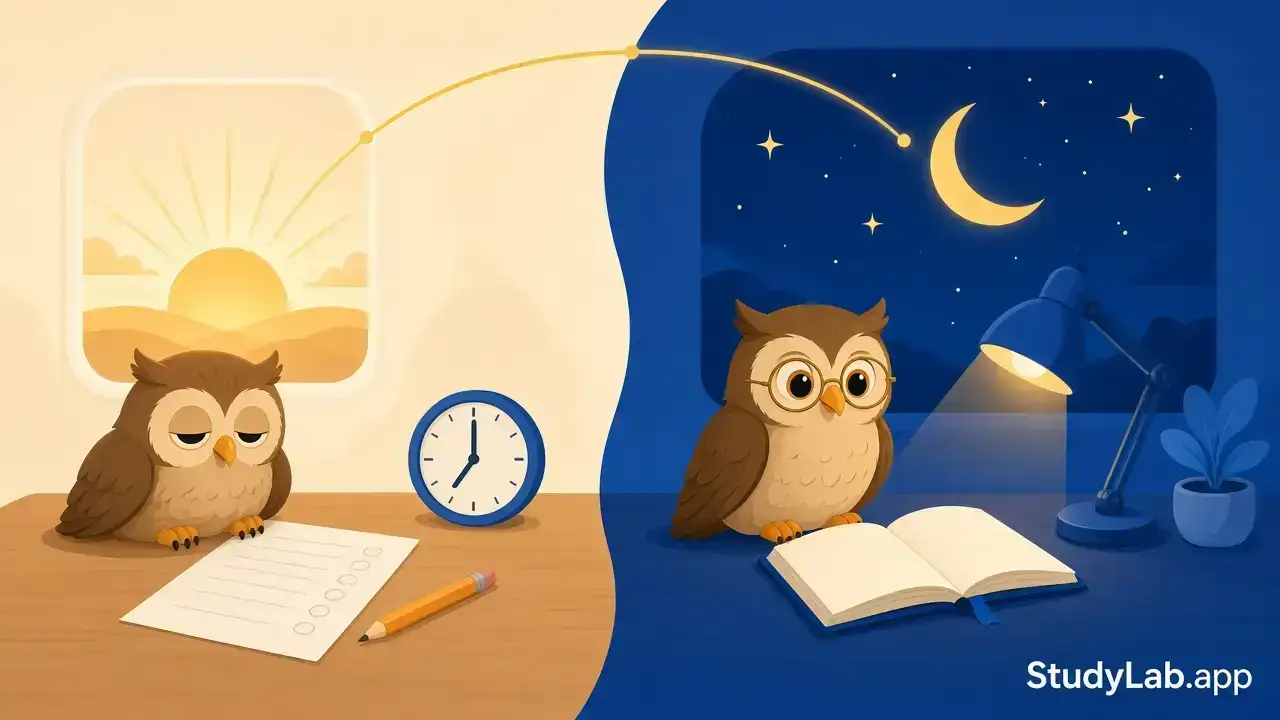
All day you can't get through a single page. Lectures go in one ear and out the other, and the library feels like a waiting room. Then it's 11 pm, everyone else is asleep, and your brain finally switches on. You finish a whole problem set before 1 am.
A post on r/GetStudying put it bluntly. Why does my brain wait until nighttime to lock in?
If that sounds like you, you're probably a night owl. And the research on studying at night has good news and bad news. The good news is that your late-night focus is real. The bad news is that school mostly tests you in the morning, which is exactly when night owls lose points. Psychologists call the pattern behind both the synchrony effect.
What is the synchrony effect?
The synchrony effect is the finding that people think best when the time of day matches their body clock. Morning types do their best work early. Evening types peak in the afternoon and evening. Test either one at their off-peak time and performance drops.
Your chronotype is where your body clock naturally sits, somewhere between early bird and night owl. It also shifts with age. In a 2004 survey of about 25,000 people, chronobiologist Till Roenneberg and colleagues found that people get steadily later through their teens, hit their latest point around age 20, then drift earlier again. So if you're in college and can't fall asleep before 1 am, part of that is just being 19.
Cynthia May and Lynn Hasher have studied this since the 1990s. In a 2023 review in Perspectives on Psychological Science, they write that the benefit of working in sync with your chronotype is strongest for people with a clear morning or evening preference. It's also strongest for tasks that need effortful, analytical thinking or ignoring distractions.
In their 1998 experiments, people were worse at blocking out irrelevant thoughts at their off-peak time of day. But pulling up well-learned answers held steady all day. Hard thinking is time-sensitive. Remembering what you already know mostly isn't.
One honest caveat before you rearrange your life around this. A 2025 systematic review from Brunel University London looked at 64 studies of adults aged 18 to 45 and found a synchrony effect in 29 of them, mostly for attention, inhibition and memory. So it's real, but it doesn't show up every time. The same review found that chronotype on its own, ignoring time of day, made no difference to thinking in more than 80% of the studies.
Night owls aren't less smart. They're just out of sync a lot of the time.
Do night owls get worse grades?
On average, yes. But look at when they're being tested.
A 2013 study of 272 German high school students found that the more of an evening type a student was, the lower their GPA, even after accounting for cognitive ability, conscientiousness and motivation.
Then a team at the University of Groningen looked at timing. In a 2015 study of 741 Dutch high school students and 4,734 exam grades, early chronotypes beat late chronotypes on exams taken in the morning, both early (8:15 to 9:45) and late morning (10:00 to 12:15). In the early afternoon (12:45 to 15:00), the gap disappeared.
Same students, different time of day.
A follow-up in 2017 collected 40,890 grades from a Dutch high school over a full school year. Late chronotypes did worse in the science subjects, which lean on reasoning, but not in languages and humanities. The gap between the earliest 20% and the latest 20% of chronotypes was roughly the gap between the 55th and the 43rd percentile of grades.
University students aren't exempt. A 2018 study of 14,894 students at Northeastern Illinois University used 3.4 million logins to the university's online learning system to estimate each student's daily rhythm. Most students were living more than 30 minutes out of sync with their body clock on average, a mismatch called social jet lag. The bigger the mismatch, the lower their grades, especially for later chronotypes.
To be fair to the data, timing doesn't explain everything. The Groningen team found late types still scored a bit lower even when tested at the same point in their own internal day. The 2017 study found they were absent more often. And students who slept very little on school nights got lower grades too. So the honest answer to the title question is both. Night owls are often tested at the wrong time, and they're often short on sleep.
Is studying at night bad?
Not by itself. What it does to your sleep is the problem.
Sleep is when your brain consolidates what you learned that day. A 2006 study from the University of Lübeck had high school students learn vocabulary and found they remembered more when sleep came within a few hours of learning, whatever the time of day. So a night owl who studies from 10 pm to midnight and then sleeps a full night is in decent shape.
The trouble starts when a 2 am bedtime meets a 7 am alarm. You're short on sleep and taking exams at your worst time of day, both at once. Our post on why sleep is your secret weapon covers what lost sleep does to memory.
There's one more catch. Late nights push your clock even later. A 2026 study at Rush University Medical Center gave teenagers 90 minutes of bright light every morning for three days while gradually moving their bedtime earlier, a combination that normally shifts the body clock earlier. Teens who'd had a normal bedtime and plenty of sleep beforehand shifted about two hours earlier. The later their bedtime had been pushed beforehand, the less the light worked. The teens who'd stayed up latest actually ended up shifting later.
How to use the synchrony effect when you study
1. Figure out your chronotype
Ignore school days, since your alarm decides those. Think about a stretch with no alarms, like a holiday week. When do you naturally fall asleep and wake up? Researchers use the midpoint of that sleep. In the Groningen study, the lowest grades went to students whose free-day sleep midpoint was later than about 5:20 am, which is something like 2 am to 9 am in bed.
2. Put the hard stuff at your peak
The synchrony effect is strongest for effortful, analytical work. So save new material, problem sets and anything you have to reason through for your best hours. For a night owl that might be 7 pm to 11 pm, not 9 am.
3. Use off-peak hours for review
Since pulling up well-learned answers held steady across the day in May and Hasher's experiments, your groggy morning slot isn't wasted. Use it for flashcards on material you mostly know, redoing problems you've already solved once, or organising your notes for later.
4. Shift early before a morning exam, and do it gradually
If your exam is at 8 am and you normally sleep at 2, don't try to flip it the night before. Start about a week out. Move your bedtime and wake-up a little earlier each day, get outside in bright light soon after you wake, and keep the evening dim, with fewer screens and lights.
Light really is the lever here. In a 2013 University of Colorado Boulder study, a week of camping with only natural light shifted people's internal clocks about two hours earlier, and the night owls shifted the most. The Rush study shows the other half. Morning light only works if you're not cancelling it out with late, bright nights.
If the night before still goes badly, read what a bad night before an exam does to your score. It's less of a disaster than it feels at 3 am.
5. Take a practice test at exam time
Do at least one full practice test at the same time of day as the real exam. If you've only ever done past papers at midnight, 8 am performance will be a surprise on the day. This is one of the reasons students score lower on the real exam than on practice tests.
6. Pick the afternoon when you get a choice
If you can choose your exam sitting, discussion section or class time, pick the later one. The Groningen researchers recommended scheduling exams in the early afternoon for exactly this reason. A good morning routine helps on the days you can't.
FAQ
Is it better to study at night or in the morning?
Study at your peak, whenever that is. For a lot of students in their late teens and early twenties, that's later in the day, because body clocks are at their latest around age 20. Just don't let late studying cut into your sleep.
Why do I focus better at night?
Probably two reasons. Your body clock may peak in the evening, which is common at student age. And night is quieter, with fewer messages, noise and interruptions. Both are real, so you don't need to fight them. Protect your sleep instead.
Can a night owl become a morning person?
You can shift your clock earlier with morning light and dimmer evenings. In the 2013 camping study, a week of natural light moved people's internal clocks about two hours earlier. Whether it lasts depends on keeping the routine once you're back home.
Is it bad to stay up late studying before a morning exam?
Usually, yes. You lose sleep that helps memory, and you push your body clock later right when you need it earlier.
Check your exam times tonight
Write down your next three exams and their start times. For any that start before 10 am, count back a week and set a reminder to start moving your bedtime earlier. Then look at tomorrow and put your hardest task in your best hours.
For the groggy hours, flashcards on material you already half know are the right job. If you'd rather not make them by hand, StudyLab can turn your lecture PDFs into a flashcard deck.