The Picture Superiority Effect: Why Ugly Doodles Beat Perfect Notes
Your brain holds onto images far better than words. The picture superiority effect explains why, and the research on drawing shows how a 20-second stick figure can outperform a page of neat notes.
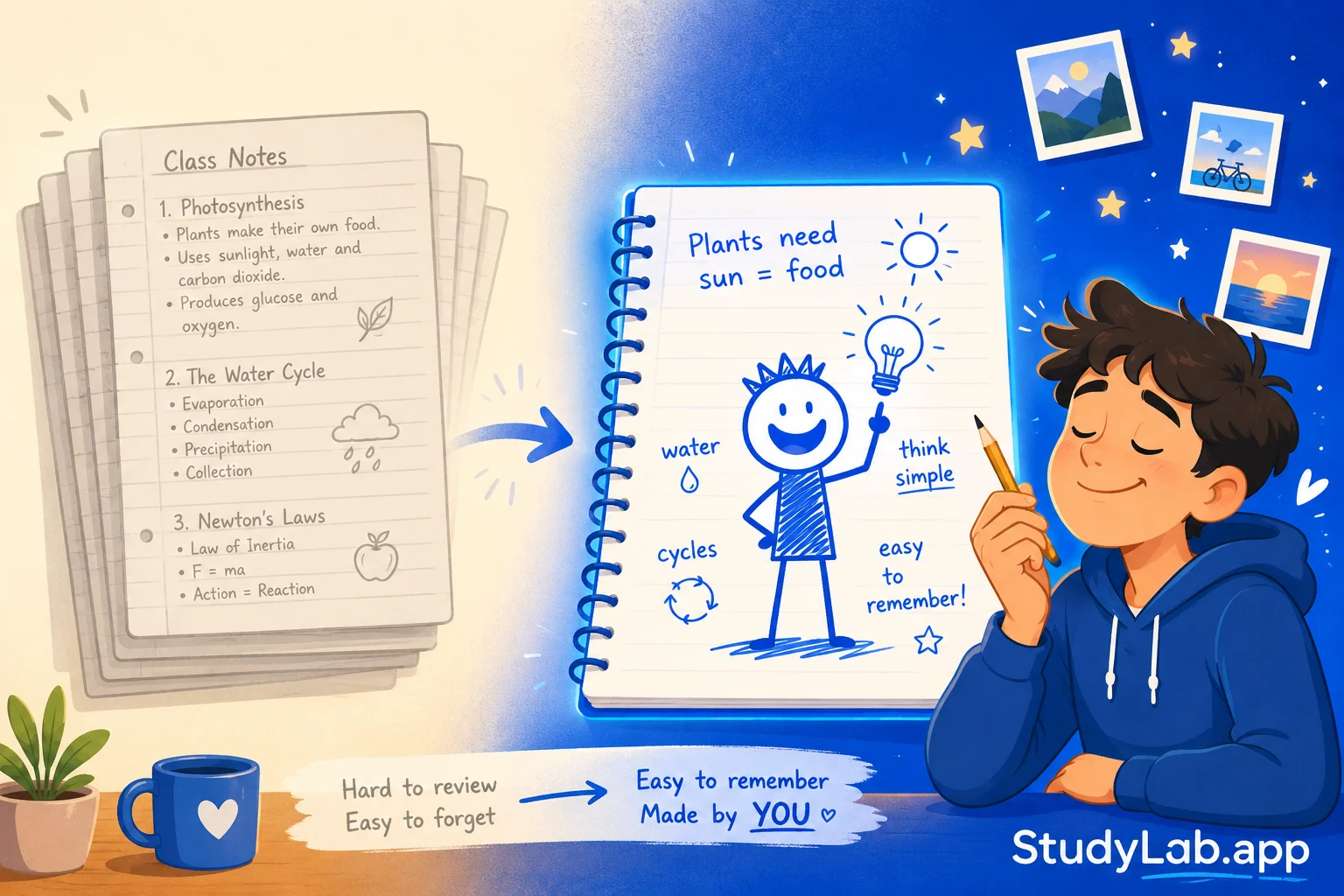
You can't remember what your professor said on Tuesday. But you can perfectly picture a meme you scrolled past three years ago.
That's not a personal failing. It's a measurable feature of how human memory works, and it has a name: the picture superiority effect. Your brain treats images and words differently, and images win. By a lot.
The good news is you can put this bias to work tonight, and you don't need any artistic talent to do it. In fact, the research suggests your ugliest drawings might do more for your grades than your neatest notes.
What Is the Picture Superiority Effect?
The picture superiority effect is the finding that people remember pictures far better than words, across recognition tests, recall tests, short delays, and long ones.
The classic demonstration came from Roger Shepard in 1967. He showed participants hundreds of items, then tested whether they could pick out what they'd seen before. With pictures, people were right about 98% of the time. With words, about 90%. That gap sounds small until you remember these were hundreds of items viewed once. Later studies pushed the picture counts into the thousands and people still recognized them at rates that seem almost unfair.
Words, meanwhile, slide out of memory constantly. You've experienced both sides of this. The diagram from your biology textbook is still in your head. The paragraph next to it is gone.
Why Does Your Brain Prefer Pictures?
The leading explanation comes from Allan Paivio's dual coding theory. When you read a word, your brain typically stores it one way: as verbal information. When you see a picture, your brain stores it twice. Once as a visual trace, and once as the verbal label you automatically attach to it. See a drawing of an apple and your brain quietly says "apple."
Two codes means two retrieval paths. If one fails during the exam, the other might still fire. A word usually gets just the one path, so when it fails, it fails completely.
Pictures also connect to meaning more directly. A photo of a heart pumping gets you to the concept faster than the word "circulation" does, because the image practically is the meaning, while a word is a label you have to translate first.
We covered the "combine words with visuals" strategy in our dual coding guide. The picture superiority effect is the raw finding underneath that strategy: given the choice between formats, your memory bets on the image every time.
The Drawing Effect: Where This Gets Practical
Knowing pictures beat words is nice. But your lecture notes are words. Your textbook is mostly words. So what do you actually do?
You draw. Badly is fine.
In 2016, researchers Jeffrey Wammes, Melissa Meade, and Myra Fernandes ran a series of experiments where participants either wrote a word repeatedly or spent the same time drawing it. Drawing won. Not by a little, and not just once. The advantage held across different settings, time limits, and instructions, whether researchers compared different people or the same person doing both.
Here's the part that should change how you study: the benefit did not depend on drawing skill. A crude 20-second sketch worked. The researchers concluded that drawing is powerful because it stacks three memory codes into one act. You process the meaning (what does this concept look like?), you create a visual trace (the image itself), and you add a motor trace (your hand physically making it). Writing the word engages a fraction of that.
Later research by the same group found the drawing benefit holds for older adults and even for people with memory difficulties. And there's a nice bridge here to the handwriting vs. typing research: in both cases, the physical act of producing something by hand deepens the memory beyond what the content alone would give you.
The Honest Caveats
The picture superiority effect is one of the most replicated findings in memory research, but it has boundaries you should know about before rebuilding your study system around it.
First, pictures lose their edge when they all look alike. Studies found that when the images in a set were highly similar to each other, the superiority effect vanished. Twenty near-identical diagrams of cell types will blur together just like twenty paragraphs do. Variety in your visuals matters.
Second, deep thinking closes the gap. When researchers forced participants to process words deeply, for example by rating each word's pleasantness, memory for words rose to roughly match memory for pictures. This fits what we covered in levels of processing: meaning is what memory runs on. Pictures are a shortcut to meaning, not the only road there. If you engage deeply with words, words work too.
Third, the effect is strongest for concrete things. An apple, a neuron, a battle map. Abstract concepts like "opportunity cost" or "irony" don't come with a built-in image, so you have to invent a visual metaphor first. That's extra work, though often worth it, since inventing the image forces exactly the deep processing that makes things stick.
How to Use the Picture Superiority Effect Tonight
Doodle one concept per page of notes. Not decoration. A drawing that captures the idea: a stick figure pushing a boulder for activation energy, two overlapping circles for a compromise. Twenty seconds each. Ugly encouraged.
Convert your hardest facts into images. Take the five things you keep forgetting and give each a deliberately weird visual. The weirder the image, the more hooks it has. This is the same principle that powers a memory palace, just without the palace.
Draw from memory, then check. This is the power combo. Close the book and sketch the diagram, the timeline, or the process from memory. Then compare against the original. You've stacked the drawing effect on top of retrieval practice, which multiplies both.
Make your flashcards visual. Put your doodle on one side and the term on the other. If making cards from scratch eats too much time, tools like StudyLab can generate flashcards and quizzes from your PDFs, and you can sketch quick visuals next to the answers you miss. The wrong answers are exactly the ones worth a drawing.
Screenshot less, sketch more. Saving the professor's slide feels like studying. It isn't. The image only helps if your brain processes it, and nothing forces processing like reproducing it with your own hand.
Common Mistakes to Avoid
Trying to make it pretty. Time spent on shading is time not spent on meaning. The memory benefit comes from the act of translating an idea into a picture, not from the picture's quality.
Drawing everything. If every fact gets a doodle, drawing becomes routine and slow. Reserve it for the concepts that matter most or refuse to stick.
Using other people's images only. Looking at the textbook's diagram is good. Redrawing it yourself is far better. The motor trace only exists if your hand does the work.
Skipping the label. Dual coding means two codes. A sketch with no word attached loses the verbal path. Caption every doodle, even with one word.
FAQ
What is the picture superiority effect in simple terms?
People remember pictures much better than words. Show someone 100 images and 100 words, and days later they'll recognize far more of the images. The leading explanation is that pictures get stored in memory twice, as a visual and as a verbal label, while words usually get stored once.
Does drawing really help you study?
Yes, and the evidence is strong. Experiments found that drawing a concept beats writing it, rereading it, and even visualizing it, because drawing combines meaning, imagery, and physical movement into a single memory trace. Drawing skill doesn't matter at all.
I can't draw. Does this still work for me?
Completely. The studies used quick, crude sketches with strict time limits, and the memory benefit showed up regardless of artistic ability. A stick figure your friends would laugh at earns the same boost as a beautiful illustration.
Does the picture superiority effect work for abstract subjects like law or philosophy?
It takes one extra step. Abstract ideas don't have automatic images, so you have to invent a visual metaphor, like scales tipping for a legal balancing test. Creating that metaphor is effortful, but the effort itself deepens the memory, so it pays off twice.
Are photos and screenshots as good as my own drawings?
No. Viewing an image gives you the picture superiority effect, but drawing it yourself adds the motor trace and forces deeper processing. A screenshot you never look at again does almost nothing. Your own reproduction, however rough, does the most.
Draw the Thing You Keep Forgetting
There's one fact in your notes right now that has refused to stick for weeks. Find it, give it the dumbest, clearest drawing you can manage in 30 seconds, and caption it.
Then make it earn its place: upload your notes to StudyLab, quiz yourself, and see if the doodled fact finally holds. Your future self won't remember the paragraph. It'll remember the picture.