Cognitive Load Theory: Why Your Brain Feels Full (And How to Fix It While Studying)
Your working memory can only hold about 4 things at once. Cognitive load theory explains why your brain shuts down during study sessions and how to fix it.
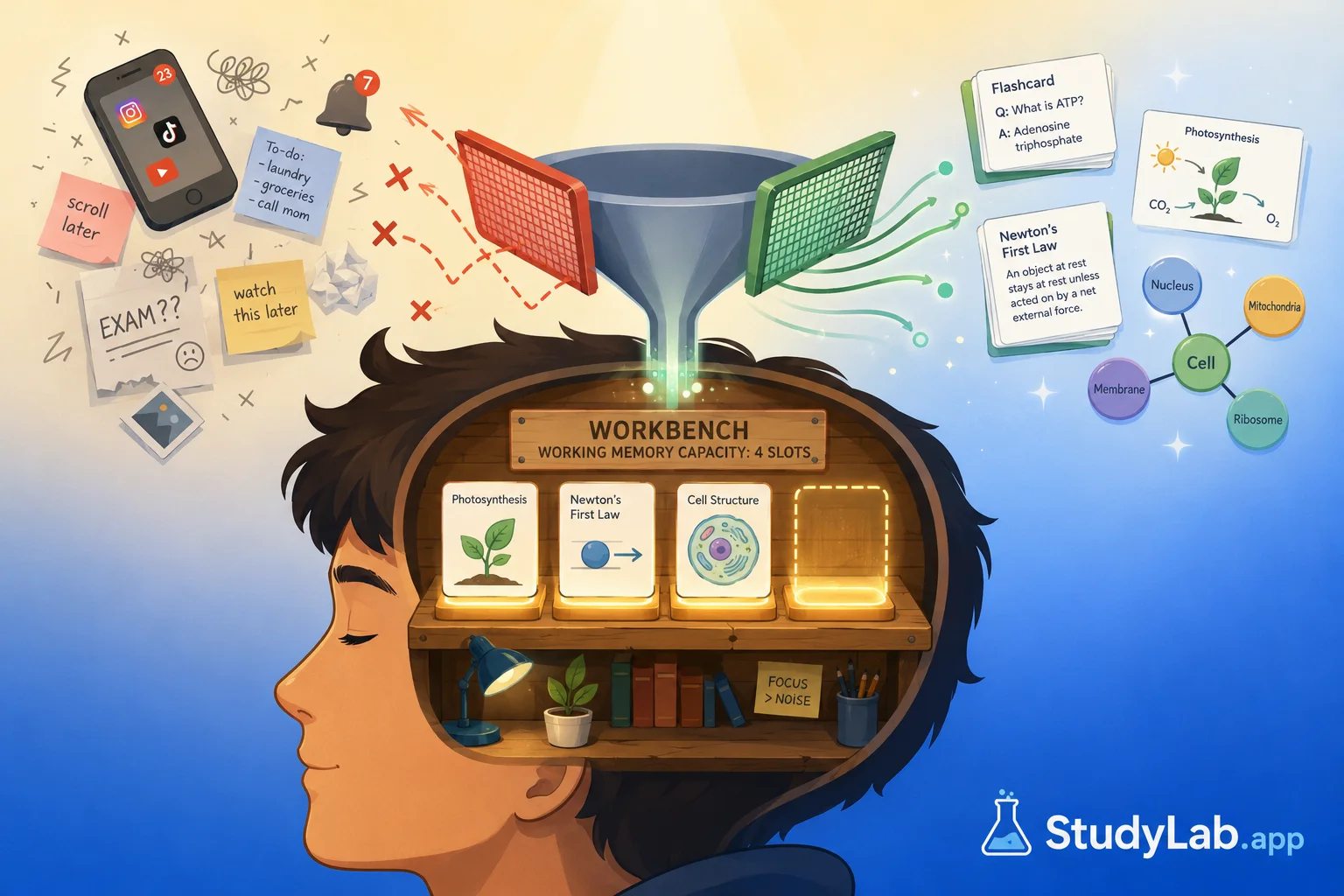
You're 30 minutes into a dense biology chapter. The first few pages made sense. But now you're reading the same paragraph for the third time and nothing is sticking. Your brain feels full. Not tired exactly, just... done. Like trying to pour water into a glass that's already overflowing.
That feeling has a name. And understanding why it happens is one of the most practical things you can learn about studying.
In 1988, educational psychologist John Sweller at the University of New South Wales published a theory explaining exactly this problem. He called it cognitive load theory, and it's built on one simple fact: your working memory, the part of your brain that processes new information, can only handle about 3 to 4 items at a time. When you exceed that limit, learning stops. Not because you're not smart enough. Because your brain literally ran out of processing space.
What Is Working Memory (And Why Is It So Small)?
Think of working memory as your brain's workbench. It's where you hold new information while you figure out what to do with it. Your long-term memory has effectively unlimited storage. But your workbench? Tiny. Research by cognitive psychologist Nelson Cowan suggests the real capacity is about 4 chunks of information, and it can only hold them for roughly 20 seconds without active rehearsal.
That means every time you read a new concept, work through a formula, or try to connect two ideas, you're using up that very limited space. And if your study materials or habits dump too much information onto that workbench at once, everything falls off. You re-read the same paragraph. You zone out. You feel like you're getting nowhere.
The good news: cognitive load theory doesn't just explain the problem. It gives you a framework to fix it.
The Three Types of Cognitive Load
Sweller identified three different types of load that compete for space in your working memory. Once you understand which type is causing the overload, you can do something about it.
Intrinsic load: the actual difficulty of the material
This is the mental effort required by the content itself. Organic chemistry has higher intrinsic load than basic vocabulary because there are more pieces of information you need to hold and connect simultaneously. You can't really eliminate intrinsic load, but you can manage it.
The most effective way? Chunking. When you group related pieces of information into a single "chunk," each chunk takes up just one slot in working memory instead of five. A phone number like 4-1-5-8-2-7-3-9-0-0 is ten items. Chunked as 415-827-3900, it's three. Same information, one-third the load.
Building on prior knowledge works the same way. If you already understand basic cell biology, learning about mitosis puts less strain on working memory because the foundational concepts are already stored in long-term memory. They don't need workbench space. This is why studying gets easier as you learn more about a topic. Your mental chunks get bigger.
Extraneous load: the stuff wasting your brain's space
This is the mental effort caused by bad study habits, poor materials, or distractions that have nothing to do with actual learning. It's the load you can and should eliminate.
Some examples students deal with every day: flipping back and forth between a textbook diagram and the explanation on a different page (Sweller called this the "split-attention effect"). Studying with your phone buzzing. Trying to take notes, listen to a lecture, and read slides all at the same time. Using a poorly organized textbook where you have to hunt for the information you need.
None of this helps you learn. All of it takes up working memory space that could be used for actual understanding. If you've ever felt exhausted after studying but can't remember what you learned, extraneous load is probably why. Digital minimalism during study sessions is one of the fastest ways to cut this type of load.
Germane load: the good kind of effort
Not all mental effort is bad. Germane load is the work your brain does to organize new information, build connections, and create lasting understanding. It's the productive struggle.
When you draw a mind map connecting different concepts, you're creating germane load. When you explain a topic in your own words instead of just re-reading, that's germane load. When you quiz yourself and have to pull answers from memory, that effortful retrieval is germane load. This is exactly what Bjork's research on desirable difficulties describes from a different angle: productive struggle that builds stronger memory.
The goal of any smart study session is simple: keep intrinsic load manageable, cut extraneous load to zero, and spend all your freed-up working memory space on germane load.
How to Reduce Cognitive Overload in Practice
Here are specific things you can do tonight.
Break complex material into smaller pieces. Don't try to learn an entire chapter in one pass. Work through one concept at a time. Make sure you understand it before moving on. This keeps intrinsic load within your working memory limits.
Combine related information into one place. If your textbook has a diagram on page 47 and the explanation on page 52, copy them onto the same sheet. This eliminates split-attention and frees up working memory for actual learning.
Remove distractions before you start. Phone in another room. One browser tab open. No background TV. Every notification that pulls your attention away is extraneous load stealing space from learning. This sounds basic, but it's one of the highest-impact changes you can make.
Use visuals and words together. Your working memory actually has two channels: one for visual information and one for verbal information. Dual coding, which combines diagrams with words, distributes the load across both channels instead of overloading just one. Draw diagrams. Sketch processes. Add visuals to your notes.
Study in short focused blocks. Working memory fades fast. The Pomodoro Technique (25 minutes on, 5 minutes off) works partly because it prevents the gradual cognitive overload that happens in marathon sessions. Your brain needs those breaks to move information from the workbench into long-term storage.
Test yourself early. Don't wait until you've finished reviewing to try practice questions. Quiz yourself after each small section. Tools like StudyLab can generate practice quizzes from your notes, which shifts your brain from passive extraneous processing (re-reading) to active germane processing (retrieval).
Why "Just Read It Again" Is the Worst Strategy
Re-reading is the most common study method and also one of the worst, and cognitive load theory explains why. When you re-read something, recognition kicks in. The material looks familiar, so your brain processes it with minimal effort. That means almost zero germane load. You're not building new connections or strengthening retrieval pathways. You're just burning time while your brain coasts.
Self-testing, on the other hand, forces your brain to reconstruct information from memory. That's high germane load. It feels harder because it is harder. But that effort is exactly what transfers information from the tiny workbench into permanent long-term storage.
Frequently Asked Questions
How do I know if I'm experiencing cognitive overload?
The signs are pretty clear once you know what to look for. You re-read the same paragraph multiple times without absorbing it. You feel mentally exhausted but can't remember what you studied. You zone out mid-sentence. Your notes from the last 20 minutes are gibberish. All of these suggest your working memory hit its limit.
Does cognitive load theory mean I should only study easy material?
No. The goal is not to avoid difficulty. It's to make sure the difficulty is productive (germane load) rather than wasteful (extraneous load). Hard material is fine. Hard material presented badly, studied with distractions, or attempted without enough background knowledge is what causes the overload.
Can I increase my working memory capacity?
Research suggests working memory capacity is relatively stable and hard to expand through training. But you can make it much more efficient. Building strong background knowledge (so more information is stored in long-term memory and doesn't need workbench space), chunking information into larger units, and eliminating extraneous load all effectively give you more room to work with.
How does this apply to studying for different subjects?
High-intrinsic-load subjects like organic chemistry, physics, and advanced math need extra attention to load management. Break problems into smaller steps. Use worked examples before attempting problems on your own. For lower-intrinsic-load subjects like history or psychology, you can handle more information per session, but extraneous load from distractions and bad materials will still hurt you.
Is this why studying with music hurts my focus?
It depends on the music and the task. Background music with lyrics adds extraneous load because your verbal working memory channel has to process the words in the song and the words you're studying simultaneously. Instrumental music is less disruptive for most people. But for complex new material, silence is usually best.
Your Brain Is Not Broken. Your Study Setup Might Be.
If you've ever felt like you're too slow, too dumb, or just "not a good learner," there's a decent chance your study methods were overloading your working memory and making everything harder than it needed to be. Cognitive load theory says the problem is usually not your brain. It's what you're asking your brain to do all at once.
Cut the distractions. Break the material into smaller pieces. Use visuals. Test yourself instead of re-reading. Give your workbench room to actually work.
Ready to turn your notes into the kind of active practice that builds real understanding? Upload your study materials to StudyLab and start quizzing yourself on one section at a time. Your brain will thank you.