How to Find Your Weak Topics Before an Exam (Without Rereading Everything)
Everything in your notes looks familiar, and that is the problem. Test yourself on every topic, mark it strictly, and let the misses decide what you study first.
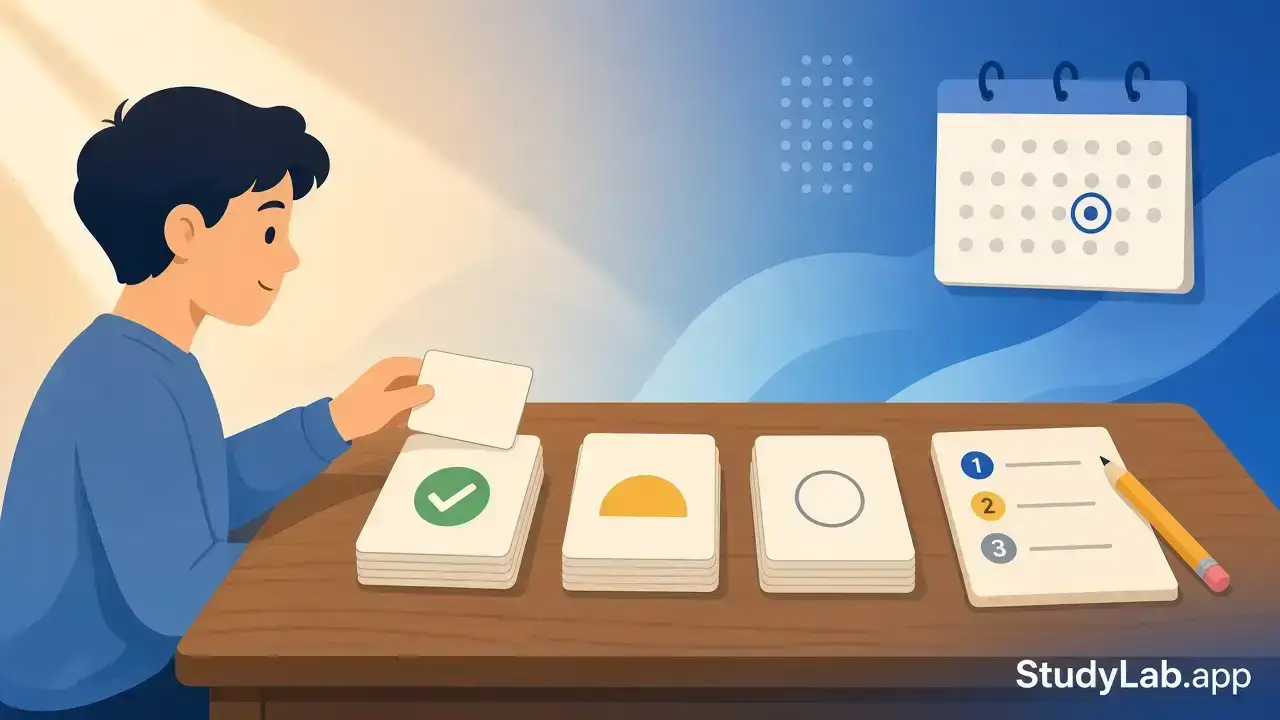
You open your notes nine days before the final. Every page looks familiar. You recognize the diagrams, you remember the lecture, you even remember where you were sitting. So which topics are actually weak?
Rereading can't tell you. Recognizing a page and being able to answer a question about it are two different things, and only the second one shows up on exam day. Finding your weak topics before an exam takes a test, not another pass through the notes.
Here's how to run that test in one evening, mark it so it tells the truth, and turn the results into a study order for the days you have left.
Why rereading hides your weak topics
When you reread, the material feels easier each time. That feeling is real, but it measures how familiar the page is, not whether you could produce the answer from a blank sheet.
Most students still lean on it. In a 2009 survey of college students, Jeffrey Karpicke, Andrew Butler and Henry Roediger found that rereading notes or the textbook was the study strategy students named most often. Testing themselves came up far less, even though it's the one that reveals gaps. The testing effect explains why the test is also the better way to learn.
So the first job isn't studying. It's finding out where you stand.
1. List every topic the exam covers
Take the syllabus, the lecture titles or the headings in your notes, and write one line per topic. Aim for 8 to 15 lines. "Cell biology" is too big to be useful. "Membrane transport" and "cell signaling" are the right size.
If your professor shared a study guide or a list of exam topics, use that instead. It's the best map you'll get.
2. Test yourself on every topic, with the notes closed
Two or three questions per topic is enough. You're measuring, not studying yet. Good sources, in order:
- past exams or practice exams from your course
- end-of-chapter questions from the textbook
- questions you write yourself from the notes, then answer the next day
For a topic with no questions at all, use a blank page. Write everything you can remember about it for three minutes, then compare with the notes.
Don't skip the topics you think you know. Those are the ones that surprise people. If you'd like the questions written for you, StudyLab builds a free 10-question mock exam from your own notes and gives you a score for each topic.
3. Mark it strictly
This step decides whether the whole test was worth doing. An answer counts as right only if it would get full marks on the real exam. "I sort of knew it" counts as wrong. So does "I'd have remembered it in the exam."
Generous marking has a cost. In a 2012 study in Learning and Instruction, John Dunlosky and Katherine Rawson found that students who judged their own answers too kindly stopped studying material too early, and remembered less of it later. They believed they knew it, so they moved on.
Strict marking feels worse tonight. It also gives you an honest list.
4. Sort the topics and rank them
Put every topic in one of three piles:
- Blank: you couldn't answer, or got most of it wrong.
- Shaky: partly right, or right but slow and unsure.
- Solid: right, complete, and you could explain it to a friend.
Then rank inside each pile by how much the exam is likely to cover it. A blank topic that took three weeks of lectures goes above a blank topic that got one slide. Past exams and the syllabus are the best guide to weight.
Here's what that looks like for a biology final:
| Topic | Self-test | Exam weight | Study order |
|---|---|---|---|
| Membrane transport | 0 of 3 | High | 1st |
| Cell signaling | 1 of 3 | High | 2nd |
| Enzyme kinetics | 0 of 3 | Low | 3rd |
| Cell cycle | 2 of 3, unsure | Medium | 4th |
| Photosynthesis | 3 of 3 | Medium | Light review only |
The solid topics still come back once or twice before the exam. They just don't get the first sessions.
5. Study the mistakes you were sure about first
While you test yourself, note how confident you were in each answer. Then look hard at the questions you got wrong while feeling sure.
It sounds backwards, but those are the easiest mistakes to fix. Butterfield and Metcalfe called it the hypercorrection effect in a 2001 paper. People corrected their high-confidence errors more often than their low-confidence ones once they saw the right answer. A confident miss also flags a topic you would have skipped, which makes it the most valuable thing your test found.
6. Retest a few days later, with new questions
A weak topic isn't fixed because you studied it once. Two or three days after working on it, test it again with questions you haven't seen. If you get them right on a different day, the topic moves up a pile. If not, it stays near the top of the list.
Coming back after a short break is spaced repetition, and it shows you what stuck rather than what you just read.
Common mistakes to avoid
- Testing only the topics you're worried about. The topics you feel fine about need the test most, because that feeling is the thing you're checking.
- Marking kindly. If an answer wouldn't get full marks, it's a miss.
- Studying in syllabus order. Your ranking decides the order, not the order of the lectures.
- Never retesting. One good study session isn't proof. A correct answer on a later day is.
FAQ
How do I know which topics to study for an exam?
Test yourself on every topic with your notes closed, mark it strictly, and rank the topics by how badly you did and how much the exam covers them. The weakest topics with the most weight go first.
How many questions do I need per topic?
Two or three is enough to sort topics into blank, shaky and solid. Later, use more questions on the weak topics when you retest them.
What if I don't have any practice questions?
Write your own from your notes and answer them the next day, or use a blank page. Write everything you know about the topic for three minutes, then check it against your notes.
Should I study weak topics or strong topics first when time is short?
Weak topics with a lot of exam weight come first. Strong topics still get one quick review before the exam, but they don't need the first or longest sessions.
Start with the list tonight
Write your topic list now, with one line per topic. Tomorrow, test yourself on every line with your notes closed, and mark each answer as if your professor were grading it.
If you want that test written from your own notes, add your exam date and notes to StudyLab. The first mock exam is free, and it shows a score for each topic, with each miss explained.