The Testing Effect: Why Practice Tests Are the Most Powerful Study Habit You're Skipping
Re-reading your notes feels productive. It is not. The testing effect is one of the most well-researched phenomena in cognitive psychology, and it explains why practice tests are your most powerful study tool.
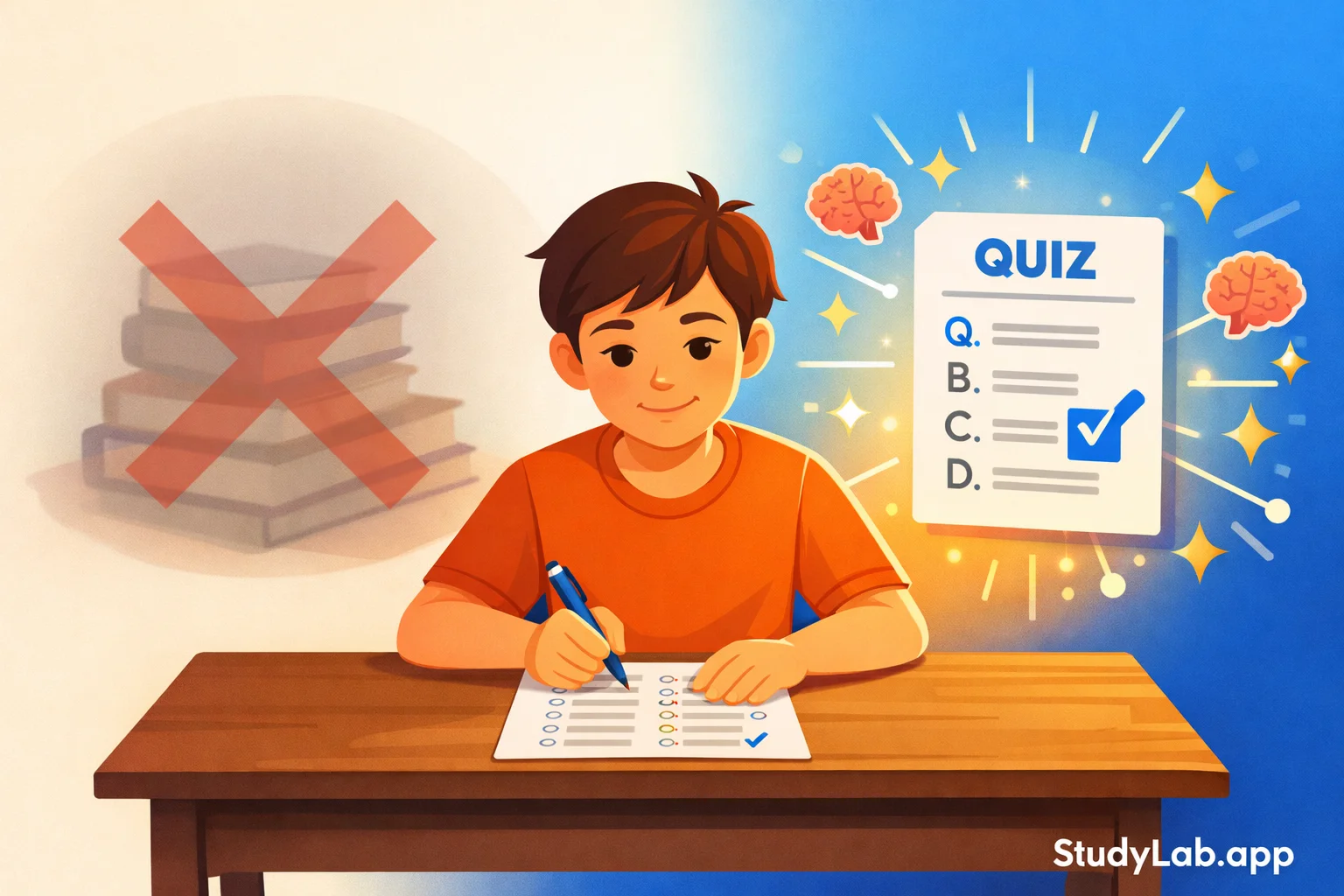
You've read the chapter. Read it again. Highlighted the important parts. Read those highlights one more time. By the time you close the book, you feel ready. Confident, even.
Then the exam comes and your mind goes blank.
Sound familiar? If so, you're not doing anything wrong. You're just using the wrong strategy. Re-reading feels productive. It really does. But there's a big gap between feeling like you know something and actually being able to recall it when it counts.
That gap has a name. And there's a fix. It's called the testing effect, and it's one of the most well-supported findings in all of cognitive science.
What Is the Testing Effect?
The testing effect is the finding that retrieving information from memory, by taking a practice test, improves retention far more than studying or re-reading the same material again.
In plain English: taking practice tests doesn't just measure what you know. It actively makes you know it better.
This isn't a productivity hack or a study guru's opinion. Researchers at Washington University in St. Louis demonstrated this in a 2006 study published in Psychological Science. Students who took practice tests after reading a passage remembered significantly more information one week later than students who re-read that same passage multiple times. The numbers were striking: students who only re-studied forgot 56% of what they originally knew. Students who took repeated practice tests forgot just 13%.
That's not a small difference. That's the gap between walking into an exam with confidence and walking out wondering where it all went wrong.
Why Re-Reading Lies to You
Here's the trap with re-reading: it creates a feeling of fluency. The words look familiar, the concepts seem recognizable, and your brain registers that recognition as understanding.
It's not.
Psychologists call this the fluency illusion. You're not encoding information more deeply when you re-read. You're getting better at recognizing it on the page, which is useless during an exam when the page isn't in front of you.
A 2013 review published in Psychological Science looked at 10 common study techniques and rated them by effectiveness. Re-reading got a "low utility" rating. It wasn't the only one. Highlighting, underlining, and summarization all landed in the same category. Techniques that feel like studying but don't move the needle much.
What got a "high utility" rating? Practice testing. Along with spaced practice, it was one of only two techniques the researchers considered genuinely effective across different subjects, age groups, and materials. That review, led by Kent State University psychologist John Dunlosky, is one of the most widely cited papers in educational psychology.
How the Testing Effect Actually Works
When you retrieve information from memory, something happens that looking at information simply doesn't trigger. Your brain has to actively reconstruct what it knows. That effort, the struggle to pull something back up, is what strengthens the memory trace.
Think of it like a path through tall grass. Every time you walk it, the path gets clearer and easier to follow. Every time you retrieve a memory, that retrieval pathway gets stronger. Re-reading doesn't walk the path. It just looks at a map of it.
This is why testing beats studying at longer intervals. Right after cramming, you can recall things reasonably well. But two days later? A week later? That's when the difference becomes dramatic. The students who tested themselves in the Washington University research didn't just retain more. They forgot at a dramatically slower rate than everyone else.
There's another benefit that's easy to miss. Testing shows you your gaps. When you re-read, everything looks familiar, including the things you don't actually understand. A practice test forces your gaps out into the open. You can't bluff yourself on a blank piece of paper.
How to Use the Testing Effect in Your Studies
You don't need anything fancy. Here's how to actually apply this.
1. Test yourself immediately after studying, not before an exam.
Don't wait until you feel ready. Read a section, close the book, and try to write down everything you remember. This feels uncomfortable at first. Good. That discomfort is the testing effect working.
2. Use short-answer questions over multiple choice when you can.
Research shows that questions requiring you to generate an answer produce stronger retention than recognition-style questions. So instead of just picking from four options, push yourself to write out explanations in your own words.
3. Space your tests out over time.
One practice test is good. Multiple tests spread across several days are much better. Combine the testing effect with spaced repetition and you've got one of the most powerful study combinations in cognitive psychology. This pairing is well-researched and consistently outperforms any single technique used alone.
4. Always check your answers.
Getting it wrong isn't a waste of time. It's actually one of the most useful things that can happen when you study. A 2008 study found that students who received feedback on incorrect answers performed significantly better on later tests than those who practiced retrieval without knowing if they were right. Look up the answer, understand why you were wrong, and move on.
5. Use past exams, textbook questions, and flashcard systems.
You don't need to create everything from scratch. Textbook chapters almost always have questions at the end. Past exams are gold. Flashcard systems like the Leitner System are built around exactly this principle, routing you back to the cards you struggle with most while retiring the ones you've nailed.
What About Active Recall? Is It the Same Thing?
Kind of, but not quite. Active recall is the broader practice of retrieving information from memory instead of passively reviewing it. The testing effect is the specific research finding that explains why doing this boosts long-term retention so dramatically.
Think of it this way: active recall is the technique. The testing effect is the science behind it.
Both point in the same direction. The best study sessions aren't about pouring information in. They're about pulling information out. If you want a full list of methods that put this into practice, the ultimate guide to active recall covers 15 approaches you can start using today.
How to Get Started Today
Pick one topic you're studying this week. After your next session, close your notes completely and try to write down everything you just covered from memory. Don't worry about getting it perfect. The goal is retrieval, not perfection. Whatever you can't recall, review briefly, then test yourself on it again the next day.
If creating practice questions from scratch feels like too much work on top of everything else, tools like StudyLab can turn your PDFs and notes into AI-generated quizzes automatically. It's much easier to actually use the testing effect consistently when you're not spending 40 minutes making questions before you've even started studying.
Common Mistakes to Avoid
Testing yourself only the night before an exam. Testing works best when spaced over time. A cram session of self-quizzing the night before won't produce the same results as shorter, weekly testing sessions throughout the semester.
Re-reading when you fail a question. If you get something wrong, look up the correct answer and move on. Going back to re-read the whole section pulls you straight back into passive mode.
Relying only on multiple choice. Recognition tests are better than nothing, but short-answer and free-recall formats produce stronger retention effects. Push yourself to generate answers, not just identify them.
Waiting until you feel ready to test yourself. You're probably never going to feel ready. Testing yourself when things still feel uncertain is exactly the point.
Frequently Asked Questions
What is the testing effect in simple terms?
The testing effect is the research finding that taking practice tests improves long-term memory more than re-reading or restudying the same material. When you retrieve information from memory, you strengthen it. When you re-read, you mostly just recognize what's already there.
Does the testing effect work for all subjects?
Yes. Research has demonstrated the testing effect across foreign languages, medical knowledge, history facts, and statistics. The specific format of questions might need to adapt (math benefits most from working through problems, not just flashcards), but the core principle holds across different subjects and types of content.
How many practice tests do I actually need?
More is better, with diminishing returns. Research shows that three spaced practice sessions across a week produce dramatically better results than a single session crammed into one study block. What matters most is spacing them out and reviewing whatever you got wrong.
Is the testing effect the same as active recall?
They're closely related but not the same. Active recall is the practice of retrieving information from memory during studying. The testing effect is the scientific phenomenon that explains why doing this consistently boosts retention. In practice, they point to the same strategy: test yourself regularly instead of just reviewing your notes.
Does the testing effect work even without getting feedback?
Yes, but feedback makes it better. A 2008 study found that students who received feedback on wrong answers performed significantly better on later tests compared to those who only practiced retrieval with no feedback. When you can, check your answers after attempting each question.
Stop Re-Reading. Start Testing.
You've probably spent years re-reading notes and wondering why things don't stick. Now you know why. The testing effect is one of the most replicated findings in cognitive psychology, and it points to a simple truth: the act of trying to remember something is itself the learning.
Pair this with the 7 evidence-based strategies for better exam retention and you've built a study system that actually works. Not just one that feels like it should.
Ready to put this into practice? Upload your notes or study materials to StudyLab and get AI-generated practice questions from your actual content. Start testing yourself today, not re-reading.