Listening vs Reading: Can You Study From Audio Textbooks and Still Pass the Exam?
Text-to-speech apps promise you can get through 200 pages a week on a walk. Two meta-analyses and a classroom experiment say the answer is more specific than yes or no. Here is when listening matches reading, when it falls short, and how to make audio count.
"Do people ever use audio as a study tool? Walk while listening to the audio textbook?" That question landed on r/GetStudying this week, right next to a post from a student trying to survive 200 pages of reading a week across four courses and already falling behind three weeks into the semester.
The appeal is obvious. If you can absorb a chapter while walking to campus, doing the dishes or lying in the dark, that's an hour of reading you got for free. Text-to-speech apps are selling exactly that promise to students right now.
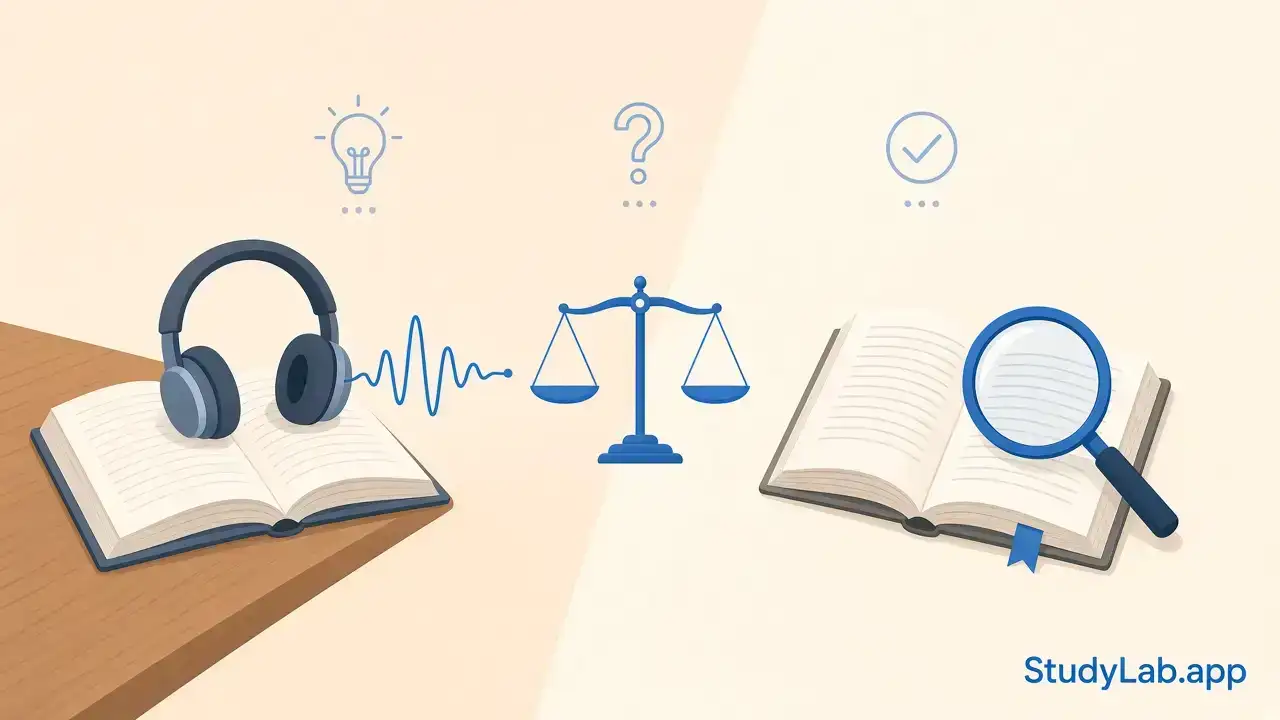
So does listening vs reading matter for how much you remember? Honestly, the research gives a more useful answer than a yes or a no. Listening can match reading under specific conditions. Outside those conditions it quietly loses, and the losses land precisely on the things exams test.
The short version
| Listening | Reading | |
|---|---|---|
| Remembering stated facts | About equal | About equal |
| Inference, "why" and "how" questions | Weaker | Stronger |
| Dense, technical material | Weaker | Stronger |
| While walking, cooking or commuting | Memory drops | Not an option |
| Controlling the pace, going back | Awkward | Easy |
| Getting through material you'd otherwise skip | Wins | Loses |
Now the evidence behind each row.
What the biggest study says
In 2022, Virginia Clinton-Lisell at the University of North Dakota published a meta-analysis in the Review of Educational Research pooling 46 studies and 4,687 people who had been tested on the same material after either reading it or listening to it.
Across everything, the difference was tiny and not statistically reliable. On average, listeners and readers understood about the same amount. Taken alone, that number makes audio look like a free swap.
But two of the moderators in that analysis are where the exam-relevant story lives. First, when readers were allowed to go at their own pace, reading came out ahead. When the researchers controlled the reading speed, that advantage vanished. Second, the type of question mattered. On literal questions, the kind where the answer is stated in the text, reading and listening were dead even. On inferential and general comprehension questions, where you have to connect two ideas or work out what follows, reading had a clear advantage.
Think about what a college exam asks you. "State the three stages of cellular respiration" is a literal question. "Explain why a cell in low oxygen switches to fermentation" is an inferential one. Most of the marks that separate a B from an A are in the second kind.
The study that looks like your actual life
The meta-analysis pooled lab conditions. A 2010 experiment in Teaching of Psychology by David Daniel and William Douglas Woody looked at what happens in a real course.
Students in a psychology class were assigned a primary-source reading. Some got it as text, others got the same content as a podcast to listen to on their own time. Then everyone took a quiz on it. The podcast group scored lower. The detail that stings is the preference data. Before the quiz, students said they preferred the podcast. Immediately after the quiz, that preference flipped.
The authors' conclusion was measured. Podcasts might be useful for supplementing course material, but they aren't as effective as text for delivering the primary content. The gap between how good listening feels and how well it works is the same gap the illusion of competence research describes for rereading. Familiar is not the same as learned.
The walking part is the problem
The r/GetStudying question wasn't really about audio. It was about multitasking, and that's where the case for audio textbooks gets weakest.
In 2018, Trish Varao-Sousa, Daniel Smilek and Alan Kingstone at UBC and Waterloo had people listen to an audiobook either sitting in a quiet lab or out in the world, going about their day. During the audio, participants were pinged at random and asked whether they were focused, mind wandering or distracted by something around them. Afterwards everyone took a memory test on the book.
The amount of inattention was about the same in both settings. What differed was the type. Outside the lab, people were far more often distracted by their surroundings than lost in their own thoughts. And memory for the audiobook was worse outside the lab. The researchers' reading of it was that external distraction damages memory more than mind wandering does, and everyday environments are full of external distraction.
So the "listen while you walk" plan runs into two problems at once. Audio already trails text on inferential questions, and doing it on the move adds a second memory penalty on top.
What about reading and listening at the same time?
Some apps push a hybrid. Play the audio while the text scrolls and you get both channels. This is worth a look because it's the one version of audio that should, in theory, help.
The 2016 study most often quoted for this, by Beth Rogowsky, Barbara Calhoun and Paula Tallal in SAGE Open, gave 91 adults a chapter of a nonfiction book as audio, as e-text, or as both at once. Comprehension was tested straight after and again two weeks later. No condition beat any other, at either point.
In 2023, Clinton-Lisell pooled 30 studies covering nearly 2,000 people on exactly this question. Reading while listening gave a trivial overall edge over reading alone. And when readers controlled their own pace, which is how you'd read a textbook, the edge disappeared entirely. The benefit only showed up when the reading speed was imposed on people. There were hints that struggling readers and second-language learners gain more from the audio track, but too few studies to say for sure.
The hybrid isn't harmful, and for some students it's a real help, but for most it's a feature you're paying for that doesn't move the needle.
So when should a student use audio?
Given all that, the case for audio textbooks is narrower than the marketing but not empty.
Use it for a first pass on narrative-heavy material. History, literature, a case study, a chapter that mostly tells a story. Literal recall is about equal between modes, and these subjects lean on it more. Listen first, then do the inferential work on paper.
Use it to get through material you would otherwise skip. The 200-pages-a-week student isn't choosing between listening and reading closely. They're choosing between listening and not reading at all. Audio beats nothing every time.
Use it for review of things you've already read. Once the ideas exist in your head, a second pass by ear while you tidy your room is cheap reinforcement. The first encounter is what needs your eyes.
Don't use it as the only exposure to dense material. Organic chemistry mechanisms, statistics, anatomy, anything with equations, diagrams or tightly packed definitions. That content is exactly where the reading advantage shows up in the meta-analysis, and where a listener can't pause on the one sentence that matters without fumbling for the phone.
Don't count walking-and-listening as a study session. Count it as a bonus. If it's the only time you touched the chapter this week, you haven't studied the chapter.
How to make audio actually stick
If you're going to listen, three changes close most of the gap.
- Sit still for the first listen. The UBC study's memory penalty came from the environment, not the medium. A first pass at your desk with the phone face down and headphones on is a different activity from a first pass on a busy street.
- Stop and say it back every ten minutes. Pause the audio and say out loud what the last section argued, as if explaining it to a friend. This is a spoken version of blurting, and it forces the inferential processing that listening tends to skip. Reading out loud has its own memory benefit, and so does producing the summary yourself.
- Test yourself the same day. The Daniel and Woody students only discovered the podcast had failed them when the quiz arrived. Run your own quiz first. A dozen questions on the chapter, written by you or generated from the PDF in StudyLab, tells you within five minutes whether the audio landed or whether you need to open the text after all.
FAQ
Is listening to a textbook as good as reading it?
For remembering facts stated directly in the text, roughly yes. A 2022 meta-analysis of 46 studies found no reliable overall difference between reading and listening. For questions that require inference, and for dense technical material, reading comes out ahead, and those are the questions most exams weight heavily.
Do you retain less from audiobooks?
It depends on what you're doing while you listen and what you're tested on. Sitting still and listening to narrative material, retention is close to reading. Listening while walking or doing chores, memory drops, per a 2018 study that tested people on an audiobook in the lab versus out in the world. Inferential questions also favour readers.
Is it better to read and listen at the same time?
For most students, it makes little difference. A 2023 meta-analysis found only a trivial benefit of reading while listening over reading alone, and none at all when readers set their own pace. Struggling readers and people studying in a second language may get more from the combination.
Can I study for exams using only audio?
Not for anything dense or technical, and not as the only exposure to a chapter. Audio works as a first pass on narrative material, as review of things you've already read, and as a way to get through content you'd otherwise skip. The primary encounter with hard material should be on the page.
Why do I remember podcasts but not audio textbooks?
Podcasts are built to be listened to, with a conversational structure, repetition and a host who signposts what matters. A textbook chapter read by a synthetic voice has none of that scaffolding, and its sentences are packed far more densely. You can retain a podcast at a walking pace. A textbook asks more of you than that.
Try it on one chapter this week
Pick a chapter you'd normally skip. Listen to it at your desk, pause every ten minutes to say back what it argued, then quiz yourself on it the same day. If the quiz goes badly, you've learned something useful about how you study for the price of one chapter. If you'd rather not write the questions, drop the PDF into StudyLab and it will build the quiz while you listen.