Overlearning: Why Studying Past the Point of "I Know This" Might Be Wasting Your Time
Drilling something over and over until it feels automatic seems like the safe move. But research on overlearning suggests most of those extra reps do almost nothing for your grade weeks later.
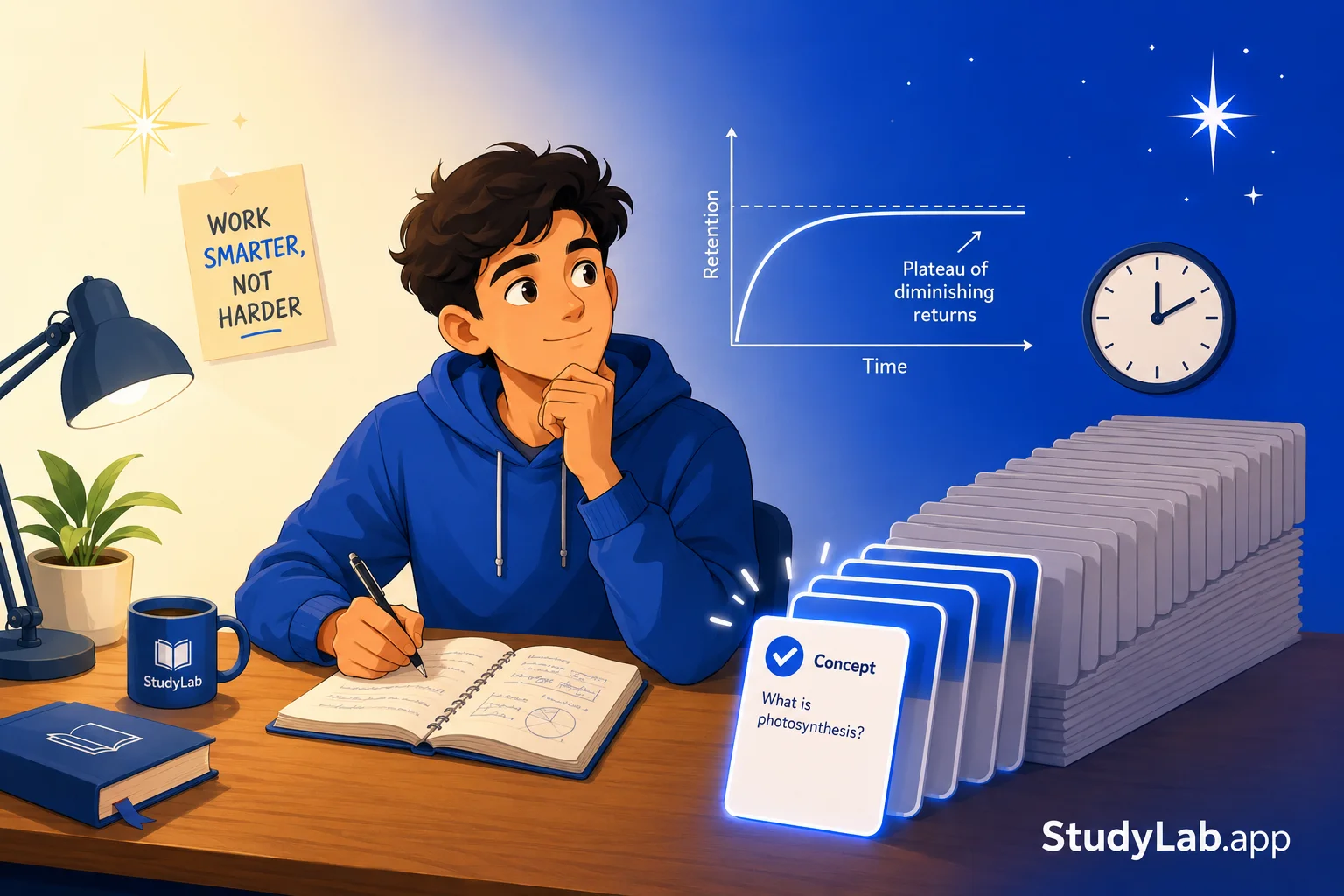
You know the feeling. You've got the definition down, you've said it right three times in a row, and yet you keep going. Another five reps. Another ten. It feels responsible, like you're really locking it in.
Here's the thing the research quietly suggests: most of those extra reps are doing almost nothing for the exam three weeks away.
That's overlearning, and it's one of the most common study habits that feels productive while barely moving the needle. Understanding why it fails, and the small exception where it actually helps, can free up hours of study time you're currently pouring into a leaky bucket.
What Is Overlearning?
Overlearning is continuing to study material after you've already learned it, meaning after you can produce it correctly at least once.
Researchers define it precisely. The moment you get one perfect recall of something, that's your criterion, the point of "learned." Every study trial you do past that point is overlearning. Practice a list of terms until you nail all of them once, then run the list four more times that same evening, and those four extra passes are the overlearning.
It's everywhere in how students study. Rewriting a definition ten times. Doing thirty practice problems of the exact same type after you clearly get it. Reading your notes over and over the night before, well past the point where anything new is landing. The instinct is that more repetition equals stronger memory, so more must always be better.
The instinct is half right. More practice does help, up to a point. It's what happens after that point where things get interesting.
Does Overlearning Actually Work?
For a while, yes. For the long haul, mostly no.
The clearest evidence comes from a 2005 study by Doug Rohrer and colleagues. They had 218 college students learn geography facts and word definitions, with some students overlearning the material and others stopping at criterion. Then students came back for a final test somewhere between one and nine weeks later.
At the one-week mark, the overlearners were ahead. Clearly ahead. But as the weeks stretched on, that gap shrank fast. By the later tests, the advantage from all those extra reps had mostly evaporated, and the overlearners had spent significantly more time to get there. The researchers concluded that overlearning is an inefficient strategy for retaining material over meaningful stretches of time.
A large 1992 meta-analysis by Driskell and colleagues found something compatible: overlearning produces a real but moderate benefit, and that benefit fades as the delay before testing grows. How much it helps depends on the task and how long until you're tested.
Put simply: overlearning buys you short-term strength that leaks away. If your test is tomorrow, those extra reps might genuinely help. If it's a month out, you're paying full price for a benefit that won't survive the wait.
The Efficiency Problem
Even setting aside how long the benefit lasts, overlearning has a second issue. It's a bad use of limited time.
Think about it as a trade. You have two hours to study forty terms. You could overlearn twenty of them to a mirror shine and barely touch the other twenty. Or you could bring all forty to criterion once. Research on this trade-off points the same direction: for a fixed amount of study time, learning more material adequately beats overlearning less material to perfection. The extra recall you squeeze out of the twentieth rep of a term you already know is tiny compared to the recall you'd gain by giving an untouched term its first solid pass.
This is the same efficiency logic behind successive relearning, which we covered recently. That research found that recalling something correctly once across several spaced days beats hammering it many times in a single session. The reps aren't the magic. The spacing between them is. Overlearning is basically the massed, single-session version, and it loses to the spaced version almost every time.
If you've read our post on spaced repetition, this will sound familiar. Your brain builds durable memory by rebuilding faded traces, not by grinding fresh ones over and over in one sitting.
When Overlearning Is Actually Worth It
This isn't a case for lazy studying, and overlearning isn't useless. There are real situations where it earns its keep.
When the test is very soon. Overlearning's strength is short-term. For a quiz tomorrow morning or a presentation in an hour, drilling past mastery can genuinely steady your performance when it counts.
For skills you need to be automatic. Motor and procedural skills are different from facts. A musician nailing a passage, an athlete grooving a movement, a nurse running an emergency protocol. For things you need to execute without thinking, especially under stress, practicing well past the first correct rep builds the automaticity that holds up when your mind goes blank. Overlearning shines here in a way it doesn't for remembering a date.
In moderation. The research hints that if you're going to overlearn at all, a modest amount (something like fifty percent more practice past criterion) captures most of whatever benefit exists. Beyond that, you hit steep diminishing returns. Endless repetition is the wasteful part, not a little reinforcement.
The trap isn't practice. It's over-practicing facts for a distant exam and mistaking the effort for progress.
What to Do Instead
Once a piece of material hits criterion, that's your signal to change what you're doing, not to keep drilling it.
Stop at one clean recall, then move on. When you can produce an answer correctly from memory, mark it and shift to something you haven't nailed yet. Your study time is worth more on the shaky material.
Come back to it another day. Instead of ten reps tonight, do one solid recall tonight and one more in two or three days. Spacing turns the same effort into far more durable memory. Mixing topics as you go, the way interleaved practice suggests, adds another layer on top.
Test, don't reread. The whole idea of criterion depends on active recall: pulling the answer from memory, not recognizing it on the page. A quick self-quiz tells you honestly whether something has hit criterion or just feels familiar. If you'd rather not build the questions yourself, tools like StudyLab can turn your notes into a quiz, so you can check each concept once, then space your return instead of grinding.
FAQ
What is overlearning in simple terms?
It's studying something after you already know it. Once you can recall a fact or perform a skill correctly one time, any further practice in that same session counts as overlearning. Students do it constantly by rewriting, rereading, or re-drilling material they've already got down.
Is overlearning good or bad for studying?
It depends on timing. Overlearning boosts short-term performance, so it can help if you're tested very soon. But for exams weeks away, the benefit fades and the extra time is largely wasted. Spacing your practice across days is more efficient for long-term retention.
Does overlearning help with math or skills?
For procedural and motor skills, yes, more than it does for facts. Practicing a skill past the first correct attempt builds automaticity, which matters when you need to perform smoothly under pressure. For memorizing facts and definitions long-term, spacing beats overlearning.
How much practice past mastery is enough?
If you overlearn at all, keep it modest. Research suggests roughly fifty percent additional practice past your first correct recall captures most of the benefit. Beyond that you hit sharp diminishing returns, so endless repetition mostly costs time.
If overlearning is inefficient, why does it feel so effective?
Because it produces fluency, and fluency feels like knowledge. Running through material you already know is smooth and confident, and your brain reads that smoothness as mastery. The problem is that this feeling fades faster than real durable memory, which is built by effortful, spaced retrieval instead.
Stop Polishing, Start Spacing
Pick the deck or the set of problems you were planning to drill tonight. Run it once, carefully, until you can recall each item correctly one time. Then stop. Genuinely stop.
Put it away and bring it back in a couple of days instead. Upload your notes to StudyLab, quiz yourself to one clean pass now, and return to the misses later in the week. That single change, criterion once and space the rest, will do more for your grade than another hour of polishing what you already know.