Successive Relearning: The Study Method That Makes Knowledge Actually Stick
Getting something right once feels like learning. A week later it is gone. Successive relearning is the method that turns a single correct answer into knowledge that survives until the exam and beyond.
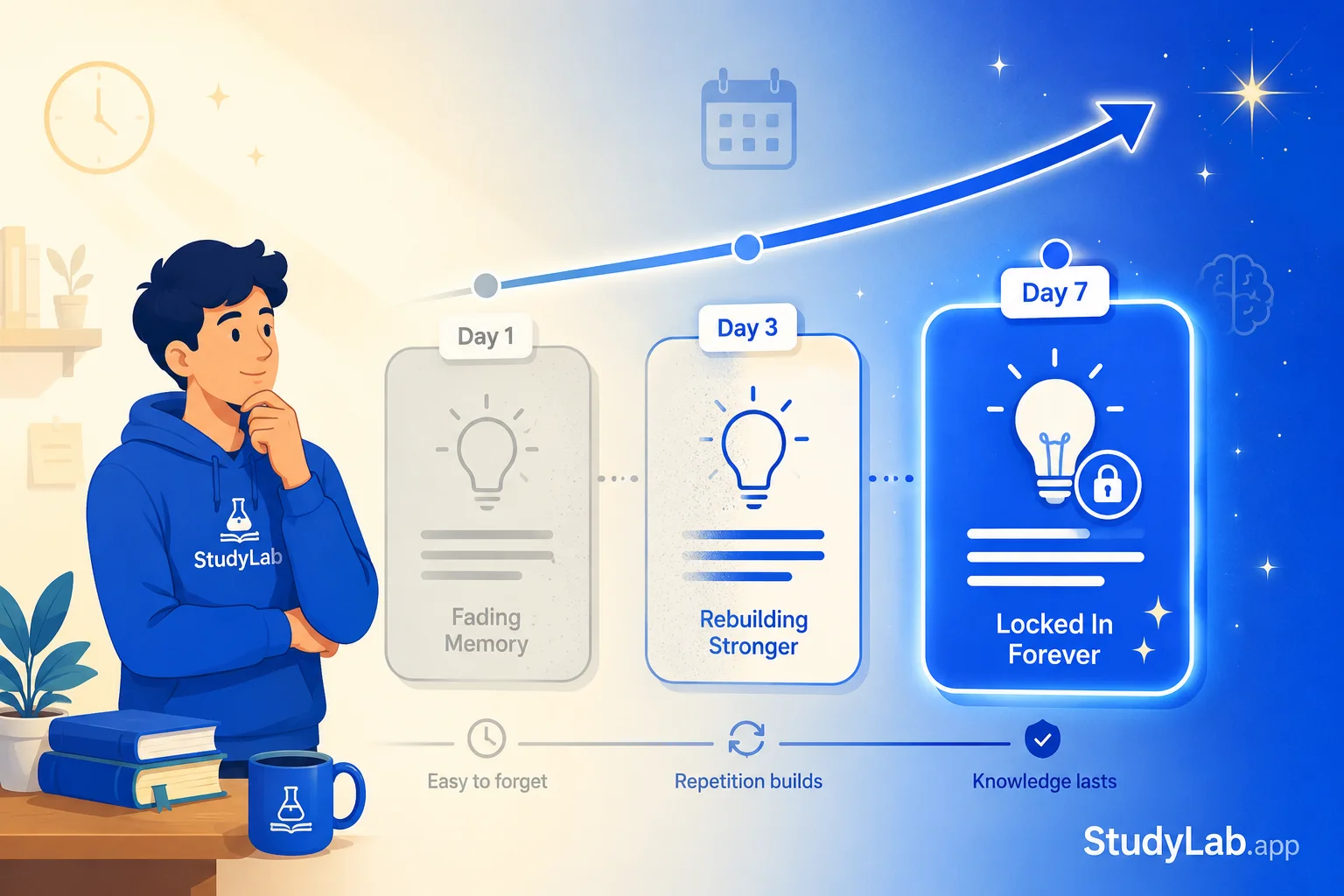
You studied the chapter. You got the practice questions right. You closed the book feeling like you knew it.
A week later, you sit down to review and it's like you never saw it. The confidence is gone, the details are fuzzy, and you're basically starting over.
That's not because you're bad at studying. It's because getting something right once and knowing something are two completely different things. The method that bridges them has a name most students have never heard: successive relearning. It's not flashy, and it won't trend on StudyTok. But in the research, few things beat it for making knowledge last.
What Is Successive Relearning?
Successive relearning is the practice of studying something until you can recall it correctly, then coming back in later sessions and relearning it to that same standard, again and again across spaced days.
Two familiar ideas sit inside it. The first is retrieval practice: testing yourself instead of rereading. The second is spacing: spreading sessions across days instead of cramming. Both are heavily supported on their own. Successive relearning is what you get when you formally combine them into a single routine, and researchers Katherine Rawson and John Dunlosky, who have done much of the work on it, describe it as practicing to a level of mastery in each of several spaced sessions.
The "to mastery" part is what sets it apart from ordinary review. You don't just glance at the material again. In each session, you actually retrieve each item correctly at least once before you're allowed to call it done. Then you leave it, let some forgetting happen, and rebuild it next session. That rebuild is where the durability comes from.
If you've read our posts on the testing effect and spaced repetition, you already know the ingredients. Successive relearning is the recipe.
Why Does Relearning Beat Learning Once?
The intuition most students have is that once you've learned something, you're done, and going back over it is wasted effort. The research says the opposite. The going back is the point.
In a set of lab studies, students who successively relearned concept definitions retained them at strikingly high levels long after: on the order of 68% correct a month later and around 49% four months later, compared to roughly 11% for material they'd studied but not relearned. Same students, same material. The difference was whether they came back and rebuilt it a few times.
Here's the finding that should reshape how you schedule study time. In one experiment, recalling an item correctly one time in each of three separate sessions produced far better retention than recalling it three times inside a single session. Same number of correct retrievals. Wildly different outcomes. One analysis reported the spaced version producing more than a 250% improvement in later retention over the massed version. This tells you the benefit isn't just about how many reps you do. It's about forcing your brain to reconstruct the memory after it has partly faded, which is the mental rep that actually builds durable storage.
Every time you nearly forget something and then successfully pull it back, you're telling your brain "this matters, keep it." Relearning manufactures that moment on purpose.
Successive Relearning vs. Just Rereading
Rereading feels productive. Your eyes move, the words are familiar, and familiarity feels like knowledge. It's the most popular study method there is, and one of the weakest.
The gap is retrieval. When you reread, the answer is right in front of you, so your brain never has to do the work of producing it. That work, active recall, is the engine successive relearning runs on. When you successively relearn, you're pulling the answer out of your own head cold, then doing it again days later. The struggle to retrieve is uncomfortable, which is exactly why it works. Difficulty that produces effortful, successful recall is the useful kind.
This is also why successive relearning pairs so naturally with flashcard systems. The Leitner system, where cards you get right move to less frequent boxes and cards you miss come back soon, is basically successive relearning with a physical scheduling engine attached.
How to Use Successive Relearning for Your Classes
Here's a protocol you can start this week. It works for definitions, formulas, vocabulary, dates, processes, anything with a clear correct answer.
1. Turn your material into question-answer pairs. Each key concept becomes a prompt you have to answer from memory. Definitions, cause-and-effect, steps of a process. If you'd rather not build these by hand, tools like StudyLab can generate quiz questions and flashcards straight from your lecture PDF, which gives you a ready-made set to relearn from.
2. In session one, practice each item to one correct recall. Go through your prompts. For each one, try to answer from memory, check, and if you missed it, cycle it back until you get it right once. Don't stop at "that looks familiar." Stop at "I produced the answer correctly."
3. Space the next session by a day or more. This is non-negotiable. The forgetting that happens between sessions is not a bug. It's the raw material relearning works on. Same-day repetition doesn't do the same thing.
4. Relearn to mastery again. In the next session, run the same items. Some you'll still have, some you'll have lost. Rebuild the lost ones to a correct recall. It'll go faster than session one, and faster again the session after.
5. Repeat across three or more spaced sessions. Most of the durability shows up over several relearning cycles. Two isn't many. Three to five spread across the weeks before an exam is where the long retention numbers come from.
6. Retire items only when they survive a gap. When a concept comes back easily after several days away, it's earned a longer break. Keep spending your effort on the ones that keep slipping.
The Honest Caveats
Successive relearning is one of the better-supported methods out there, but a few limits are worth stating plainly.
The research base, while strong, is still fairly narrow. A lot of studies used similar types of learners and similar material, often concept definitions recalled from cues. Rawson and Dunlosky themselves flag that more work is needed across different populations, subjects, and kinds of knowledge. It's very well evidenced for fact-and-definition learning. It's less tested for messy, open-ended skills.
There's also a real time cost. Relearning to mastery across several sessions takes more total sessions than a single cram, and in at least one classroom study the benefit over other decent methods was modest rather than dramatic. The payoff is durability, not speed. If you only need to hold information until tomorrow morning, this is overkill. If you need it for a cumulative final or a subject that builds on itself, it's hard to beat.
And it requires feedback. Retrieving an answer and never checking whether it was right just risks practicing errors. Every attempt needs a correction close behind it.
FAQ
What is successive relearning in simple terms?
It's studying something until you can recall it correctly, then coming back on later days and rebuilding that recall again, several times. It combines testing yourself (instead of rereading) with spacing sessions across days, and the repeated rebuilding is what makes the knowledge last for months.
How is successive relearning different from spaced repetition?
They overlap heavily. Spaced repetition is about the timing of reviews. Successive relearning adds a specific requirement: in each session you practice to a mastery standard, meaning at least one correct retrieval per item, not just a quick look. Most good flashcard apps blend the two automatically.
How many sessions do I need?
More than two. The long-retention findings tend to come from three or more spaced relearning sessions. A practical target is to relearn each set to mastery three to five times across the weeks leading up to an exam.
Does successive relearning work for math or problem-solving?
The strongest evidence is for definitions, facts, and vocabulary. It can work for procedures if you turn them into retrievable prompts (for example, "what's the first step when you see this type of problem?"), but the research is thinner there. For fact-heavy material, it's excellent.
Isn't relearning the same thing I already forgot a waste of time?
It feels that way, but no. The moment of nearly forgetting and then successfully recalling is the exact moment durable memory gets built. If you never let anything fade, you never get that rep. The forgetting between sessions is doing quiet work.
Relearn One Set Until It Sticks
Pick one set of concepts you'll be tested on later this term. Turn it into question-answer prompts, practice it to one clean correct recall today, then put it away. Come back in a couple of days and rebuild whatever slipped. Do that a few more times before the exam.
Want the prompts built for you? Upload your notes to StudyLab, generate a quiz, and use it as your relearning set: test today, come back in two days, and relearn the misses until forgetting them becomes almost impossible.