Staring at a Wall Before You Study: Does "Rawdogging Boredom" Actually Fix Your Focus?
Students are sitting in silence and staring at a wall before they open their notes, and swearing it fixed their focus. Here is what the research on boredom, phones and attention says about it, and how to try a 10-minute version tonight.
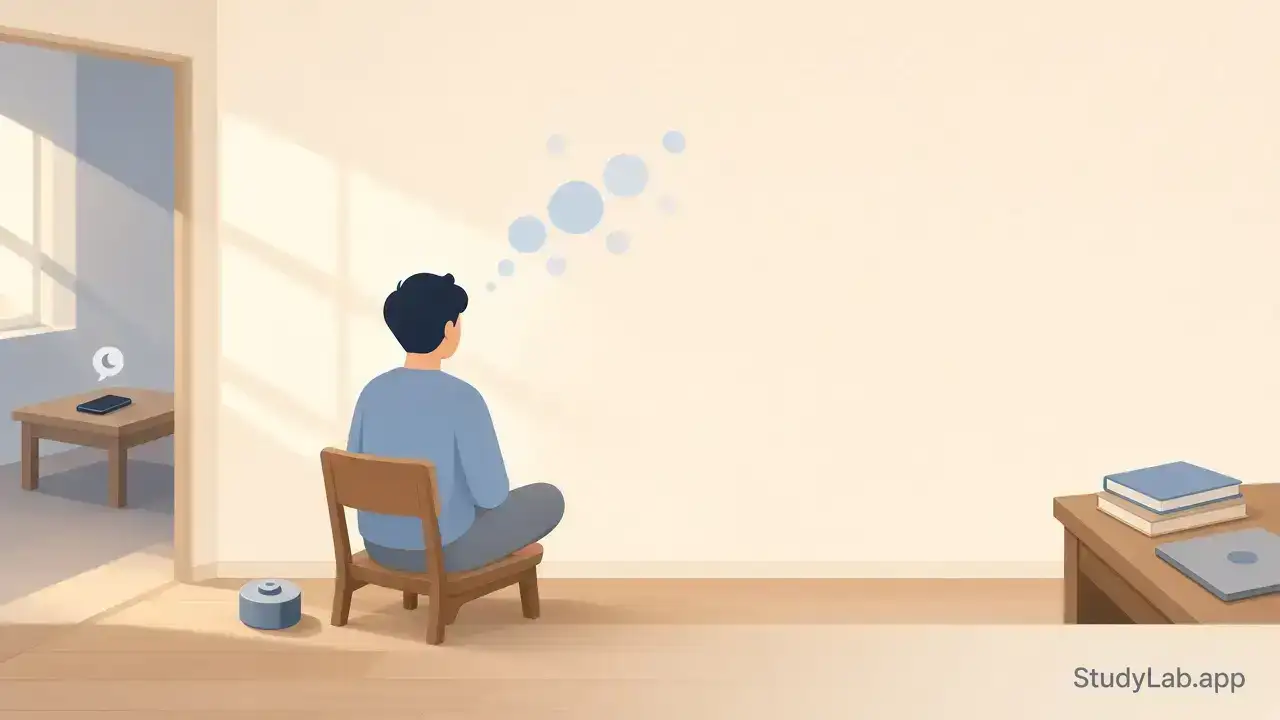
You sit down to study. You open the laptop. And somewhere in the next 42 seconds you're watching a stranger frost a cake.
That number isn't a joke. It's from a Reddit post that hit the top of r/GetStudying this week, written by a student with ADHD and depression who described exactly that loop, every day, for months. Their fix sounds ridiculous. For 194 days straight they've started each study session by staring at a wall. Not meditating. Not journaling. Staring. They went from fighting for five minutes of studying to sitting through two-and-a-half-hour blocks the same day, and passed exams they'd already written off.
The internet has a name for this now. On TikTok it's "rawdogging boredom", and it's been covered by Newsweek, Discover and NBC over the past year. Teenagers film themselves sitting in silence next to a timer for 15 minutes, and some go for an hour.
So is staring at a wall before studying a real technique, or a trend that will be gone by midterms? Honestly, a bit of both. Nobody has run a study on wall staring specifically. But the research on boredom, phones and attention explains why it works for so many people, and it also explains why it feels so awful for the first week.
What "rawdogging boredom" actually is
The rules are short. Put the phone in another room. Sit somewhere with nothing to look at. Set a timer you can't see. Do nothing until it goes off. No music, no podcast, no closed-eyes breathing exercise, no "noticing your thoughts". Just sit there and be bored.
Most people do 10 to 30 minutes. The Reddit poster does it before every study session as a warm-up, which is the version worth caring about if you have an exam coming.
What separates it from meditation is the absence of instructions, and the Reddit post nails why that matters. Meditation has a right way to do it, so there's a way to fail at it, so on your worst days your brain finds a reason to skip it. Staring at a wall has no technique to get wrong. There's nothing to do, so there's nothing to mess up. On a burnt-out week, it's the only thing low enough to still happen.
Why sitting still feels so bad (and why that's the point)
The first few sessions feel terrible. Your leg bounces. You reach for a phone that isn't there. You'd rather do almost anything else.
That reaction is normal, and it's been measured. In 2014, psychologists at the University of Virginia and Harvard published a series of 11 experiments in Science in which people were asked to sit alone in a room for 6 to 15 minutes with nothing to do but think. Most disliked it. Many said they'd rather do a boring external task. And in one of the experiments, participants were given the option of giving themselves a mild electric shock during the sitting period. A quarter of the women and two-thirds of the men chose to shock themselves at least once, even though every one of them had said earlier that they would pay money to avoid that shock.
People would rather be zapped than sit quietly for 15 minutes. That was in 2014, before TikTok existed.
Gloria Mark, a professor at UC Irvine who has tracked attention on screens for two decades, gives the trend line. When she measured it in 2004, people stayed on one screen for about two and a half minutes on average before switching. By 2012 it was 75 seconds. Her most recent measurements put it at 47 seconds. Your brain hasn't broken. It has just been trained, very thoroughly, to expect a new thing every 47 seconds.
Staring at a wall is uncomfortable because it's the first time in a long time your brain has asked for a hit and been told no. Students who stick with it describe that discomfort fading over a week or two, and that fade is what they're really training.
What the research says about boredom and your brain
There are three findings that make wall staring look less silly than it sounds.
Boredom makes the mind wander, and wandering helps. In 2014, Sandi Mann and Rebekah Cadman at the University of Central Lancashire had people copy numbers out of a phone book for 15 minutes, then asked them to think of uses for a pair of plastic cups. The bored group came up with more creative uses than a group who skipped the boring task. A 2012 study in Psychological Science by Benjamin Baird and colleagues at UC Santa Barbara found something similar with problem-solving. People who spent a break on an undemanding task, the kind that lets the mind drift, improved more on creativity problems they'd already seen than people who rested or did a demanding task.
Your brain has a "nothing to do" mode, and it's busy. In 2001, Marcus Raichle and his team at Washington University in St. Louis described a default mode of brain function using PET scans. A network of brain regions ramps up when you're awake but not focused on anything, and quiets down when you turn to a task. A 2023 review in Neuron by Stanford's Vinod Menon summarised two decades of work tying this default mode network to remembering your own past, thinking about yourself and mind wandering. The time you spend staring at nothing isn't empty time. It's the brain filing things.
The phone costs you even when you ignore it. In 2017, researchers led by Adrian Ward at the University of Texas at Austin gave nearly 800 people working memory and problem-solving tests with their phone either on the desk, in their pocket or bag, or in another room. Phones were silenced and nobody used them. The other-room group scored best, and the gap was biggest for people who said they depended on their phone most. Part of your attention stays parked on the phone just because it's within reach, which is why wall staring only works with the phone in a different room.
Does staring at a wall work as a study warm-up?
Wall staring won't teach you anything and won't replace active recall. What it does is lower the price of starting. If your problem is that you know the material and know the deadline but can't get your body into the chair, the bottleneck isn't a study technique. It's the 42 seconds between opening the laptop and opening TikTok.
Ten minutes of nothing does three things at once. It gets the phone into another room before you need willpower to leave it there. It lets the craving for stimulation peak and start to fade before the study material has to compete with it. And it makes the first real task, the flashcards or the practice questions, feel like relief rather than effort. After ten minutes of a blank wall, a biology chapter is the interesting option.
Andreas Elpidorou, a philosopher at the University of Louisville who wrote The Anatomy of Boredom, told Newsweek the trend could help attention, but only if it's done regularly rather than as a one-off challenge. That matches the Reddit poster's experience. The 194-day streak is the technique. Day one is just an uncomfortable ten minutes.
One caution. If sitting still with your own thoughts brings up something heavier than restlessness, that's a signal to talk to someone, not to push through a TikTok trend.
How to try it tonight, in 10 minutes
- Decide the first study task before you sit down. Write it on paper. "Redo the 20 flashcards I got wrong yesterday." Not "study chemistry." The wall time works as a runway, and a runway needs somewhere to land. If you want the science on why a pre-decided next step matters, the if-then trick post covers it.
- Phone in another room. Not face down. Not in a drawer. Another room, per the Texas study.
- Set a 10-minute timer on something you can't see. A kitchen timer, a smart speaker, a laptop with the lid closed. Watching the countdown defeats the purpose.
- Sit facing a wall. Do nothing. Eyes open. No breathing exercise, no mantra, no gratitude list. Let your mind go wherever it goes. Boredom is the goal, not a failure.
- When the timer goes off, start the task you wrote down. Straight away, no "let me just check". Ideally the task is something that tests you, since retrieval is where studying pays off. Uploading your notes to StudyLab beforehand and having a quiz ready to open means the first thing you touch is a question, not a scroll.
- Repeat before every session for two weeks before you judge it. If ten minutes is too much, start with three. Lower the bar until you clear it every day.
Common mistakes
- Turning it into meditation. The second you add a technique, you add a way to fail. Keep it stupid.
- Phone on the desk, face down. The 2017 study found that isn't enough. Another room.
- Doing an hour on day one. Heather Lench, a psychologist at Texas A&M, told Newsweek that a gradual build works better than diving into extreme boredom. Three minutes you actually do beats an hour you quit.
- Using it instead of studying. It's a warm-up. Pair it with a real method like the Pomodoro Technique for the block that follows.
- Scrolling during the "break" afterwards. If you take breaks, the study break research is clear that a phone break isn't a break. You'd be undoing the warm-up you just did.
FAQ
How long should you stare at a wall before studying?
Ten minutes is plenty as a study warm-up. The Reddit poster who ran the 194-day streak uses it as an on-ramp, not a marathon. Start at three to five minutes if ten feels impossible, and build up. The research on sitting alone with your thoughts used 6 to 15 minutes, and even that was hard for most people.
Is rawdogging boredom the same as meditation?
No. Meditation gives you something to do, like following your breath or noticing thoughts, and a standard to measure yourself against. Rawdogging boredom has no instructions beyond removing stimulation. That lack of a "right way" is why students who bounce off meditation apps often stick with it.
Does staring at a wall help with ADHD?
The Reddit account that started this week's conversation came from a student with ADHD, and the mechanism (lowering the friction of starting and removing the phone) fits what works for a lot of ADHD students. But there's no clinical study on wall staring for ADHD. Treat it as a cheap experiment, not a treatment, and see the studying with ADHD guide for methods with more evidence behind them.
How long until it stops feeling awful?
The 2014 Science experiments found that sitting still with nothing to do is unpleasant for nearly everyone at first, and the students posting about the trend describe the first week as the hard part. Give it two weeks of daily sessions before deciding.
Try it before your next study session
Pick the task, move the phone, set the timer, sit. Ten minutes of nothing, then straight into something that tests you. If you'd rather not build the questions yourself, StudyLab turns your notes or a lecture PDF into a quiz in a couple of minutes, so the first thing waiting for you after the wall is a question you have to answer.