Temptation Bundling: The Study Trick That Turns "I Should" Into "I Want To"
Temptation bundling means pairing the studying you avoid with something you enjoy, so the two only happen together. Here is the research behind it and how to use it tonight.
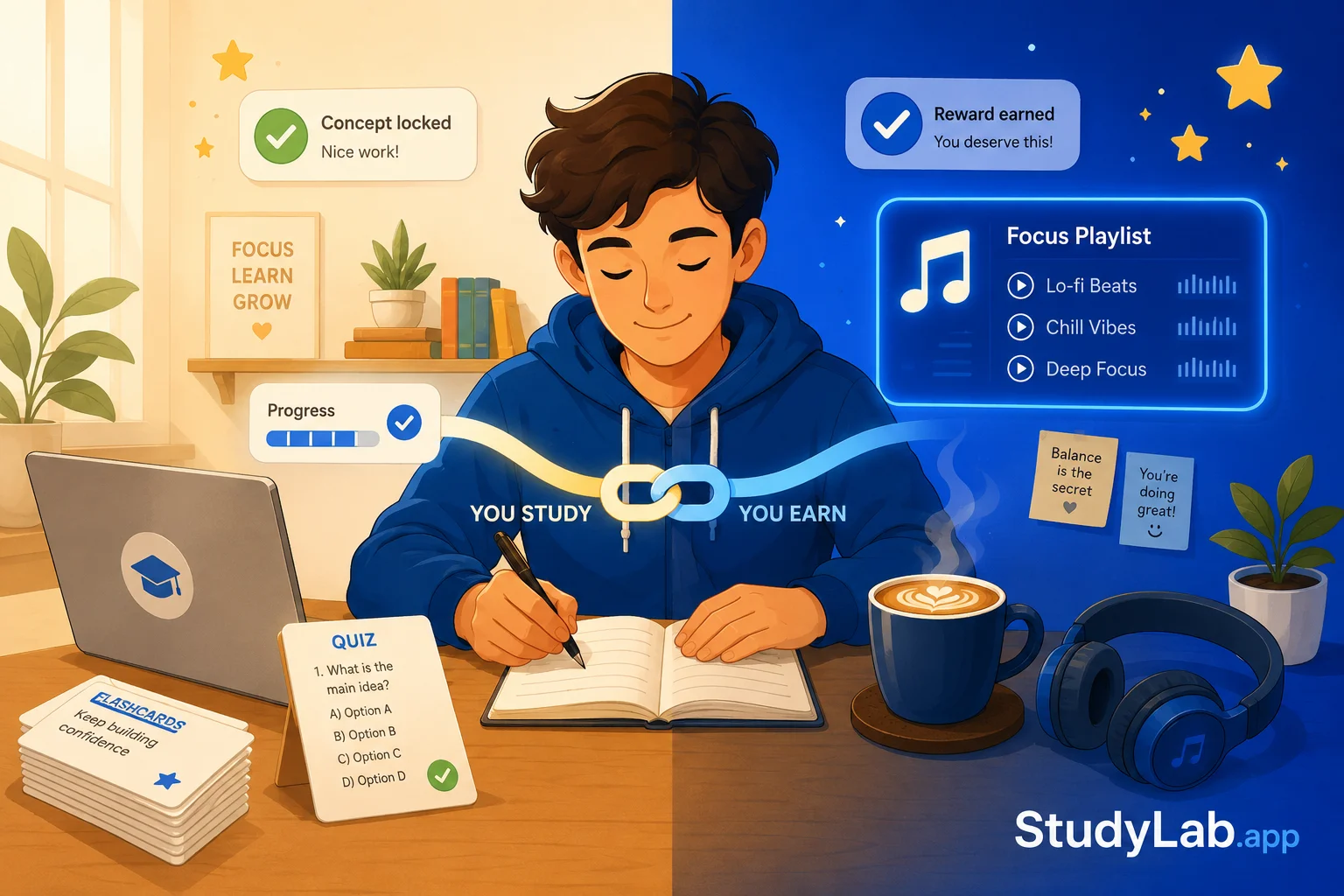
It's 4 PM on a Tuesday. You've got two chapters of bio to review, and your brain would rather do literally anything else. So you open your phone "just for a second," and forty minutes vanish. Sound familiar?
Here's a fix that doesn't rely on willpower you don't have. It's called temptation bundling, and the idea is almost embarrassingly simple. You pair the studying you keep avoiding with something you actually enjoy, so the two only happen together. Your favorite iced coffee, a specific playlist, one episode of a show. The catch is that you only get the reward while you study.
A behavioral scientist named Katy Milkman coined the term. The research behind it is more interesting (and more honest) than most study advice you'll find online.
What is temptation bundling?
Temptation bundling means linking a "want" (something instantly enjoyable but a little guilt-inducing) with a "should" (something good for you that you keep putting off). You gate the want behind the should. No studying, no reward.
Milkman came up with it as a grad student. She kept skipping the gym and kept binge-reading page-turner novels she felt guilty about. Then it clicked. What if she only let herself read those novels while on the treadmill? The gym stopped feeling like a chore, and the guilty reading stopped feeling like wasted time.
She tested the idea in a study published in Management Science in 2014, with 226 students, faculty, and staff. One group could only access tempting audiobooks at the gym. Another was encouraged to save their audiobooks for workouts. A third got neither. The results looked great at first. The gym-only group visited 51% more often than the control group, and the encouraged group about 29% more.
Then something telling happened. The effect faded over the weeks, and it dropped off after a Thanksgiving break interrupted everyone's routine. That honesty matters for how you use this, so hold onto it. The idea got a wider audience when James Clear built it into Atomic Habits in 2018, filed under his rule to "make it attractive."
Why does temptation bundling work?
Your brain has a bias built into it. Psychologists call it present bias, which means you massively overvalue rewards you can get right now over bigger rewards later. Studying pays off in two weeks, at the exam. Scrolling pays off in two seconds. It's the same wiring behind chronic procrastination, and your brain usually wins.
Temptation bundling attacks that gap directly. It takes a task with a delayed payoff (studying) and staples an immediate reward onto it. Now studying comes with something your brain wants right now, so the trade feels fair instead of miserable.
The locking part is what does the work. In Milkman's study, the group that got the strongest boost was the one physically restricted to gym-only audiobooks. When the reward was available anytime, the effect shrank. So the rule isn't "study, then reward yourself." It's "the reward only exists during studying."
One more thing worth being straight about. That flashy 51% came from a small study, and it didn't last. A much bigger follow-up in 2020, run by Erika Kirgios and Milkman with 6,792 gym members, found a real but far more modest result: roughly a 10 to 14% higher chance of a weekly workout, holding up for about 17 weeks. So temptation bundling works. It just isn't magic, and the viral number oversells it. A steady 10% edge that lasts four months is still a very good deal for something this easy.
How to use temptation bundling when you study
Start with two lists. On one side, write down the guilty pleasures you reach for anyway: a specific show, a snack you love, a playlist, a fancy coffee, a podcast. On the other, write the study tasks you keep dodging: flashcards, practice problems, re-reading lecture notes.
Now pair them. Match one want to one should, and make the reward available only during that task.
Some examples across subjects:
- Only listen to your hype playlist while grinding through chemistry practice problems
- Only sip that expensive latte while reviewing history flashcards
- Only watch your comfort show while making a study guide (the low-focus, busywork kind of task)
- Only use your favorite gel pens for the class you hate most
Match the reward to the difficulty of the task. Save the show for low-focus work like organizing notes, because you can't actually absorb organic chemistry while watching Netflix. For heavy focus work, pick a background reward instead, like a drink or a playlist, that won't steal your attention.
This pairs well with a timer. If you run the Pomodoro Technique, your bundle becomes "coffee only during the 25-minute block." It also stacks neatly with implementation intentions, the if-then planning trick. Your plan becomes "If it's 4 PM, then I make my latte and start bio flashcards," with the latte gated behind the flashcards.
The friction on the "should" side matters too. If starting the study task is a pain, the bundle breaks before it starts. Make the task itself as easy to begin as possible. If building flashcards or practice questions from your notes is the part you dread, StudyLab can generate a quiz from your PDF in seconds, so the study side of your bundle takes ten seconds to start instead of an hour to prep.
What temptation bundling can't fix
It won't save a bundle where the reward is too good. If the show is more gripping than anything could survive, you'll just watch the show. Pick rewards that are nice, not all-consuming.
It also breaks if you let the reward leak. The moment you start enjoying that latte on the couch instead of at your desk, the bundle stops working. The whole thing runs on the reward staying locked to the task. And if your routine gets disrupted by a holiday or a rough week, expect to rebuild the habit, exactly like Milkman's participants did after Thanksgiving.
Bundling also isn't a substitute for good study methods. It gets you into the chair. What you do in the chair still needs to be active recall and real practice, not passive re-reading.
FAQ
Is temptation bundling the same as habit stacking?
No. Habit stacking chains a new habit to an existing routine using a cue ("after I brush my teeth, I review one flashcard"). Temptation bundling gates a reward behind a task you avoid. Stacking links a behavior to a behavior. Bundling links a want to a should.
Does temptation bundling actually work?
Yes, with a caveat. The original 2014 study showed big early gains that faded. A larger 2020 follow-up found a smaller but durable effect, around a 10 to 14% boost lasting months. It's a real, well-tested nudge, not a miracle cure.
What can I bundle with studying?
Anything you enjoy and can control access to: a playlist, a snack, a drink, a show, a podcast, nice stationery. The only rule is that the reward stays off-limits unless you're studying.
Won't the reward distract me from studying?
It can, if you pick the wrong one. Match high-attention rewards like shows or gripping podcasts to low-focus tasks like organizing notes. For deep work, use background rewards like a drink or instrumental music that don't compete for your attention.
How is this different from just rewarding myself after?
Rewarding yourself after studying is a finish-line treat, and it's easy to skip the studying and take the treat anyway. Bundling makes the reward and the task happen at the same time, so you can't have one without the other.
Start with one bundle tonight
You don't need a system overhaul. Pick one study task you've been dodging and one small reward you like. Lock them together for tonight's session and see how it feels to start studying without the usual dread. If the hardest part is prepping the material, upload your notes to StudyLab and let it build the quiz, so the only thing left to do is press start, latte in hand.