The Google Effect: Why Looking Everything Up Is Wrecking Your Memory
You have Googled the same thing five times this week and still cannot remember it. That is the Google effect, your brain choosing not to store what it knows it can look up. Here is what the science says, what AI changes, and how to study so it finally sticks.
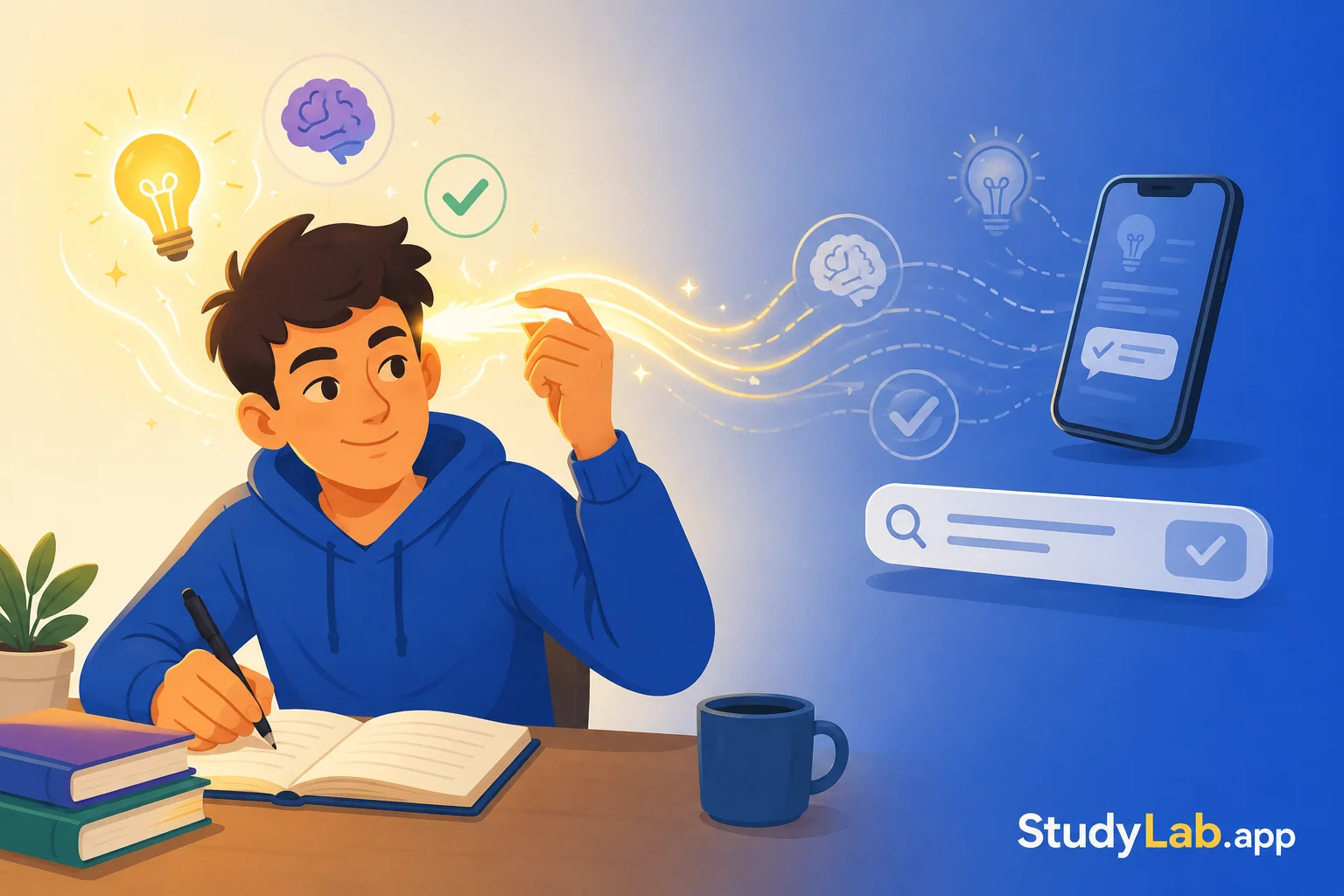
You've looked up the same thing five times this week. The keyboard shortcut. That one formula. The date of that battle you keep forgetting. And every time, about thirty seconds later, it's gone again.
You're not lazy, and your memory isn't broken. There's a name for this. It's called the Google effect, and it describes a quiet trade your brain makes without asking you. When it knows it can find something again in two taps, it decides not to bother holding onto it.
For students, that trade adds up fast. Here's what's actually going on, and how to stop handing your memory over to a search bar.
What is the Google effect?
The Google effect is the tendency to forget information you believe you can easily look up later. You remember where to find it instead of what it actually says.
The idea comes from a 2011 set of experiments by Betsy Sparrow, Jenny Liu and Daniel Wegner, published in the journal Science. In one study, people typed out a series of trivia facts. Half were told the computer would save their work. Half were told it would be erased. The group that thought the facts were safely stored remembered far fewer of them. Their brains had quietly filed the information under "no need to keep this."
The mechanism behind it is called cognitive offloading. Your brain treats your phone and the internet like an external hard drive, a memory partner it can lean on. So why spend effort encoding a fact when the cloud is holding it for you?
One honest note, because it matters. The flashiest part of that original 2011 study, a result about the brain being primed to think of computers, didn't hold up when other labs tried to repeat it. And the forgetting effect shows up most strongly when people genuinely trust the information will stay available. But the bigger pattern is on solid ground. A 2024 review that pulled together 35 studies found that heavy search habits really do change how we process and hold onto what we learn.
Why the Google effect matters more than ever
It used to be just Google. Now it's AI.
You don't only look facts up anymore. You ask ChatGPT to explain the concept, summarize the chapter, or draft the essay. That's offloading on a different level. You're not outsourcing a fact, you're outsourcing the thinking.
A 2025 study from MIT's Media Lab put this under a microscope. Researchers had students write essays in three groups: one using ChatGPT, one using a search engine, and one using nothing but their own head. Using brain scans, they found the ChatGPT group showed the weakest brain connectivity and the worst memory of what they had just written. Many of them couldn't even quote their own essays afterward.
That study was small and is still a preprint, so treat it as an early signal rather than the final word. But it fits everything we already know. If a tool does the mental work, your brain doesn't build the memory. The effort is the point, and skipping it skips the learning.
The Google effect isn't all bad
Here's the part most panicky headlines leave out. Offloading isn't the enemy.
You shouldn't try to memorize every phone number, every date, every stray fact. Research shows that saving information can actually free up mental space for new learning. Your working memory is limited, and dumping low-value trivia onto your phone can genuinely help you focus on what matters.
The trouble starts when you offload the wrong things. When you hand off the exact material you're supposed to learn for an exam, you get the convenience today and a blank page on test day. The real skill is telling the difference between what to look up and what to lock in.
How to study so it actually sticks
You don't need to quit Google or delete your AI apps. You just need to change the order you do things in.
Retrieve before you look up. Hit a question you can't answer? Try to pull it from memory first, even if you get it wrong, before you reach for a search bar. That little struggle is the exact moment learning happens. It's the whole idea behind active recall and the testing effect.
Use AI as a checker, not a crutch. Write your answer or explanation first. Then ask AI to check it, find your gaps, or argue back. You keep the thinking, it adds the feedback.
Say it in your own words. Producing an answer yourself, rather than reading or pasting one, is what makes it stick. That's the generation effect. Close the tab and explain the idea out loud like you're teaching it.
Quiz the stuff you keep looking up. If you've Googled something five times, that's your brain flagging it as not learned yet. Turn it into a question and test yourself until it lands. Tools like StudyLab can turn your notes into quizzes so the facts you keep offloading finally stay put. Otherwise they slide right down the forgetting curve.
Google effect FAQ
Is the Google effect real?
The core idea, that we remember where to find information more than the information itself, has decent support, even though one famous early result didn't replicate. The broader mechanism, cognitive offloading, is well established across many studies.
Does using AI like ChatGPT hurt your memory?
Early research suggests leaning on it too heavily can. When a tool does the thinking for you, your brain builds weaker memories. Used as a checker after you've done the work yourself, it's far less of a problem.
Should I stop Googling things?
No. Looking up low-value trivia is fine and can even free up mental space. Just don't offload the material you actually need to learn. Try to recall that yourself first.
Why do I forget things right after I look them up?
Because your brain tags them as easy to find again and doesn't bother storing them properly. Force yourself to recall them without help, and they'll start to stick.
Convenience or memory, pick your moment
The Google effect isn't a reason to throw your phone in a drawer. It's a reminder that convenience and memory pull in opposite directions. Every time you look something up without trying to recall it first, you trade a bit of learning for a bit of speed.
So flip the order this week. Before you Google or ask AI, try to answer from memory. Then check. If you want to drill the things you keep forgetting, upload your notes to StudyLab and let it quiz you until they stick, no lookup required.