The Keyword Method: The Fastest Way to Memorize Vocabulary and Foreign Words
The Spanish word for duck is pato. Picture a duck wearing a pot as a hat. You will not forget it now. That trick has a name, the keyword method, and decades of research behind it.
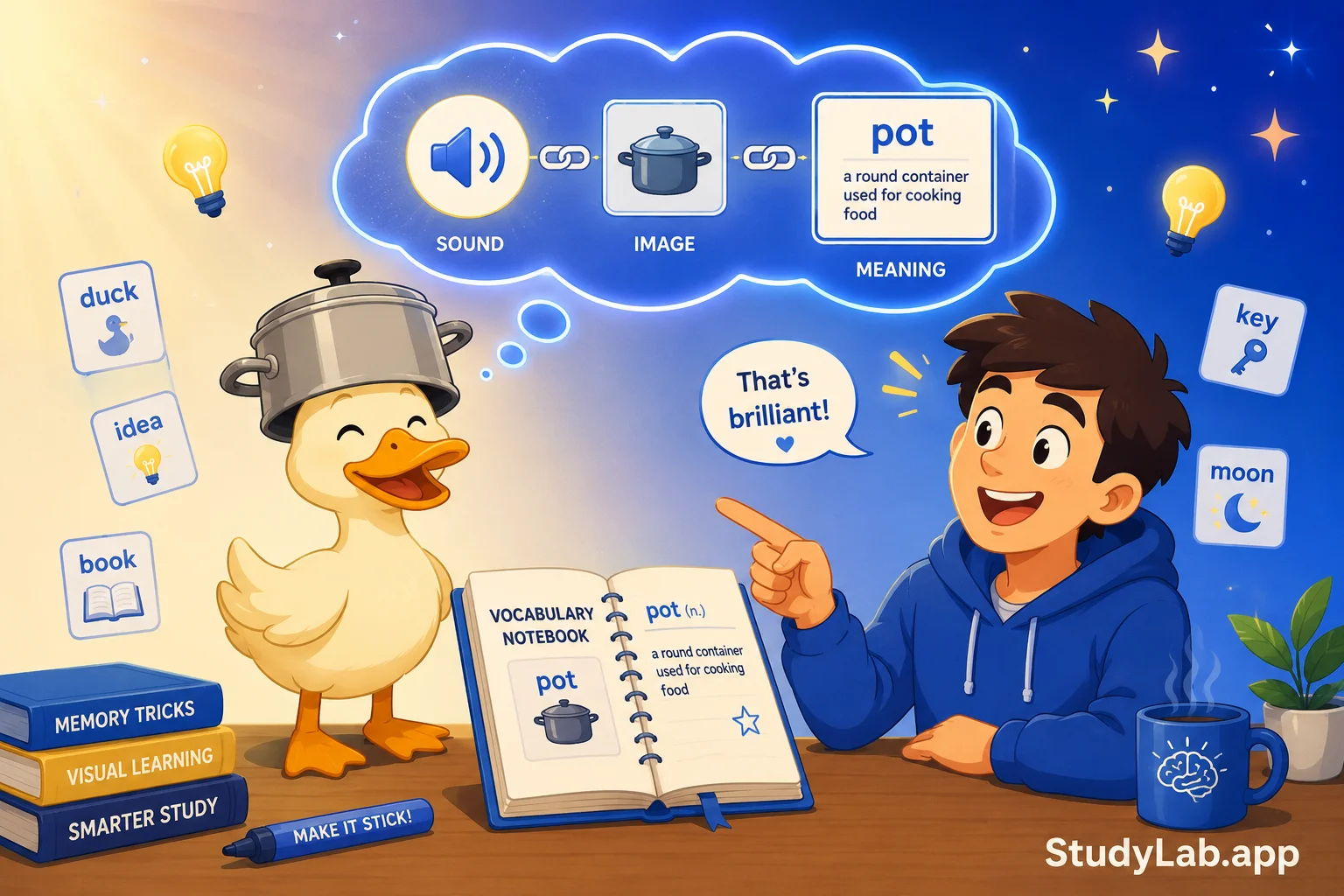
The Spanish word for duck is "pato." Picture a duck waddling around with a cooking pot balanced on its head. Silly, right?
Now try to forget it. You can't. That connection is stuck.
You just used the keyword method, one of the most researched memory techniques for learning vocabulary and foreign words. It sounds like a party trick, but it comes with decades of studies behind it, and for the right kind of material it flat out beats rote memorization. If you've ever stared at a list of terms or foreign words that refuse to stick, this is the technique that turns them into pictures your brain can't drop.
What Is the Keyword Method?
The keyword method is a two-step memory technique for connecting an unfamiliar word to its meaning through a sound-alike word and a mental image.
Psychologists Richard Atkinson and Michael Raugh formalized it in the 1970s while teaching foreign vocabulary, and the two steps are simple.
Step one is the acoustic link. You find a familiar word (the keyword) that sounds like part of the word you're trying to learn. For "pato," the sound "pot" is right there. The keyword doesn't need to mean anything related. It just needs to sound similar.
Step two is the imagery link. You build a vivid mental picture connecting your keyword to the actual meaning. Pato means duck, your keyword is pot, so you picture a duck with a pot on its head. Now when you hear "pato" later, the sound triggers "pot," the pot triggers the image, and the image hands you "duck."
That chain is the whole method. Foreign word to keyword by sound, keyword to meaning by picture. Two links, and the hard word suddenly has handles.
The method goes beyond languages too. Medical, legal, and science terms work the same way. Take "gustatory," meaning related to taste. Keyword "gust," and you picture a gust of wind blowing a delicious meal off the table so you can taste it. The term stops being a random string of letters.
Why Does the Keyword Method Work So Well?
The technique leans on one of the most reliable findings in memory research: your brain stores pictures far better than abstract words. We covered this in depth in the picture superiority effect. A word like "pato" is just sound with no hook. Turn it into a duck wearing a pot and you've given your memory something visual to grab.
Underneath that is dual coding. When you learn a plain vocabulary word, your brain encodes it one way, as verbal information. The keyword method forces a second code, a visual one, so the memory gets stored through two pathways instead of one. Two paths mean two chances to retrieve it during the exam. If the sound slips your mind, the image might still be there.
The results can be striking. In one of Atkinson and Raugh's Russian vocabulary experiments, students using the keyword method scored around 72% correct on the key test, compared to about 46% for students using ordinary study methods. That's a large gap for a technique that costs nothing but a few seconds of imagination per word. Later research has been more mixed, which we'll get to, but the core finding, that a sound-plus-image link beats rote repetition for hard vocabulary, has held up across many studies.
How to Use the Keyword Method Step by Step
Here's the workflow for any word or term that won't stick.
1. Say the word out loud and listen for a sound-alike. What familiar word or phrase hides inside it? "Caballo" (horse, in Spanish) has "cow" and "boy" in it. Good enough. Your keyword is "cowboy."
2. Pick the most vivid, slightly ridiculous image you can. Link the keyword to the meaning. A cowboy riding a horse is fine, but a cowboy riding a horse that's also a cow is stickier. Weird wins. Research suggests learners genuinely believe bizarre images help them remember, and bizarreness fits everything we know about distinctive material grabbing attention.
3. See the image for a few seconds. Don't just think it, picture it. Let the duck's pot wobble. The clearer and more animated the scene, the stronger the trace.
4. Test yourself, don't just admire it. This is the step people skip. Cover the meaning, look at the foreign word, and make yourself retrieve the answer through the chain. The keyword method gets the word into memory. Active recall is what keeps it there.
5. Space your reviews. Come back to the word over several days rather than drilling it once. Pairing the keyword method with spaced repetition is where the long-term retention comes from.
You can build these into flashcards fast. Put the foreign word on the front, and on the back put the meaning plus a quick note of your keyword and image. If you'd rather not make every card by hand, tools like StudyLab can turn your vocabulary lists or PDFs into quizzes and flashcards, and you can add your keyword image to the ones that keep tripping you up.
The Honest Caveats
The keyword method is powerful, but it isn't magic, and it's not for everything.
It works best for concrete words. A duck, a horse, a house, these come with easy pictures. Abstract words are much harder. What's the image for "although" or "meanwhile"? You can force one, but it's slower and shakier. In the original research, students reported the method worked least well for adjectives, which tend to be less imageable than nouns.
The evidence is also more mixed than the flashy early numbers suggest. Some later studies found the keyword method didn't clearly beat other solid approaches like breaking words into meaningful parts or letting students use their own strategies. It's a strong tool, not a universal winner.
And there's a real cost. Inventing a keyword and image for every single word is slower than plain review. That's why most researchers suggest using it selectively, for the stubborn words that resist normal studying, rather than for your entire vocabulary list. For easy words, simple practice is faster.
One useful finding: in the early studies, students often did better when they were given a good keyword than when they had to invent their own. If you're stuck generating one, borrowing a keyword from a textbook or a language app is completely fair, and often works better.
Common Mistakes to Avoid
Using it for every word. The method is for the hard ones. Spending 30 seconds building an image for a word you already half-know is wasted effort.
Making forgettable images. A vague, static picture won't stick. Push for vivid, moving, weird. If the image is boring, the memory will be too.
Skipping the retrieval step. Building the image feels like learning, but you haven't proven you can retrieve the word until you test yourself. Always close the loop with a self-quiz.
Forcing it on abstract words. If a word has no natural image, the keyword method may be the wrong tool. Try connecting it to a sentence or context instead.
FAQ
What is the keyword method in simple terms?
It's a two-step trick for memorizing hard words. First you find a familiar word that sounds like the one you're learning (the keyword). Then you picture that keyword interacting with the meaning. The sound leads you to the image, and the image leads you to the definition.
Is the keyword method good for learning a language?
Yes, especially for building vocabulary. It was originally developed and tested on foreign-language words, and it shines for concrete nouns. It's less useful for abstract words and grammar, so treat it as one tool in your language-learning kit, not the whole toolbox.
How is the keyword method different from a memory palace?
A memory palace stores a sequence of items by placing them along a familiar route, which is great for ordered lists. The keyword method links one word to one meaning through sound and image, which is built for vocabulary and term-definition pairs. Use the palace for lists, the keyword method for individual tough words.
Does the keyword method work for long-term memory?
It can, but only if you review. The image gets a word into memory quickly, and some studies have found the benefit lasting a long time when learners do brief refreshers. Without any spaced review, keyword-encoded words fade like anything else. Combine it with testing and spacing for durability.
Can I use the keyword method for medical or science terms?
Absolutely. Any term-definition pair works. Find a sound-alike for the term and picture it interacting with the meaning. It's popular for anatomy, pharmacology, and other vocabulary-heavy subjects where you're drowning in unfamiliar names. For a broader set of memory tricks, our guide to mnemonic devices covers more options.
Turn One Word Into a Picture Right Now
Pick one word that's been refusing to stick, foreign vocabulary, a medical term, anything. Find the sound-alike hiding inside it, build the most ridiculous picture you can, and hold it for a few seconds.
Then make it earn its place. Upload your vocabulary list to StudyLab, quiz yourself on it, and add keyword images to the words you miss. The ones that used to slide right off your brain will finally have something to hold onto.