The Self-Explanation Effect: Why You Understand Worked Examples in Class but Bomb the Exam
You followed every step of the worked example and it all made sense. Then the exam handed you a slightly different problem and nothing worked. The self-explanation effect explains the gap, and how to close it.
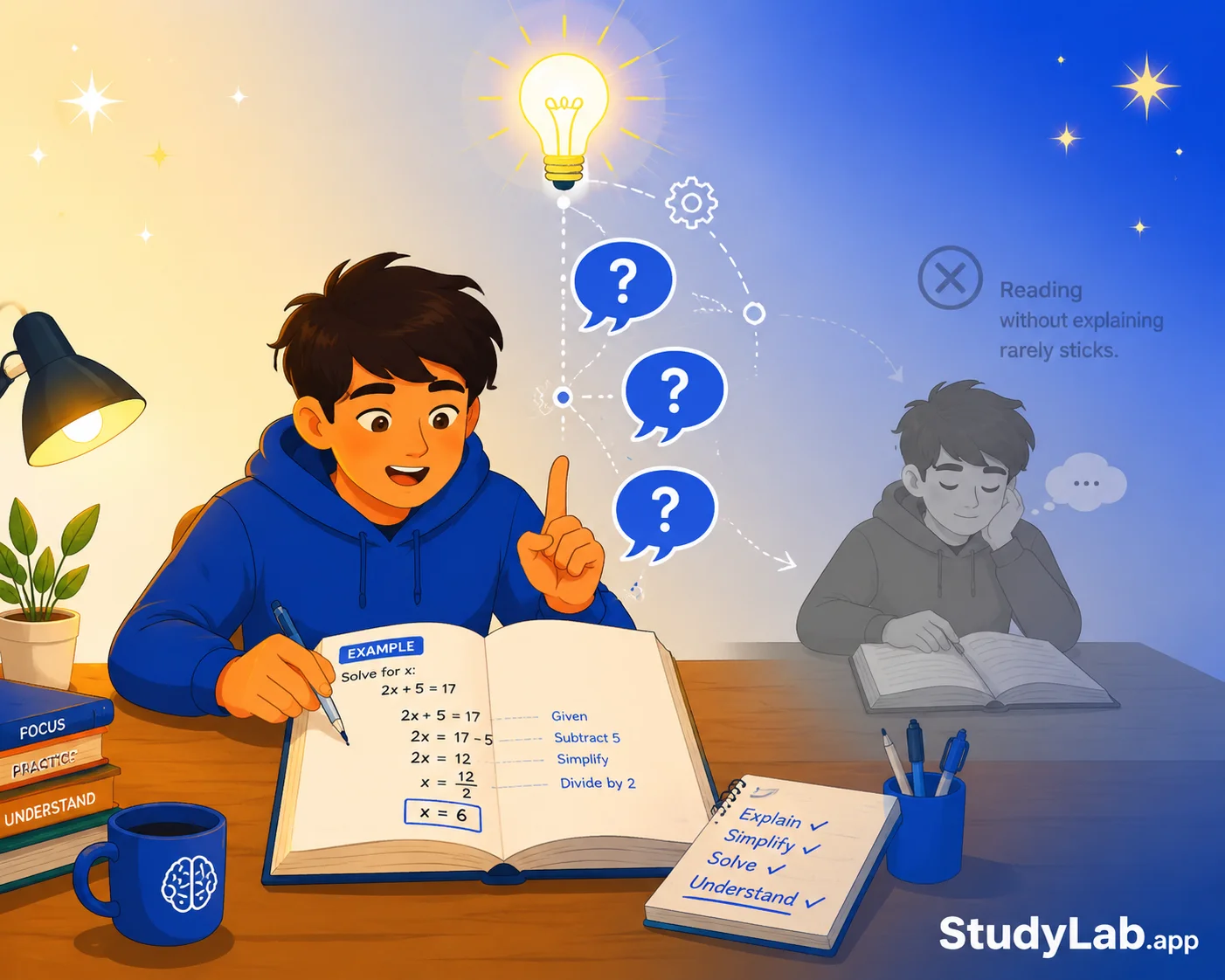
The professor solves the example on the board. Step by step, it all makes sense. You nod along, copy it down, and walk out feeling good.
Two weeks later the exam gives you a problem that's maybe 15% different. And you freeze. The steps you watched so confidently are gone, and you can't figure out where to even start.
Sound familiar? This gap between "it made sense when I watched it" and "I can't do it myself" is one of the most studied failures in learning science. And the fix has a name: the self-explanation effect. It's the single habit that research keeps finding in top students, especially in math, physics, chemistry, and anything with worked examples.
What Is the Self-Explanation Effect?
The self-explanation effect is the finding that students who explain material to themselves while studying, step by step and in their own words, learn far more than students who just read or follow along.
The landmark study came from Michelene Chi and her colleagues in 1989. They watched physics students study worked examples and then tracked who could solve new problems. The difference between the strong and weak problem-solvers wasn't raw ability or time spent. It was what they did while reading. The strong students paused constantly to explain things to themselves: why this step follows from that one, where this formula came from, what the example was quietly skipping over. The weak students read the same examples, understood each line in isolation, and moved on.
Here's the uncomfortable part. Both groups felt like they understood. Only one group actually did.
Since then, the effect has been replicated across math, science, medicine, and programming. John Dunlosky's well-known 2013 review of study techniques rated self-explanation as one of the strategies with the most promise. And a consistent finding runs through the research: left alone, most learners are passive or superficial self-explainers. The habit almost never happens by accident. You have to do it on purpose.
Why Does Following Along Fool You?
Worked examples are seductive because they remove all the friction. Every step is already correct, already ordered, already there. Reading one produces a smooth feeling of understanding, and your brain mistakes that smoothness for knowledge.
But an example always hides more than it shows. It shows what was done. It rarely shows why that step, why there, and why not something else. Those missing whys are exactly what you need when the exam changes the problem, because the whys are what transfer. The whats don't.
Self-explanation forces you to generate the missing whys yourself. And generating matters. As the generation effect shows, information you produce sticks far better than information you receive. Explaining a step to yourself also drags the material through deeper processing, connecting it to what you already know, which is the same mechanism behind levels of processing. Watching is shallow. Explaining is deep.
How Is This Different From the Feynman Technique?
Fair question, because our catalog has some cousins, and they're easy to mix up.
The Feynman Technique has you explain a topic to an imaginary beginner in the simplest possible words. It's an output test: can you teach this? Elaborative interrogation has you ask "why is this fact true?" about statements you're learning. It's built for facts.
Self-explanation lives inside the studying itself. You're not performing for an audience or drilling facts. You're working through a solution or a passage, and at each step you stop and explain to yourself how it works, why it's justified, and how it connects to what came before. It shines exactly where the other two get awkward: multi-step procedures, derivations, proofs, code, mechanisms.
Use all three. They just live at different moments of studying.
How to Self-Explain a Worked Example (Step by Step)
Take any solved example from your textbook. Then work through it like this.
1. Cover the solution. Before reading it, attempt the problem yourself for a minute or two. Even a failed attempt primes you to notice what the solution does differently.
2. Read one step, then close the loop. For each step, answer out loud or in the margin: Why is this step here? What rule or principle allowed it? Could I have done something else? If your answer is "because that's what they did," you've found a gap. Good. That's the point.
3. Explain the skipped steps. Every worked example jumps. It goes from line 2 to line 3 and assumes you see the algebra in between. Say the invisible steps explicitly. In Chi's study, filling in what the example left out was precisely what the successful students did.
4. Predict before you peek. Before revealing each next step, guess what it will be. Being wrong here is useful, because the mismatch between your prediction and the real step shows you exactly what you don't understand yet.
5. Explain one wrong path. When you have decent footing, look at an incorrect solution (or your own failed attempt from step 1) and explain why it fails. Research on learning from errors found that explaining why wrong solutions are wrong helps you avoid those mistakes later. One caveat from the same research: this works best once you have some grounding in the topic. If you're brand new to the material, stick to explaining correct solutions first, because hunting for errors too early gets overwhelming.
6. Close the book and re-solve. The final test isn't feeling ready. It's producing the full solution with the example hidden.
If you want a fast way to check whether your explanations actually closed the gaps, upload your notes or textbook chapter to StudyLab and take an AI-generated quiz on the concepts. The questions you miss point at the steps you explained too shallowly.
Common Mistakes to Avoid
Paraphrasing instead of explaining. Restating a step in different words isn't self-explanation. The explanation has to answer why, not repeat what.
Only explaining when it's easy. The steps you're tempted to skip past are the ones hiding your gaps. Discomfort is the signal to slow down, not speed up.
Doing it silently in your head. Silent "explaining" collapses into nodding along within seconds. Speak it or write it. The moment your mouth or pen has to produce the explanation, the gaps become undeniable.
Believing the fluency. A smooth read-through of an example proves the author understood it. Your understanding only shows up when you generate the reasoning yourself.
FAQ
What is the self-explanation effect in simple terms?
Students who pause while studying to explain each step to themselves, why it works and how it connects to what they know, learn much more than students who just read or follow along. The original physics research found this habit was what separated strong problem-solvers from weak ones.
Does self-explanation work if I'm bad at the subject?
Yes, and possibly especially. One study that trained learners in self-explanation found the biggest gains among people with low prior knowledge of the topic. You don't need to be good at the subject to ask why a step works. Asking is how you get good.
Is self-explanation the same as the Feynman Technique?
No. The Feynman Technique means explaining a whole topic simply, as if teaching a beginner. Self-explanation happens during studying, step by step, and the audience is you. Feynman tests whether you can teach it after. Self-explanation builds the understanding while you study.
How long should self-explaining a worked example take?
Longer than reading it, and that's the feature, not the bug. A ten-minute example might take twenty-five minutes with full self-explanation. You'll cover fewer examples and learn dramatically more from each. One deeply explained example beats five skimmed ones.
Does self-explanation work for non-STEM subjects?
Yes. The research habitat is worked examples in math and science, but the same move works on a historical argument, a legal ruling, or a paragraph of philosophy: at each claim, stop and explain why it follows from what came before. Any material with steps or logic responds to it.
Explain One Example Tonight
Pick one worked example from whatever you're studying this week. Cover the solution, attempt it, then work through it step by step, explaining every why out loud. When something resists explanation, you've just found what the exam would have caught.
Then confirm the gap is closed. Upload the chapter to StudyLab, quiz yourself on it, and see whether your explanations hold up when the questions change. That's the difference between watching understanding and owning it.