The Zettelkasten Method: The Note-Taking System That Connects Everything You Study
Most note-taking systems trap your knowledge in folders. The Zettelkasten method builds a network of connected ideas that grows more useful the longer you use it.
Your notes are everywhere. Notion folders, highlighted PDFs, color-coded notebooks. You've tried the Cornell method, you've tried mind mapping, you've tried just writing everything down and hoping for the best.
And then exam time hits. You open your notes app and feel nothing. Hundreds of highlights from a textbook you barely remember reading. A folder called "Biology Stuff" with 47 untitled documents inside.
Sound familiar? You're not disorganized. You're just using a system that wasn't built for how knowledge actually works.
The Zettelkasten method was. And it's been quietly used by some of the most productive thinkers in history.
What Is the Zettelkasten Method?
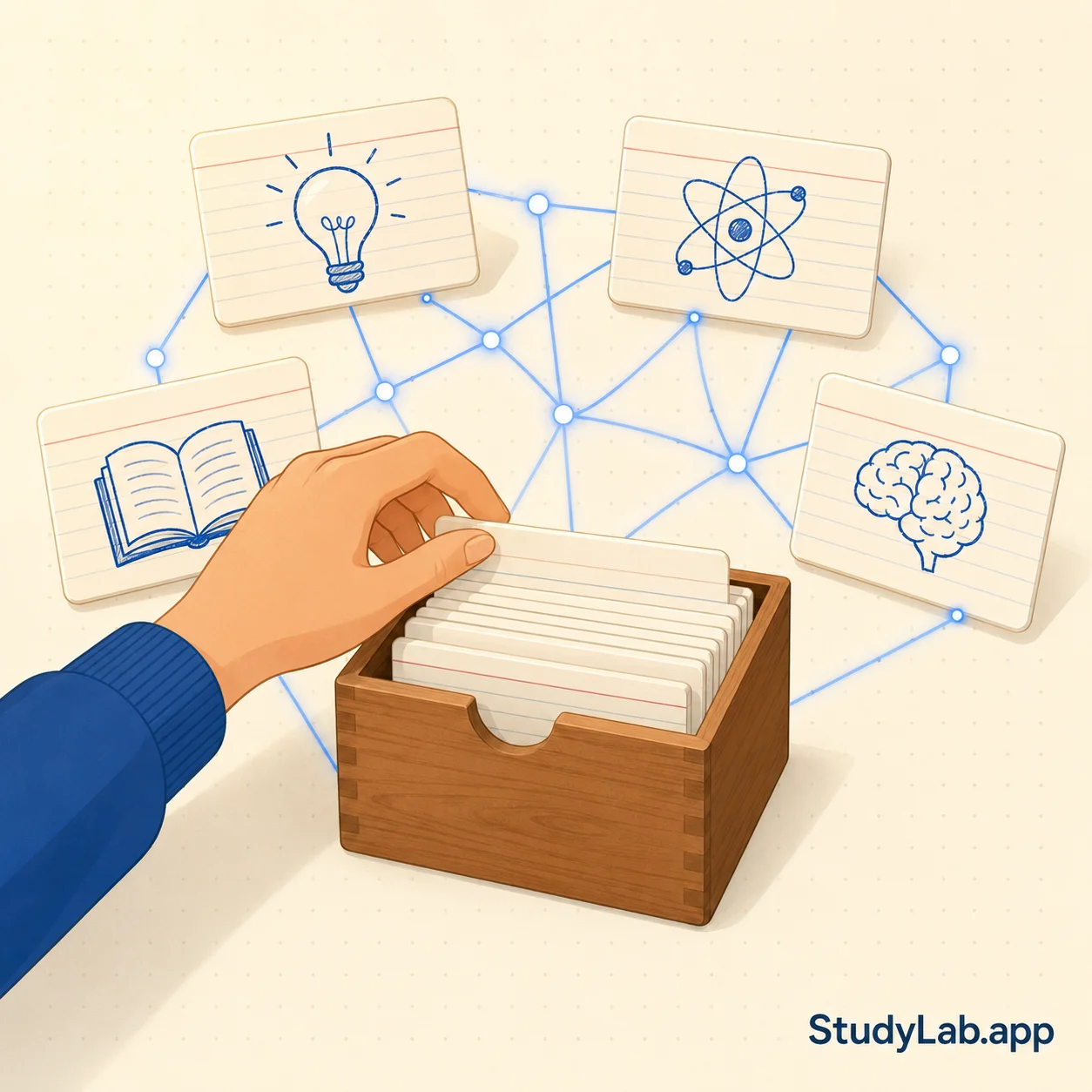
"Zettelkasten" is German for "slip box." Instead of dumping notes into folders organized by subject or source, you write one idea per note and link each note to related ideas. Over time, you build a network of connected knowledge, not a graveyard of forgotten highlights.
The method was popularized by German sociologist Niklas Luhmann, who used it to produce 70 books and more than 400 scholarly articles over a career spanning four decades. His Zettelkasten held approximately 90,000 index cards. When asked how he managed such output, Luhmann said most of his thinking came from "conversations" with his slip box. He wasn't being poetic. He was describing how a connected note system can surface ideas you didn't know you had.
The system works the same way your brain does. Your brain doesn't store memories in neat folders. It stores them in webs of association. Cognitive psychologists have known for decades that connecting new information to existing knowledge, a process called elaborative encoding, leads to stronger long-term retention than re-reading ever will. The Zettelkasten builds that process directly into how you take notes.
Why Your Current Notes Aren't Working
Most students take notes by source. You read a chapter, you take notes on the chapter. You attend a lecture, you write down what the professor says. Everything organized by where it came from.
This feels logical. But it creates isolated silos. Your psychology notes don't talk to your education notes. Your biology flashcards don't connect to the neuroscience chapter you read last semester. You can retrieve information inside a folder, but you can't see how ideas relate across different subjects.
That's the real problem. Learning isn't about storage. It's about connections. A concept doesn't stick until it's linked to something you already know. That's also why active recall works so well: it forces your brain to build retrieval pathways. The Zettelkasten builds the map those pathways run through.
How the Zettelkasten Method Works: The 4 Note Types
You don't need a special app. You can start with a simple folder of text files, a notes app, or physical index cards. The system has four components.
Fleeting Notes
A fleeting note is any quick capture while you're reading, in class, or just thinking. A bullet point, a voice memo, a sticky note. Don't organize these. Just capture them. You'll process them later.
Literature Notes
After you read something, write a short summary in your own words. One or two sentences per idea. No copy-pasting. No highlighting and calling it done.
Writing it yourself is the whole point. You're not transcribing. You're thinking.
Permanent Notes
This is the core of the system. A permanent note is a single idea, written clearly, as if you're explaining it to someone with no context. One note, one idea. And at the bottom of every permanent note, you add links to related notes.
That link is what makes the system work. It's what turns a pile of notes into a network.
The Index
An index is a simple master list that points to the main entry points of major topics in your system. You don't need to index everything, just the ideas you return to most often. Think of it as a table of contents for your own thinking.
How Your Notes Start Talking to Each Other
Here's where it gets interesting. After a few weeks, you'll start writing a permanent note and realize it connects to something you wrote months ago, in a totally different subject. You link them. And suddenly you see a pattern you couldn't see before.
Sönke Ahrens, author of "How to Take Smart Notes," describes this as writing that thinks with you rather than for you. Your notes stop being a record of what you read and start becoming a tool for generating new ideas.
This also makes exam prep much faster. Instead of re-reading everything, you follow the links from one concept and pull up every related idea in seconds. It's a completely different kind of review, and it actually works.
Zettelkasten vs. Other Note-Taking Methods
You've probably already used the Cornell note-taking method. It's excellent for organizing a single lecture. But it doesn't connect notes across lectures or subjects.
Mind mapping is useful for big-picture overviews but gets messy at scale and isn't easy to search through.
Zettelkasten is slower to set up. But it compounds. Every note you add makes the whole system more useful. Your third-year notes link back to your first-year notes, and those connections teach you things your original reading didn't.
The other two systems help you organize what you know. Zettelkasten helps you discover what you know.
How to Start Your Zettelkasten This Week
Pick one subject you're actively studying right now. Don't wait until you have the perfect setup.
Day 1: Read one chapter or watch one lecture. Write 5 to 10 fleeting notes as you go.
Day 2: Turn those into 2 or 3 permanent notes. One idea per note, written in your own words.
Day 3: Look at your existing notes and ask where each one connects. Add at least one link per permanent note.
That's it. You're already doing Zettelkasten.
For tools: Obsidian is free, widely used by students, and built for linked notes. Notion works if you already use it. Even a well-organized folder of plain text files works.
The one rule that matters: every permanent note needs at least one outgoing link. A note that connects to nothing is just a note.
Once you've built your notes, the next step is testing yourself on them. Tools like StudyLab can generate quiz questions from your study materials automatically. Pair your Zettelkasten with active recall and you're combining two of the most evidence-backed approaches to learning that exist.
Common Mistakes Students Make With Zettelkasten
Collecting instead of writing. Saving articles and PDFs is not Zettelkasten. Notes you never write don't help you.
Notes that are too long. One note, one idea. If your note has three sections, break it into three notes and link them together.
Skipping the links. This is the most common mistake. The links are the whole system. Without them, you just have a folder structure with extra steps.
Waiting for the perfect tool. The tool matters far less than the habit. Start with what you already have.
Frequently Asked Questions
What is the Zettelkasten method?
The Zettelkasten method is a note-taking and knowledge management system where each note contains a single idea, written in your own words, and links to related notes. Instead of organizing notes by source or subject, the system builds a network of connected ideas that becomes more useful the longer you use it.
Is Zettelkasten good for students?
Yes, particularly for subjects where understanding matters more than memorization. Because notes link across topics and subjects, the system reveals connections that isolated folders would hide. It's especially useful for essay-heavy subjects, sciences, and any course where concepts from earlier in the year build on each other.
Do I need Obsidian or a special app to use Zettelkasten?
No. Obsidian, Notion, and Roam Research all support Zettelkasten workflows, but you don't need any of them to start. A plain notes app, a folder of text files, or physical index cards all work. The method is about how you write and link notes, not which tool you use.
How is Zettelkasten different from Cornell notes?
The Cornell method helps you organize a single lecture or reading session. Zettelkasten connects notes across multiple sources, sessions, and subjects. Cornell is great for short-term review. Zettelkasten is built for long-term understanding and knowledge that compounds over time.
How long does it take to see results with Zettelkasten?
Most students notice a difference after two to four weeks of consistent use. The real payoff comes when your note network is large enough to surface unexpected connections between ideas you studied months apart. The more notes you add, the more useful the system becomes.
The Notes You Build Now Pay Off Later
Most note-taking systems work for the exam you're studying for right now. The Zettelkasten builds something bigger. Each note you write connects to what you already know, and over time those connections become the kind of deep understanding that's genuinely hard to fake in an exam.
You don't need 90,000 cards. You just need to start. Pick your subject, write your first five permanent notes, add the links, and see what the system shows you.
Pair it with spaced repetition for better long-term retention, and test yourself regularly. Upload your study materials to StudyLab and get AI-generated quizzes from your notes in seconds. Because connecting ideas is how you understand them. Testing yourself is how you keep them.