Why You Get Sleepy the Moment You Sit Down to Study (And What Actually Fixes It)
Neuroscientists have watched small patches of the brain fall asleep while the rest of it stays wide awake. It explains why coffee alone never fixes the 2pm slump, and it points to a better fix.
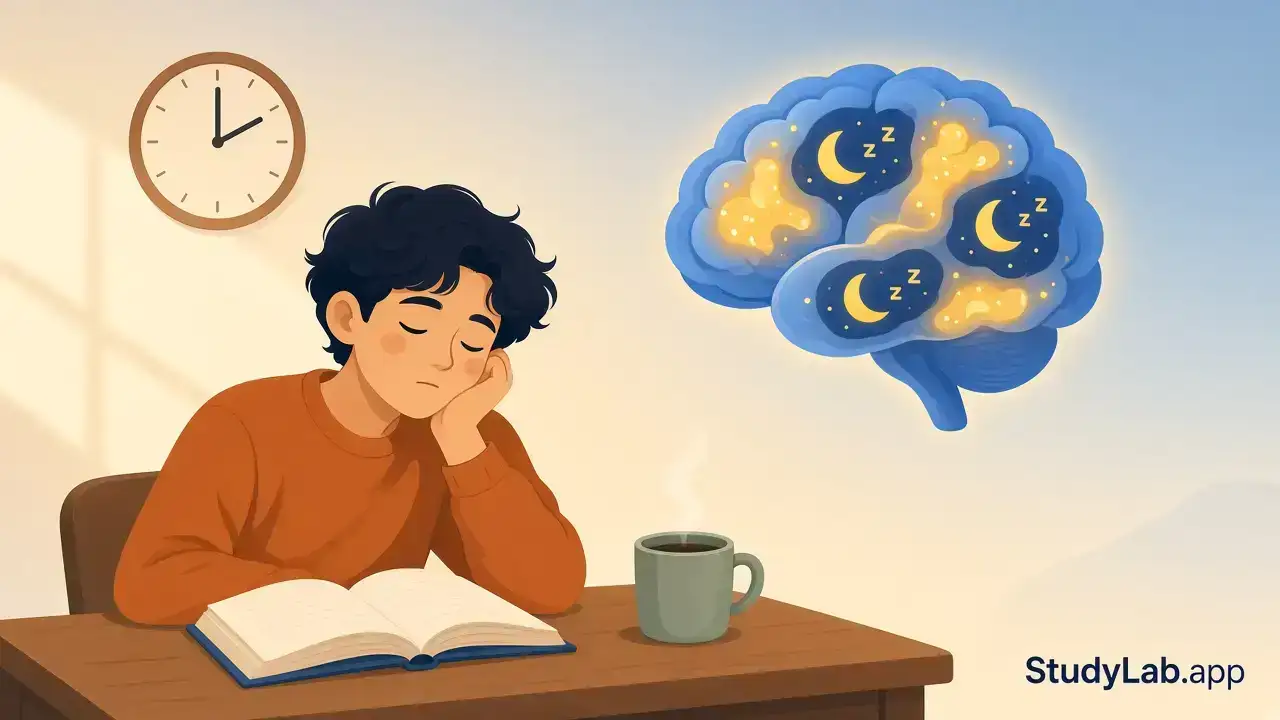
You sit down at two in the afternoon with three chapters to get through. Twenty minutes later you have read the same paragraph four times and you could not tell anyone what it said. Your eyes are open. Your brain has clocked off.
If you get sleepy when you study, the standard advice is more coffee, cold water on your face, or just push harder. All of it treats sleepiness as a willpower problem. It isn't one. Neuroscientists have recorded what happens inside the brain during exactly this moment, and what they found explains why grinding through it never works, and what does.
Why Do You Get Sleepy the Moment You Start Studying?
In 2011, a team at the University of Wisconsin-Madison published a strange result in Nature. They recorded individual brain cells in rats that had been awake for a long stretch, and they watched small groups of cortical neurons briefly go offline. Stop firing altogether. Exactly the way neurons behave in deep sleep.
The rats were awake the entire time. Moving around, behaving normally, with an EEG that read as a perfectly ordinary waking brain. But little patches of cortex were asleep. The researchers called it local sleep, and the longer the animals had been awake, the more often it happened.
The consequence matters more than the mechanism. As local sleep crept in, the rats got measurably worse at a task where they had to reach for a sugar pellet. They looked awake. They were failing anyway.
That was rats, and rats are not students revising for finals. So the obvious question was whether human brains do the same thing. In 2017, researchers recorded single neurons directly inside the brains of neurosurgical patients who already had electrodes implanted for medical reasons, after a full night without sleep. Just before each lapse in attention, individual neurons in the medial temporal lobe went quiet. Their responses got weaker, slower and more smeared out. The lapse appeared in the neurons before it appeared in the behaviour.
The medial temporal lobe is the region doing most of the work when you form a new memory. So the exact part of your brain you need for studying is the part that browns out first.
That's why rereading feels so pointless when you're tired. The words go in. Nothing is home to catch them.
Sleep Pressure and the Afternoon Trough
Two separate systems decide how sleepy you feel right now, and around 2pm they can both be working against you.
The first is sleep pressure. Every hour you stay awake, a molecule called adenosine accumulates in your brain. Researchers at Harvard measured this directly in the 1990s, tracking adenosine in the basal forebrain and watching it climb through long stretches of wakefulness, then fall again during recovery sleep. More adenosine means more pressure to sleep. It's a countdown that starts the second you wake up, and motivation does not pause it.
Caffeine works by blocking the receptors adenosine binds to. Read that again, because the wording is the whole story. Caffeine blocks the signal. It does not clear the adenosine. Everything you accumulated is still sitting there, which is why the crash lands so hard when the caffeine wears off.
The second system is your body clock. There is a genuine dip in alertness in the early afternoon, and lunch does not cause it. A review in Clinics in Sports Medicine described it plainly. The dip shows up even in people who ate nothing and had no idea what time of day it was. A heavy, carb-loaded lunch makes it worse. But it doesn't create it.
So if your worst study slot is reliably between one and three, that's your biology running on schedule. Not a character flaw.
Does a Coffee Nap Actually Work?
Yes, and the evidence is better than the goofy name suggests.
In 1997, two sleep researchers at Loughborough University tested twelve sleepy participants facing a two-hour monotonous afternoon drive in a simulator. During a thirty-minute break beforehand, each person got either a placebo, 200mg of caffeine, or 200mg of caffeine followed straight away by a nap of under fifteen minutes.
Caffeine alone brought driving incidents down to 34% of the placebo level. Caffeine plus the short nap brought them down to 9%.
The order is the entire trick. Caffeine needs time to reach your bloodstream, so you nap inside that gap. Your brain clears some adenosine while you doze, and the caffeine arrives right as you surface. You stack both effects instead of picking one.
One detail from that study is worth keeping. Naps where people only dozed and never properly fell asleep still worked. So "I can't nap" doesn't disqualify you.
Be fair about what this study was, though. Twelve people, in a driving simulator, not a library. It's a small sample and a different task. What carries over is the mechanism it targets, which is the same sleep pressure making your notes swim at 2pm.
The Five-Step Fix for Studying While Sleepy
1. Run the coffee nap deliberately
Drink your coffee quickly rather than sipping it over twenty minutes. Then set an alarm for 20 minutes and lie down. You're aiming for a short doze, not a proper sleep. Don't let it stretch to 30 minutes, because that's where you drop into deep sleep and wake up groggier than when you started.
2. Move your hardest material out of the trough
Map your week around your dip instead of pretending it isn't there. If you reliably fade between one and three, hand that slot the low-demand work, like reorganising notes, sorting flashcards, or clearing admin. Save the reading that needs actual thinking for your sharp hours.
Most students do this backwards. They put the scary subject in the afternoon because they've been dreading it all morning.
3. Stop before you fade, not after
Local sleep gets more frequent the longer you've been awake and on task. By the time you notice you're sleepy, you've already been losing material for a while. Short sessions with real breaks beat long grinding ones, which is the actual reason the Pomodoro Technique works so well for so many people. And what you do in the break changes how much it helps, which the science of study breaks gets into properly.
4. Give your brain something it has to answer
Passive input is where sleepiness always wins. Reading and highlighting demand almost nothing from you, so those offline patches of cortex never get challenged and never come back online. Testing yourself does the opposite, because a question you can't dodge forces retrieval.
This is one place where letting software do the boring part genuinely helps. Turning a chapter into practice questions by hand takes an hour you don't have, so tools like StudyLab can generate a quiz straight from your PDF and hand you something to answer while your attention is still there.
One thing worth separating out. If your head feels full rather than sleepy, that's a different problem with a different fix, and cognitive load theory explains that one better.
5. Fix the night, because the day can't
Every technique above manages sleep pressure. None of them removes it. The rats went offline more as their time awake stretched on, and the human neurons lapsed after a full night of deprivation. If you're running on five hours, you're starting each afternoon already deep into the deficit, and no nap protocol digs you out. The case against all-nighters covers what that costs you at exam time.
How to Start This Afternoon
Pick tomorrow's worst slot, the one where you normally fade. Twenty minutes before it, drink a coffee fast and lie down with a 20-minute alarm. When it goes off, don't open your notes to read them. Open them to quiz yourself on what you covered yesterday.
That's it. One session, one comparison. You'll know within a day whether the slump was sleep pressure or something else entirely.
Common Mistakes That Keep You Nodding Off
Napping for an hour. You wake up in deep sleep, foggy and worse off. Keep it under 25 minutes including the time it takes to drift off.
Saving the coffee until after the nap. Then you're just waiting around for it to kick in. Drink it first.
Treating sleepiness as proof you're lazy. It's a measurable physiological state, and dressing it up as a moral failing keeps you sitting at the desk producing nothing.
Studying in bed. Your afternoon slump does not need the help.
FAQ
Why do I get sleepy when I study but not when I watch TV?
Sleep pressure is the same in both cases. The difference is stimulation. Video gives your brain constant novelty with almost no effort required from you, so it papers over the drowsiness. Studying asks for sustained effort from the exact regions that go offline first, so you feel every bit of the pressure that was already there.
How long should a study nap be?
Under 25 minutes, alarm included. The Loughborough study used naps of under fifteen minutes and got a strong result. Longer naps push you into deep sleep, and waking up from that leaves you foggy for a while, which defeats the point.
Does drinking more coffee eventually stop working?
For sleepiness driven by real sleep debt, mostly yes. Caffeine masks the adenosine signal instead of clearing it, so the pressure keeps building underneath. Regular heavy use also builds tolerance. You end up needing more caffeine to reach the same baseline you used to hit on nothing.
Is it better to push through the sleepiness or take a break?
Take the break. Pushing through means reading with patches of your cortex offline, which is why the hour feels productive and the recall isn't there the next day. Twenty minutes lost to a nap is cheaper than three hours of studying that doesn't stick.
Why do I feel most awake at 11pm when I have an exam tomorrow?
That's your circadian rhythm producing a genuine evening alertness bump after the afternoon trough. It feels like proof you're a night person. Mostly it's proof you're about to trade the sleep that consolidates today's material for a few more hours of reading it.
Start With One Afternoon
The useful shift here is small. Sleepiness while studying isn't a sign you lack discipline, it's a signal that sleep pressure has stacked up faster than your attention can hold out. You can work with that. Coffee first, twenty-minute alarm, hardest material moved to your sharp hours, and testing instead of rereading when you sit back down.
Try it on the next session where you'd normally fade. When you get up, upload that chapter to StudyLab and answer a few questions on it rather than reading it again. Fifteen minutes of that will tell you more about what actually stuck than an hour of highlighting ever will.