How to Cram for an Exam When You Left It Too Late
Exam tomorrow and you have barely started? Cramming can still save the grade if you do it right. Here is a triage plan built on retrieval, short spacing and sleep, plus what it costs you a week later.
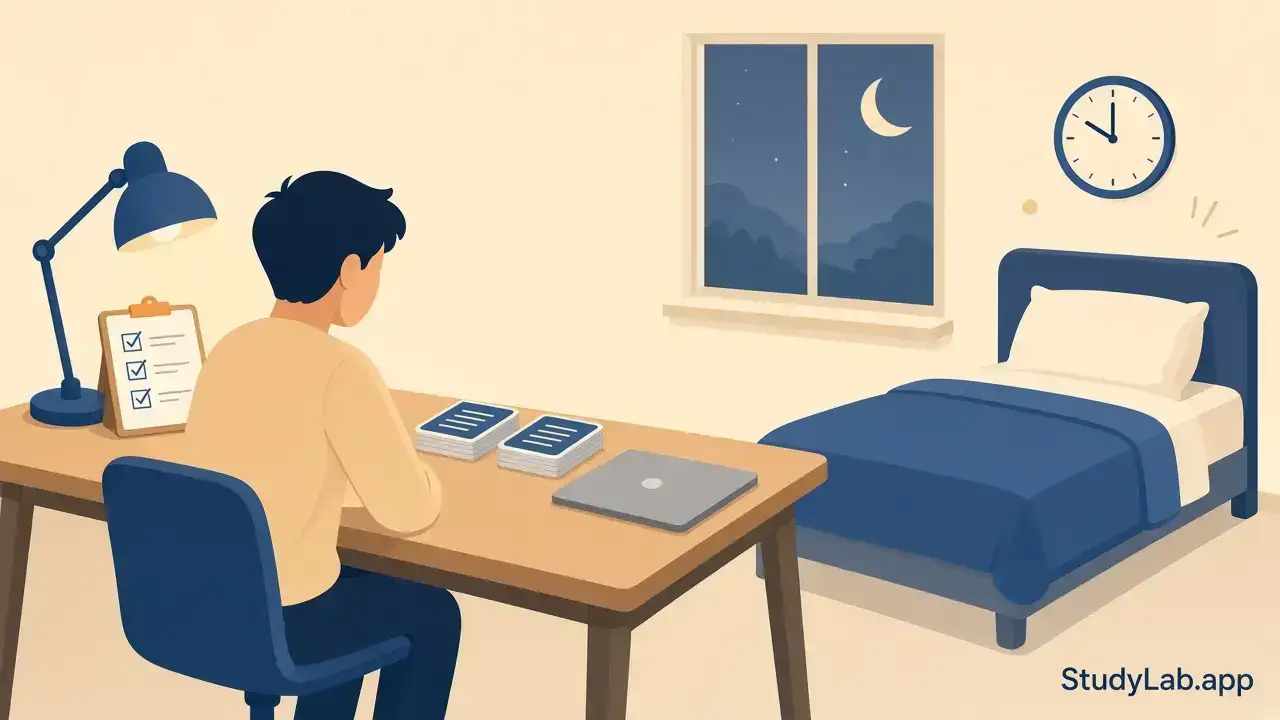
It's 7 pm. The midterm is at 9 tomorrow morning. You open the slides and there are 140 of them, and you're pretty sure you've seen maybe a third.
So you're going to cram. Fine. This post won't tell you that you should have started two weeks ago (you know). It'll tell you how to cram for an exam in a way that gets the most points out of the hours you have left, using what memory research says about short-term performance.
Because cramming does work, for a while. That's why the all-nighter never dies. The problem is that most people cram in the least effective way possible, then pay for it twice.
Does cramming actually work?
For tomorrow, yes. For next week, much less.
The clearest evidence comes from a 2006 study in Psychological Science by Henry Roediger and Jeffrey Karpicke. Students learned a prose passage in one of three ways. One group read it four times. Another read it once and then tried to recall it from memory three times, with no feedback. A third group did a mix.
Five minutes later, the readers won. They recalled 83% of the ideas, against 71% for the recall group. That's the cramming experience. Rereading feels like it's working because, right now, it is.
One week later the picture flipped. The readers had dropped to 40%. The recall group held 61%. And the readers had gone through the passage about 14 times on average, against roughly 3 for the recall group. Way more effort, way less memory a week later. The readers were also the most confident they'd remember it.
Your cram session can get you through tomorrow. And the way most students cram (rereading slides until they feel familiar) is the version that falls apart fastest. If your final is cumulative, that matters.
Why rereading is the worst way to cram
Rereading builds familiarity, and familiarity feels like knowing. You look at a slide on the citric acid cycle, it seems obvious, you move on. But the exam doesn't show you the slide. It asks you to produce the answer from nothing.
That gap has a name, the illusion of competence, and cramming makes it worse because you're tired and short on time and desperate for the feeling of progress.
There's a second trap. Most students cram one topic at a time. Finish chapter 3, never look at it again, start chapter 4. A 2009 study by Nate Kornell in Applied Cognitive Psychology tested this with flashcards. Studying one big stack, so each card came back after a longer gap, beat studying four small stacks one after another. Spacing won for 90% of participants. But after the first session, 72% of them believed the massed version had worked better. Your gut is a bad judge here.
How to cram for an exam tonight: the plan
Do these in order. They assume you have somewhere between 3 and 6 hours tonight plus a little time tomorrow morning.
1. Triage first (20 minutes)
Don't open the slides yet. Find whatever tells you what's on the exam. That's the study guide, the past paper, the learning objectives, the topics your professor said "this will be on the exam" about. Make a list of topics.
Next to each one, write two things. How many points it's probably worth, and how well you know it (a quick 1 to 3). High points plus low knowledge goes first. Low points plus already-solid goes last, or nowhere.
You won't cover everything. Triage means deciding what you're giving up on purpose instead of by accident at 2 am.
2. Test before you read
For your top topic, try the practice questions or blurt what you know onto a blank page before reviewing anything. Two minutes, closed book.
Then open the material and read only what you missed or got wrong. This flips cramming from "read everything and hope" to "find the gaps and fill them." It's also much faster, because you skip the parts you already know.
No practice questions? Turn each slide heading into a question ("What are the three stages of mitosis and what happens in each?") and answer it before reading the slide.
3. Recall, check, repeat the misses
After reading a section, close it and recall it again. Say it out loud, write it, draw the diagram. Check. Anything you missed goes on a "misses" list.
This is the testing effect doing the work, and it's the single biggest change you can make tonight. Every minute spent pulling an answer out of your head is worth more than a minute spent looking at it.
If writing questions eats too much of your time, you can export your lecture slides as a PDF and upload them to StudyLab for a practice quiz, so the time goes to answering.
4. Rotate topics so each comes back
Even in one evening you can space a little. Work through topic A, then B, then C, then come back to A and quiz yourself again before moving on. Each topic should come back at least twice, with other stuff in between.
It'll feel worse than finishing one topic properly. That's the Kornell result again. The struggle of coming back after a gap is what makes it stick, which is the whole idea behind spaced repetition, compressed into one night.
5. Stop and sleep
A 2007 study in Nature Neuroscience from Matthew Walker's lab found that a single night without sleep cut activity in the hippocampus (the brain area that files new memories) when people tried to learn new material, and they remembered less of it later. So the stuff you "learn" at 4 am after being up all night goes in badly.
Sleep also helps the material you studied before it. In a 2016 study in Psychological Science, Stéphanie Mazza's team had people learn French-Swahili word pairs, then relearn them 12 hours later. The group that slept in between needed about 3 rounds to relearn all 16 words. The group that stayed awake needed about 6.
So set a hard stop. Five or six hours of sleep beats an all-nighter. If you're worried you won't sleep, this post on exam-night insomnia covers what a bad night really does to your score (less than you fear).
6. Morning: misses only
Give yourself 20 to 30 minutes before the exam. Go through your misses list and quiz yourself on it. No new material, no rereading the whole deck. You're topping up the shaky stuff, not starting over.
The cost you pay a week later
Cramming is borrowing. You get the grade tomorrow and lose most of the material soon after. The Roediger and Karpicke numbers show how steep that drop is for rereading, and the forgetting curve shows it's normal for anything you only saw once.
That matters if the final is cumulative or the next course builds on this one. So after the exam, put two short review sessions in your calendar, one about three days out and one a week or two later. Fifteen minutes each, using your misses list. That turns tonight's cram into something you'll still have in December.
Common cramming mistakes
- Making notes instead of testing. Rewriting slides into pretty notes feels productive. It's mostly copying.
- Going topic by topic, once. Finish-and-forget is the massed pattern. Rotate.
- The all-nighter. See step 5. You trade memory formation for hours that don't count much.
- Ten more hours tomorrow. If you have the day too, 16-hour marathons don't work either. Shorter blocks with breaks beat sitting there.
FAQ
Is it better to cram or sleep the night before an exam?
Sleep, at least five or six hours. Sleep deprivation hurts your ability to form new memories, and sleep between study and review makes relearning faster. Cram in the evening, sleep, then do a short review in the morning.
How long before an exam should you stop cramming?
Stop new material the night before, early enough to get real sleep. The morning of the exam is for a quick self-quiz on your weak spots only. Learning new topics in the last hour mostly adds anxiety.
Can you cram for a math or physics exam?
Partly. You can't cram understanding, but you can cram problem types. Do practice problems without looking at the solution first, check, and redo the ones you got wrong. Reading worked examples is the math version of rereading.
Does cramming affect long-term memory?
Yes. Material crammed by rereading fades fast. In the Roediger and Karpicke study, recall fell from 83% to 40% in a week. Crammed material you tested yourself on holds up much better, and two short reviews after the exam help it stick.
Before you open the slides
This plan won't be as good as two weeks of spaced studying. But it'll be a lot better than 140 slides and a can of energy drink at 3 am.
If you want the practice questions ready before you start, save your slides as a PDF and drop them into StudyLab before you start step 2.