Studymaxxing Is Trending. Here Is What 16-Hour Study Days Actually Do to Your Memory
StudyTok is full of 16-hour study timelapses. The science of spacing, fatigue and sleep says those marathon days produce far less learning than they appear to. Here is what the research shows, and what to do with a free day instead.
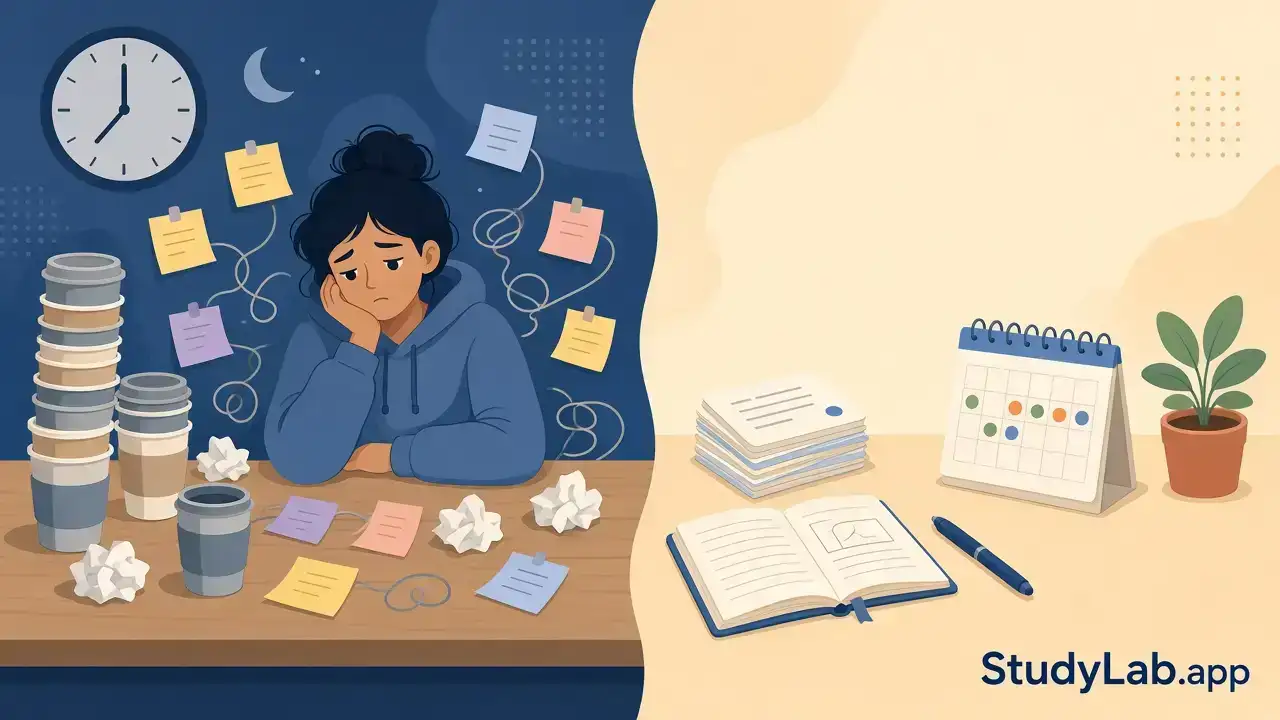
Open TikTok during exam season and you'll find them. Timelapse videos of someone at a desk from 6 am to 10 pm, coffee cups accumulating, captioned something like "studymaxxing until my exams are over." Sixteen hours compressed into thirty seconds, hundreds of thousands of likes.
And look, part of you watches that and feels behind. If they're doing 16-hour days and you're doing three, you must be losing, right?
Honestly, no. The memory research on this is old, deep and unusually clear. Those marathon days produce far less learning per hour than shorter spaced sessions, and past a point they produce almost nothing at all. The timelapse looks like discipline. A lot of it is just sitting.
What studymaxxing actually is
Studymaxxing is the current name for an old idea, that the way to ace your exams is to maximize raw hours at the desk. The videos share a formula. One person, one desk, a timer overlay, an entire day compressed into seconds. The hours themselves are the achievement being displayed.
To be fair, the trend gets a couple of things right. Studying is more appealing when it feels like an identity, and the people filming themselves at least show up. Showing up matters.
But the format has a built-in lie. A timelapse shows time passing, not learning happening. You can't see whether hour eleven added anything that hour three hadn't already covered. The research says it mostly didn't.
What the science says about marathon days
Massed hours are the weakest hours
The best-studied finding in all of learning science is the spacing effect. In 2006, researchers led by Nicholas Cepeda pulled together 317 experiments on distributed practice covering more than 14,000 participants. The pattern held across almost all of them. Given the same total study time, material reviewed across multiple separated sessions is remembered far better than material crammed into one continuous block.
Read that again, because it's the whole argument. Same hours, split across days, more remembered. The 16-hour day isn't impressive to your memory. It's the layout your memory handles worst.
Repetition past "got it" pays almost nothing
Within a marathon day, you reread the same chapters and redo the same examples, because what else fills 16 hours? That's overlearning, and the research on it shows the gains from continuing to hammer already-learned material within a single session fade fast. The productive version is stopping once you can recall something, then returning days later, which is successive relearning and needs a calendar, not a heroic Tuesday.
Attention doesn't survive the day
Sustained attention degrades over a long session, which is why breaks aren't a luxury. By the evening of a marathon day you're rereading paragraphs and calling it studying. The timelapse can't show the difference between focused reading at 9 am and glazed scrolling of a PDF at 9 pm. Your memory can.
The hours have to come from somewhere
A 16-hour desk day eats sleep, and sleep is where memories consolidate. Trading sleep for study hours is one of the worst trades in academics. A shorter day followed by a full night beats a longer day that ends at 2 am, on the material you studied that very day.
Why the videos still get made
Because the format rewards what's filmable. Retrieval practice looks like nothing on camera. Someone staring at a blank page trying to remember the Krebs cycle is terrible content. Fourteen hours of aesthetic desk shots is great content.
There's a selection effect too. You see the person who filmed the 16-hour day. You don't see their exam result, and you don't see the classmate who studied 90 focused minutes daily for three weeks and outscored them. Performative studying optimizes for the audience. Learning optimizes for the test. They're different sports.
Worth saying plainly. Some students posting these videos are also spacing their subjects and testing themselves across those hours, and for them a long day near finals is fine. The problem isn't ever having a big study day. The problem is copying the hours while skipping everything that makes hours count.
What to do with a free Saturday instead
Say you genuinely have a whole day and exams coming. Here's the version the research supports:
- Cap the real work at 5 to 6 focused hours. Three blocks of roughly 90 to 120 minutes, spread across morning, afternoon and early evening, with genuine breaks between. That's a huge day, and unlike hour thirteen, these hours all count.
- Rotate subjects between blocks. Biology in the morning, stats after lunch, essay planning in the evening. Coming back to material after a gap is spacing working for you inside a single day.
- Make retrieval the default activity. Closed-book recall, practice problems, explaining topics out loud. Testing yourself beats rereading in study after study. If writing practice questions feels like its own chore, upload your notes to StudyLab and let it generate quizzes, so your blocks are spent answering, not preparing to answer.
- End the day by scheduling the returns. Ten minutes. Put the next pass over today's weak spots two or three days out. That step converts one good Saturday into an actual spaced schedule.
- Sleep normally. It's part of the studying, not the reward for it.
Do that and you'll finish by dinner having learned more than the timelapse person, with nothing worth filming.
FAQ
Is studymaxxing completely useless?
The showing-up part is genuinely useful, and some long days near exams are unavoidable. What the research rejects is the core premise, that more consecutive hours means more learning. Past several focused hours in a day, retention per hour drops steeply.
How many hours a day can I study effectively?
There's no exact universal number, and be suspicious of anyone quoting one. The consistent finding is that several focused, well-broken-up hours daily across many days beats occasional marathons of double the length. Most students do their best work in 3 to 6 real hours.
Does watching study-with-me videos count as studymaxxing?
No, and used differently they can help. Playing one in real time as background accountability is body doubling, which works through social presence rather than hour-count worship. Watching timelapses for motivation is fine too. Copying the 16-hour schedule is the part to skip.
What should I do if my exam is in three days and I'm behind?
Space what you can. Three days of two sessions each beats one 15-hour panic day, even now. Spend the sessions on retrieval, prioritize the topics most likely to be tested, and protect your sleep, especially the night before.
The boring truth
Studymaxxing sells the image of learning, and images are what the format is for. Your memory doesn't watch TikTok. It responds to spacing, retrieval, breaks and sleep, and it's completely indifferent to how impressive your desk setup looked at hour fourteen.
So skip the marathon. Pick your subjects, run a few real blocks today, quiz yourself instead of rereading, and book the follow-ups. If you want the quizzes ready before your first block, StudyLab can build them from your study materials in seconds.