The Protégé Effect: How Teaching Others (Even Imaginary Students) Makes You Learn Faster
When you study to teach instead of to pass a test, your brain does the work differently. The protégé effect is the reason, and you do not actually need a student to use it.
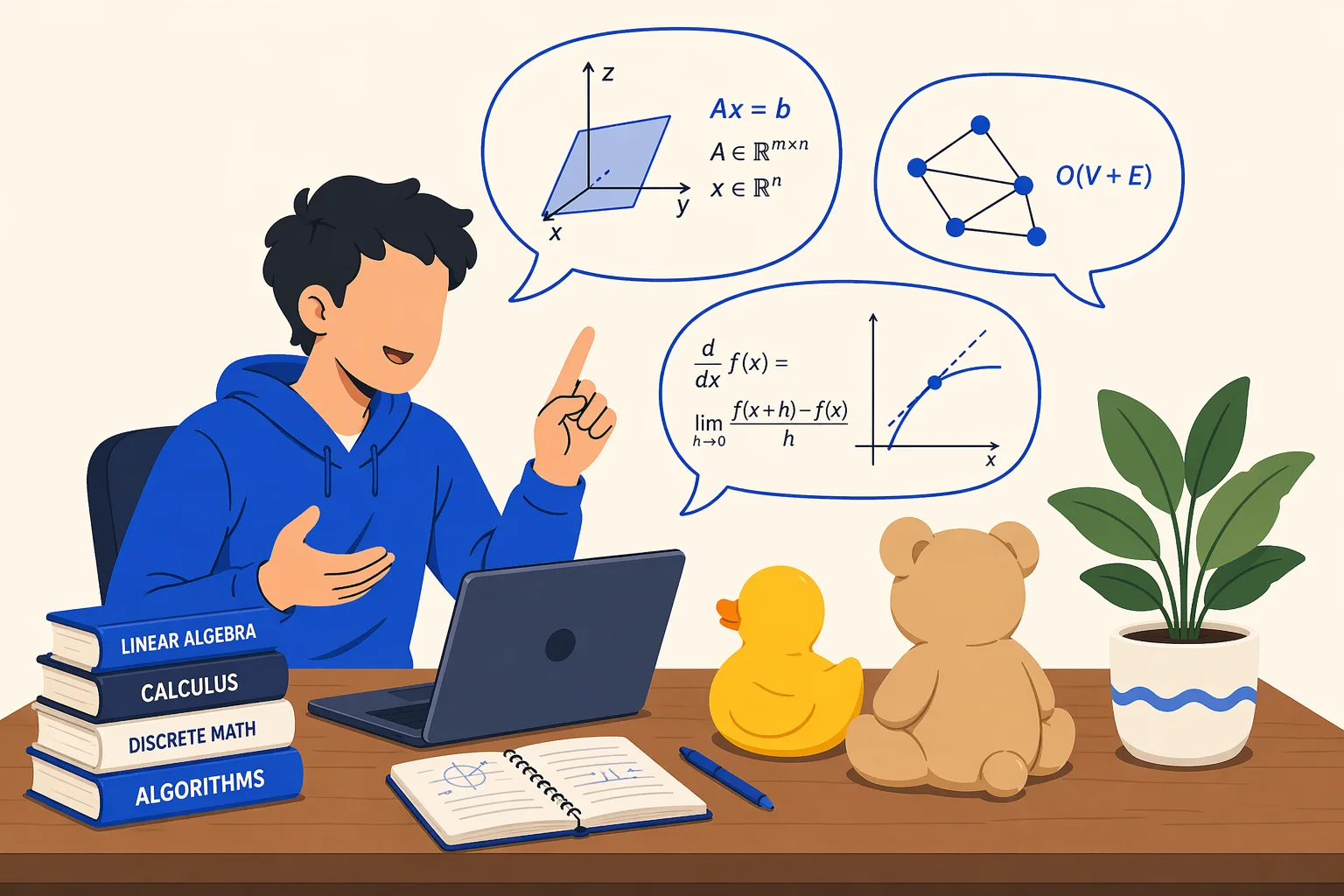
You've probably had this weird moment. You try to explain something you "totally understand" to a friend, and halfway through, you realize you don't actually get it at all.
That sinking feeling? It's one of the most useful study discoveries in decades.
Psychologists call it the protégé effect. When you prepare to teach something, your brain studies differently. You pay closer attention. You hunt for key points. You organize ideas. You notice gaps. And the weird part? You don't even need a real student for it to work.
What is the Protégé Effect?
The protégé effect is a learning phenomenon where you understand and remember material better when you study with the goal of teaching it to someone else, compared to studying just to take a test.
The term was popularized by a 2009 study from researchers at Vanderbilt and Stanford. Catherine Chase and her colleagues built a computer program where students "taught" a virtual character named Betty, who would then take a quiz based on what they taught her. The students who taught Betty worked harder, spent more time studying, and scored higher than students who learned the same material for themselves.
The idea itself goes back much further. In 1980, psychologists John Bargh and Yaacov Schul published a paper called "On the cognitive benefits of teaching" in the Journal of Educational Psychology. They found that students who studied with the expectation of later teaching a peer scored higher on retention tests than students who studied with the expectation of being tested. Same material. Same study time. Totally different results.
A 2014 study by John Nestojko and colleagues at Washington University pushed this further. They had students read passages, telling one group they'd be tested afterward and another group they'd later teach the material. In reality, everyone got tested and nobody taught anything. The students who thought they'd teach produced more complete recall, better organized their answers, and remembered more of the main points than the students who thought they'd just be tested.
That's the wild part. The teaching never actually has to happen. The mindset alone changes how your brain processes the material.
Why Does Teaching (or Planning to) Help You Learn?
A few things shift when you study with a teaching goal in mind.
You search for structure. When you study to be tested, you tend to focus on what might show up on the exam. When you study to teach, you have to build the concept from the ground up for someone who knows nothing. That forces you to find the big picture, not just memorize the details. Nestojko's team found that the teach-expecting group organized their recall more coherently, which is exactly what teachers do naturally.
You find your gaps faster. Explaining something out loud reveals the spots where your understanding is fuzzy. You can read a textbook chapter three times and feel like you know it. Try to teach that chapter to someone, and within two minutes you'll hit a sentence where your words dry up. Those dry spots are your real study targets. This overlaps heavily with metacognition, which is the skill of knowing what you actually know.
You spend more time and effort. In Chase's 2009 Betty study, students who taught the virtual character voluntarily spent more time on the material than students who studied the same content for their own benefit. The social pressure of "someone is depending on me" kicks in even when that someone is software.
You use retrieval naturally. To teach, you have to pull information out of your head without notes in front of you. That pull is active recall, which is one of the most studied learning techniques in cognitive science. The protégé effect tricks your brain into doing active recall without you planning for it.
Protégé Effect vs. Feynman Technique: What's the Difference?
Students mix these up constantly, and they're genuinely similar, but they're not the same thing.
The Feynman Technique is a specific 4-step method: pick a concept, explain it in simple language, find the gaps, and refine. It's a conscious tool you pick up when you want to test your understanding.
The protégé effect is broader and often unconscious. It's the underlying cognitive shift that happens the moment you believe you'll need to teach something. The Feynman Technique is one way to trigger the protégé effect on purpose. But you can get the effect from any teaching-oriented activity, even just walking around your room explaining quantum mechanics to a houseplant.
Think of it like this: Feynman is the workout. The protégé effect is what's happening in your muscles while you do it.
How to Use the Protégé Effect When You Have No One to Teach
Most students don't have a study buddy sitting around waiting to be taught organic chemistry. Good news: the research is clear that imaginary or fictitious audiences work too. Fiorella and Mayer's 2013 study found that students who recorded explanations for a fictitious future student still got meaningful learning benefits.
Here are five ways to trigger the effect solo.
1. The rubber duck method
Programmers have been doing this for decades. Grab any object, your bedroom plant, a stuffed animal, a literal rubber duck, and explain the concept to it out loud. Simple rule: if you use a word your "student" wouldn't understand, you have to define that word too. You'll hit a wall somewhere in the first 90 seconds. That's your real study gap.
2. Record a Loom or voice memo
Open your phone, hit record, and deliver a 3-5 minute lecture on today's topic as if you were a YouTube tutorial. Don't rewatch it if you don't want to. The act of recording it is most of the benefit, because your brain treats an imaginary audience as a real one. Bonus: if you do rewatch it, you'll instantly hear the parts where you hedged or got vague.
3. Write a "for a 12-year-old" explanation
Grab a blank page and explain the topic as if you were writing a blog post for a smart 12-year-old. No jargon. No "as we discussed." Assume zero background. This forces the same structure-building your brain would do if you were preparing a real lesson.
4. Turn the material into quiz questions
Writing good quiz questions requires you to decide what the most important points are, which is exactly the cognitive work teachers do. Bargh and Schul's original 1980 paper highlighted this "select and organize" process as one of the main drivers of the effect. Once you've written the questions, answer them a day later without the notes. That's two powerful techniques in one session. See the testing effect for the retrieval side of this.
5. Use the "why" prompt before each chunk
Before you start a new section of material, ask yourself: "How would I explain why this matters to someone who's never heard of it?" Answer out loud. You'll find you process the section more deeply because you've already committed to having a teacher's perspective on it. This pairs well with elaborative interrogation, which is the science of asking why during study.
When the Protégé Effect Doesn't Work
A few honest caveats from the research.
Fiorella and Mayer's 2013 study found that just preparing to teach wasn't enough for long-term retention. Students who prepared to teach but never actually did it scored better on an immediate test, but the advantage faded after a week. The big gains came when students actually taught the material, even to a camera or a fictitious audience.
Translation: don't just think about teaching. Actually do the explanation out loud or in writing. The research is clear that the active explanation step is what locks it in.
Also, the effect works best when you already have a baseline understanding of the material. Trying to "teach" a topic you haven't studied at all just reinforces misconceptions. Study first, teach second.
How to Start Today
Pick one topic you're studying this week. Here's a 15-minute version of the technique you can run tonight.
Read through the material once. Close the book. Then grab your phone, hit voice memo, and deliver a 5-minute explanation of the topic as if you were teaching a curious friend who has no background in it. When you hit a spot where you fumble or say "uh, I think it works like…", pause. Write that concept down on a separate page. Those fumbles are exactly what you need to review next.
Do this once per study session and you've built the protégé effect into your routine.
Frequently Asked Questions
Does the protégé effect work if I teach a pet or a stuffed animal?
Yes, and this is one of the most surprising findings in the literature. Chase's 2009 study used a computer character named Betty, not a real person, and students still showed significant learning gains. The brain responds to the expectation of teaching, not the specific student. A rubber duck or your cat works fine.
Is the protégé effect the same as the Feynman Technique?
Not exactly. The Feynman Technique is a specific 4-step method you apply on purpose. The protégé effect is the broader cognitive shift that happens when you study with teaching in mind. Feynman is one way to trigger the protégé effect, but you can also trigger it by recording a voice memo, writing a beginner-friendly explanation, or even just telling yourself "I'll need to teach this" before you start studying.
How long does it take to see results?
Most studies show immediate benefits on same-day tests. Long-term benefits (one week or more) appear mainly when you actually deliver the explanation, not just plan to. Even one 5-minute "teach it to someone" session per topic can noticeably improve your recall by the next day.
Can I combine the protégé effect with flashcards?
Yes, and it's a strong pairing. Use flashcards for retrieval practice, then once a week pick the trickiest cards and record yourself "teaching" those concepts. The flashcards handle spaced repetition, the teaching handles organization and depth.
Does it work for math and problem-solving subjects?
Yes, especially when you walk through your problem-solving steps out loud. Instead of just solving a calculus problem, solve it while narrating every move as if teaching a classmate. Studies on math learning show the same teaching-expectancy benefit, with the extra bonus that verbalizing the steps forces you to make your reasoning explicit rather than intuitive.
The Bottom Line
You don't learn by reading. You don't learn by highlighting. You don't even learn much by just taking notes. You learn by doing something with the material that forces your brain to structure it, question it, and pull it back out.
Teaching does all three at once, even if your student is a rubber duck.
Ready to try it tonight? Pick one chapter, record a 5-minute voice memo "teaching" that chapter to a friend who knows nothing about it, and notice where you trip up. If you'd rather skip making the quiz questions yourself, upload your notes to StudyLab and the AI will generate a quiz from your material, so you can test whether your teaching session actually stuck.