Should You Skip Lectures and Watch the Recording? (And Is 2x Speed OK?)
The recording goes up by lunch, so why drag yourself to a 9 am lecture? Here is what the research says about skipping lectures, whether recordings make up for it, whether 2x speed hurts, and how to use recordings without ending up with a backlog of 14 videos.
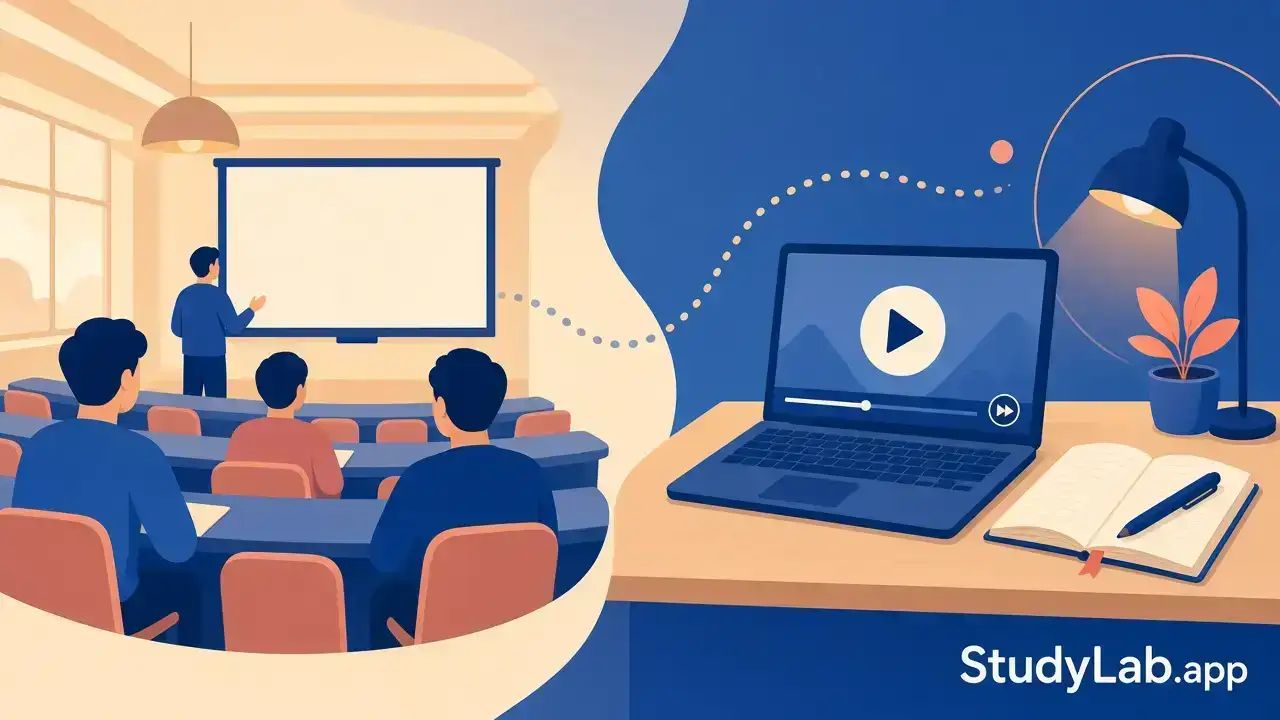
It's 8:40 am, it's raining, and the lecture will be online by lunch. You'll watch it later at 2x speed. Honestly, that sounds efficient.
Then it's week 7 and there are 14 unwatched recordings sitting in a tab you're scared to open. A student on r/Students summed it up recently. Recording every lecture "sounded smart at the time."
So should you skip lectures and watch the recordings instead? The research gives a fairly clear answer. Recordings are a great backup and a weak replacement. And watching at 2x speed is mostly fine, with a couple of catches.
Does skipping lectures actually hurt your grades?
On average, yes, and by more than most students expect.
In 2010, Marcus Credé and colleagues pooled 69 studies covering more than 21,000 college students in a meta-analysis published in the Review of Educational Research. They found class attendance was a better predictor of college grades than SAT scores, high school GPA, study habits or study skills.
The obvious objection is that good students just turn up more. The authors checked that. Attendance was only weakly related to traits like conscientiousness and motivation, and it explained a chunk of grades that SAT scores and high school GPA didn't. It's still a correlation, so it doesn't prove going to lectures causes better grades. But "only lazy students skip, so it doesn't matter" isn't what the data shows either.
Can lecture recordings replace going to class?
Recordings are supposed to fix that.
Researchers at King's College London looked at a compulsory second-year research methods module before and after lecture recordings were introduced, comparing two matched cohorts of about 160 students each. Once recordings were available, attendance dropped. According to Times Higher Education's report on the study, the number of students who didn't attend any lectures doubled.
And the recordings didn't make up for it. In the published paper by Martin Edwards and Michael Clinton, attendance predicted higher grades, while watching recordings showed no significant link with grades once attendance was taken into account. Watching the videos also failed to make up for the effect of low attendance. The net effect of introducing recordings on that cohort was negative.
A 2017 study by Nordmann and colleagues, which followed students across four years of an undergraduate degree, adds some nuance. In first year, attending and using recordings both predicted better results, and weaker students benefited from using recordings on top of going. But only stronger students managed to use recordings to make up for low attendance. By second year, neither one predicted grades anymore, and in the final year there was no relationship at all. The researchers found no good evidence that recordings themselves hurt anyone.
Put together, recordings work well as a supplement, especially in first year. As a replacement they mostly don't, unless you're already doing well.
Is it bad to watch lectures at 2x speed?
Mostly not, up to 2x.
In a 2021 UCLA study published in Applied Cognitive Psychology, Dillon Murphy and colleagues had 231 students watch lecture videos at different speeds and tested them right away and a week later. Going from 1x to 1.5x or 2x cost very little. Beyond 2x, performance dropped, and 2.5x was noticeably worse.
Watching a video twice at 2x wasn't better than watching it once at 1x. But rewatching at 2x right before the test, instead of watching once at 1x a week earlier, did improve scores. So the time you save is most valuable when you spend it close to the exam.
A 2023 study in Medical Teacher found something similar with 60 medical students. The 2x group didn't do significantly worse than the 1x group, either straight after or a week later, though they did score a little lower on both tests.
The catches. In the UCLA study, students couldn't pause or take notes, and the videos were on fairly general topics (real estate appraisal and the Roman Empire). Dense material like organic chemistry mechanisms or proofs might not hold up as well at double speed.
When is it OK to skip a lecture?
Here's a reasonable way to decide, based on the research above.
Go in person when:
- You're in first year, when attendance mattered most in the Nordmann study
- Attendance, participation or in-class quizzes count toward your grade
- The lecturer works through problems or says things that aren't on the slides
- The module is cumulative, so missing week 4 breaks week 5
Skipping is easier to justify when:
- You're later in your degree and already doing well
- The recording and slides really do cover everything
- You have a specific slot to watch it within a day or two, and you actually use it
That last condition is where most skipping goes wrong. The plan to "watch it later" is fine. The 14-video backlog is the problem.
How to use lecture recordings without falling behind
1. Watch it within 48 hours
Put the recording in your calendar like a class, at a fixed time in the same week. A recording you haven't watched by the next lecture is a backlog item, and backlogs grow faster than you clear them.
2. Use 1.5x to 2x, and slow down for the hard parts
Speed up through the intro, the admin and the parts you already get. Drop to 1x or pause when the lecturer works through something new. Never go above 2x.
3. Take notes by pausing, not transcribing
Copying every word at 2x is impossible, so don't try. Pause after each section and write the main idea in your own words. The Cornell method works well for this, and there's a case for writing those notes by hand.
4. Test yourself straight after
Close the video and write down the three most important things from that lecture without looking. Then check. That small quiz does more for your memory than a second watch, which is the testing effect at work.
5. Spend the saved time on practice
If 2x saves you 25 minutes, put those 25 minutes into problems, flashcards or past papers. If you're working from the slides afterwards, our guide on how to study from lecture slides covers turning them into something you can test yourself on.
FAQ
Is it bad to skip lectures in college?
On average, students who attend more get better grades. A 2010 meta-analysis found attendance predicted college grades better than SAT scores or high school GPA. Skipping the odd lecture isn't a disaster, but skipping as a habit usually costs you.
Does watching lectures at 2x speed affect learning?
Not much, up to 2x. A 2021 UCLA study found minimal costs at 1.5x and 2x, but performance dropped beyond 2x. Slow down for dense or unfamiliar material.
Are recorded lectures as good as live lectures?
As a replacement, usually not. In the King's College London study, watching recordings didn't make up for missed lectures. As a supplement for reviewing hard parts, they're useful, especially in first year.
What should I do if I don't learn anything from lectures?
Change how you use the lecture before you drop it. Skim the slides beforehand so you know what's coming, take notes in your own words, and quiz yourself afterwards. If it still adds nothing beyond the slides, use the recording at a fixed time instead and test yourself after.
Before your next lecture
Look at this week's timetable and pick one lecture you've been planning to skip. Either go, or put the recording in your calendar for a specific time within 48 hours. Then write down three things from it without looking.
If your lecturer posts the slides as a PDF, StudyLab can turn them into a short quiz, so you can test yourself straight after watching instead of just moving on to the next video.