The 3-2-1 Study Method: Which Version Actually Works?
Four different study methods share the name 3-2-1, and they do not agree with each other. One comes from 2004 education research, one is a focus trick, and the most viral version opens with the weakest study step there is.
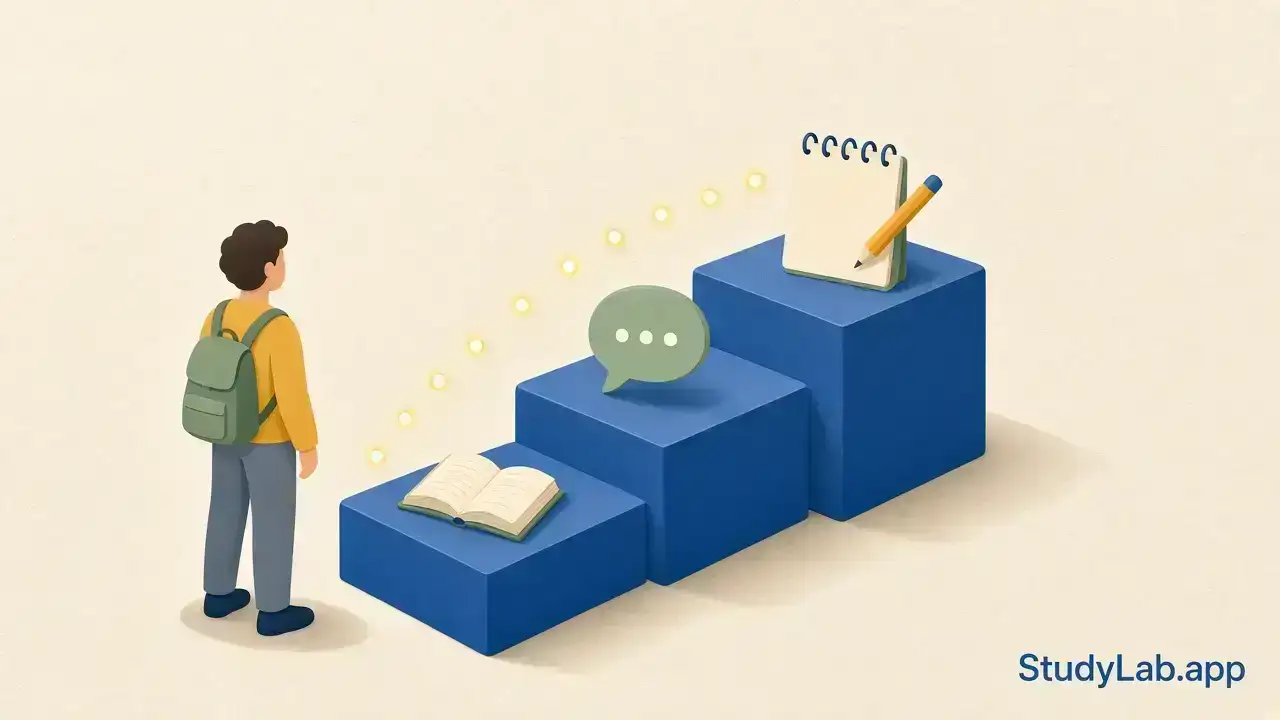
You looked up the 3-2-1 study method and got four different answers. One video says read your notes three times, explain the topic out loud for two minutes, then write for one minute. The next says jot down three things you learned, two connections, one question. A third tells you to move for three minutes, breathe for two, and set one small goal. A fourth is just counting backwards from three so you finally start.
They cannot all be the same technique. They are not.
One of them has been sitting in education research since 2004. One is a decent way to get unstuck when your brain is fried, and has nothing to do with memory. And the version doing the rounds on StudyTok right now opens with the single weakest thing you can do with a set of notes. Below is each one, what the evidence says, and the rebuilt version I would actually hand you before a midterm.
Why there are four different 3-2-1 study methods
The name is a container, not a technique. Three descending numbers are easy to remember and easy to attach to almost anything, so four unrelated ideas ended up wearing the same label.
The oldest one is genuine classroom research. In 2004, reading researchers Vicky Zygouris-Coe, MaryEllen Wiggins and Lourdes Smith published a strategy called 3-2-1 in the journal The Reading Teacher. Students finish a text by writing three things they learned, two things they found interesting, and one question they still have. It was built to get students engaging with a reading, not to get them through finals.
The version trending now has no traceable author at all. The article most people land on is by Katie Azevedo at SchoolHabits, and she does not claim to have invented it or cite an original source. That is not a criticism of her. It matters because a method with no origin also has no evidence attached to it, and it gets repeated online as though it does.
The four versions, sorted
Version 1: read three times, speak twice, write once
The StudyTok favorite. Read a concept three times, say it from memory twice, write it from memory once. Two of those three steps do real work. The opening step is the problem, and it is also the step that eats most of your time.
Version 2: three things learned, two connections, one question
The 2004 original. It works well in the ten minutes after a lecture, when the goal is noticing what landed and what did not. As your only revision strategy it is thin, because writing three things you already remember never forces you to confront the material you have quietly forgotten.
Version 3: the 3-2-1 reset
Move for three minutes, breathe deeply for two, set one achievable goal. Judged as a study technique this is nothing. Judged as a way to restart a dead afternoon, it is reasonable. Just do not expect it to move anything into memory by itself.
Version 4: the 3-2-1 countdown
Count down from three and begin the task. It is a starting trick, not a learning one, and it targets a real problem. Getting going is the hardest part of most study sessions. But nothing about counting decides whether you remember the material an hour later.
Does the 3-2-1 study method actually work?
The two versions that claim to help you remember things both lean on one weak step, so that is the step worth checking.
In 2013 a team led by John Dunlosky reviewed ten popular study techniques for Psychological Science in the Public Interest and rated each on how well it held up. Rereading landed in the low utility group, alongside highlighting and summarizing. Practice testing and spreading study out over time were the two that earned a high rating.
The sharpest demonstration comes from a 2006 experiment by Henry Roediger and Jeffrey Karpicke, published in Psychological Science. Students studied prose passages under three schedules. One group read the passage four times. One read it three times and recalled it once. One read it once and recalled it three times.
Tested five minutes later, the repeat readers came out on top with 83 percent, against 71 percent for the recall group. Rereading looked like the winner.
One week later the order had completely reversed. The recall group held 61 percent. The repeat readers had dropped to 40 percent. Put another way, the rereading group forgot 52 percent of what they once had, and the retrieval group forgot 14 percent.
That gap is the whole problem with starting a method by reading something three times. Rereading really does work, for about a day. It also feels smoother every pass, which your brain reads as progress, and that feeling is the illusion of competence that sends people into exams confident and underprepared.
The 3-2-1 study method, rebuilt
Keep the shape. Flip the numbers.
The two good steps in the viral version are the speaking and the writing, and both are rationed to almost nothing while the weakest step gets the most repetitions. Reverse the ratio and you get something defensible.
1. One careful read. Read the section once, slowly, with the goal of understanding rather than memorizing. One pass is enough to get the structure in place. Anything past that is you rereading because it feels nice.
2. Two minutes explaining it out loud. Close the notes. Say the concept aloud as though a friend just asked you, in ordinary words, for two full minutes. Saying material aloud beats reading it silently, an effect named by Colin MacLeod and colleagues in 2010 and worth understanding properly before you skip this step. Where you stall is the real information. That is your gap, and it only shows up when the notes are shut. This step is the Feynman technique in miniature.
3. Three minutes writing from memory. Blank page, still no notes, write down everything you can about the concept. Then open your notes and mark in a different color every single thing you missed. This is blurting, and the marking is not optional. The gaps are the entire output of the exercise.
So the honest version counts up, not down. One read, two minutes speaking, three minutes writing. Effort rises as you go, and the two steps that produce retrieval get the time instead of the step that produces a warm feeling.
How to run it tonight
Pick one section of one subject. Not a chapter, not a module, one section that would take you ten minutes to read.
Set a timer for six minutes after your single read. Two minutes talking to the wall, three minutes writing on a blank page, one minute marking what you missed. That is one cycle, and it is short enough that you have no excuse tonight.
Then leave it. Come back to the same section in two or three days and run only steps two and three. Skipping the reread on the second pass is the point. If turning your marked gaps into questions feels like more admin than you have time for, StudyLab can generate practice questions straight from the PDF you are studying, so the testing part is waiting for you instead of being one more thing to build.
Common mistakes to avoid
Rereading until it feels smooth. Fluency is not memory. If the page feels easy, that is the exact moment to close it.
Explaining with your notes open. Your eyes will follow the page and you will narrate instead of recall. Nothing is being tested.
Writing a summary instead of a memory dump. A tidy summary copied from the structure in your head is a different task. Write badly and fast.
Running it once and calling it done. A single cycle beats a reread. Three cycles spread across a week beats three cycles tonight, which is the finding from that same Dunlosky review, and the reason spacing your retrieval practice matters more than any numbering scheme.
FAQ
Is the 3-2-1 study method backed by science?
Partly, and not in the way it is usually presented. No study has tested the read three times, speak twice, write once sequence as a package. The speaking and writing steps rest on well established research into retrieval practice and the production effect. The three reads at the front contradict it.
How long should a 3-2-1 study session take?
Around fifteen to twenty minutes per section using the rebuilt version, including the read. If a single cycle is taking you an hour, your section is too big. Shrink it until one cycle fits in twenty minutes.
Is the 3-2-1 method better than the Feynman technique?
The rebuilt version is close to a timed Feynman with a written pass bolted on. Feynman goes deeper on explanation and works better for concepts you need to truly understand. The 3-2-1 shape is faster and better suited to getting through a lot of material before a test.
Can I use the 3-2-1 method for maths or problem based subjects?
Change what step three means. Instead of writing what you remember, work a problem from a blank page with no worked example in front of you. Speaking still helps for the why behind a method, but the writing step has to be solving, not describing.
What is the difference between the 3-2-1 method and blurting?
Blurting is a single step, the memory dump onto a blank page. The rebuilt 3-2-1 wraps that dump in a read beforehand and a spoken explanation in between, which catches gaps earlier and gives you two different retrieval routes instead of one.
The short version
The viral 3-2-1 is a good technique with its numbers pointing the wrong way. The reading step got three repetitions and the retrieval steps got scraps, which is exactly backwards against what the retrieval research shows. One read, two minutes out loud, three minutes on a blank page. Same rhythm, same easy name, and a version that survives contact with the evidence.
Pick one section tonight and run a single cycle. If your marked gaps turn out to be bigger than you expected, that is the method working, not you failing.