The Pretesting Effect: Why Guessing Wrong Answers Before You Study Helps You Learn
Quizzing yourself before you study sounds backwards. But research shows that guessing answers you do not know yet, even wrong ones, makes the correct information stick better once you see it.
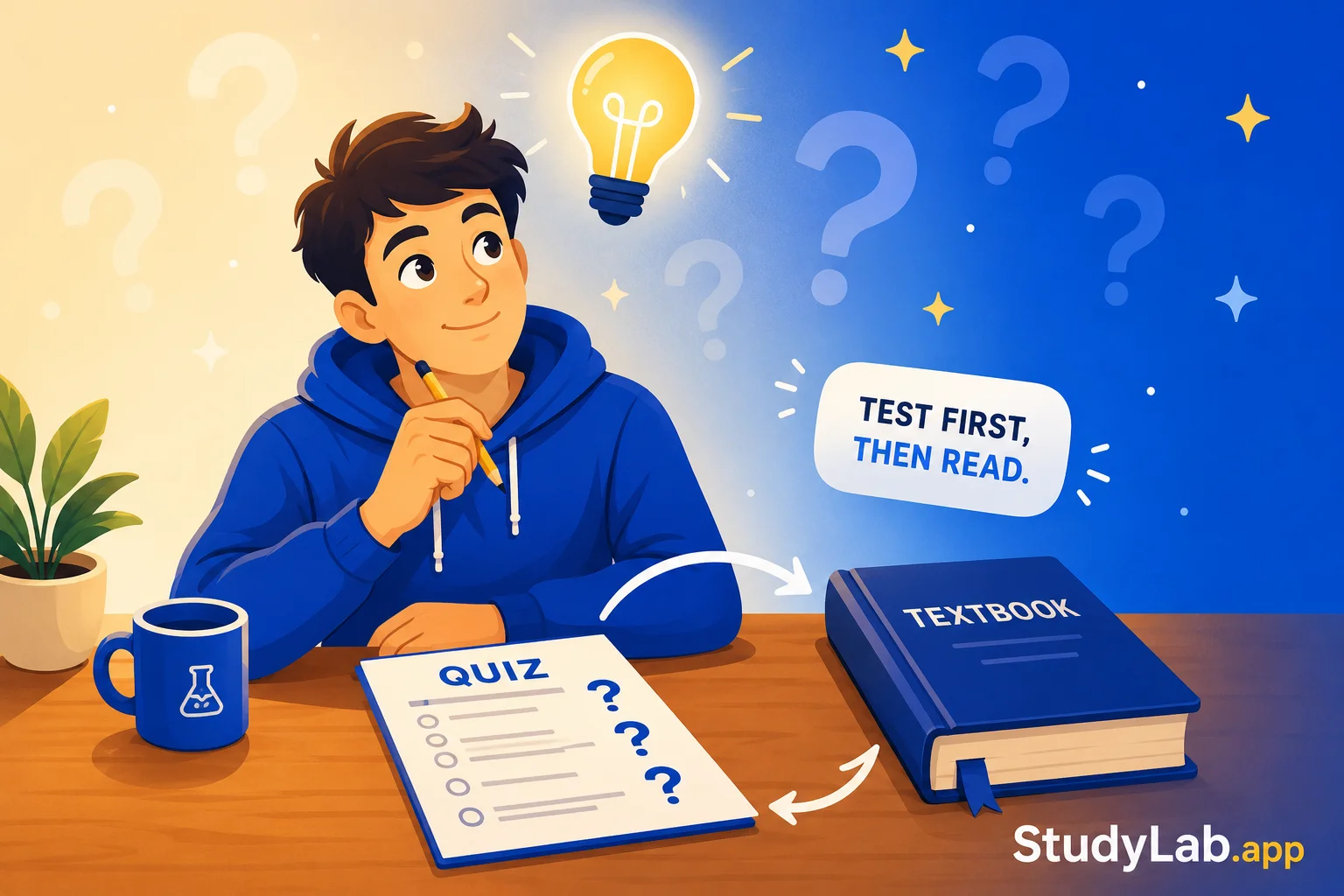
Imagine taking a quiz on a chapter you haven't read yet. You'd fail it. Badly. Every guess would feel like a shot in the dark, and you'd probably wonder why you're wasting your time.
Here's the weird part: that failed quiz would make you learn the chapter better.
This is the pretesting effect, and it's one of the most counterintuitive findings in learning science. Testing yourself before you study, when you're almost guaranteed to get things wrong, improves how well you remember the correct answers later. Your wrong guesses aren't wasted effort. They're priming your brain for what's coming.
Most students only quiz themselves after studying, if at all. That's still great. But the research says you're leaving learning on the table by not testing yourself before you even open the book.
What Is the Pretesting Effect?
The pretesting effect is the finding that attempting to answer questions about material before you've learned it improves your memory for that material, even when your attempts fail.
The modern research kicked off in 2009 with two landmark studies. In one, researchers Lindsey Richland, Nate Kornell, and Sean Kao had students read a science essay. Some students answered questions about key concepts before reading. Others got extra time to read instead. Across five experiments, the pretest group remembered more on the final test, even though their pretest answers were mostly wrong.
The second study, by Kornell, Hays, and Bjork, used word pairs. Some participants guessed the second word of a pair before seeing it. Others just read the complete pair. The guessers remembered more, despite guessing incorrectly almost every time.
Wrong answers helping you learn sounds like it shouldn't work. But it does, and researchers have replicated it with trivia facts, science texts, vocabulary, and video lectures. A 2026 study from the National University of Singapore found the same thing with language learning: 341 adults learning Spanish vocabulary remembered more words when they guessed the meaning before getting feedback, compared to passive study.
Why Do Wrong Guesses Help You Learn?
Three things happen when you attempt a question you can't answer yet.
First, your brain searches. Even a failed retrieval attempt activates everything you know that's related to the question. That mental groundwork gives the correct answer something to connect to when it arrives.
Second, you get curious. There's something almost annoying about not knowing an answer. That itch makes you pay closer attention when the real answer shows up. Researchers have found that pretest questions reduce mind wandering during lectures for exactly this reason.
Third, the gap gets exposed. Before the pretest, you might have assumed you understood the topic. After it, you know precisely what you don't know. That awareness changes how you read.
If this sounds familiar, it should. Pretesting is a close cousin of the generation effect, where information you produce yourself sticks better than information you passively receive. It's also a textbook example of a desirable difficulty: studying that feels harder but works better.
Pretesting vs. the Testing Effect: What's the Difference?
Students sometimes confuse pretesting with the testing effect, and the two are related but not the same.
The testing effect is about quizzing yourself after studying. You learn something, then retrieve it from memory, and the act of retrieval strengthens it. Pretesting flips the order. You quiz yourself before studying, fail, and the failure prepares your brain to encode the material better.
You don't have to pick one. They stack. Pretest to prime your brain, study the material, then use retrieval practice to lock it in. That sandwich turns one pass through a chapter into three learning events.
The Honest Caveats (Read These Before You Try It)
Pretesting isn't magic, and the research comes with real limits you should know about.
The biggest one: the benefit is specific, not general. A 2023 meta-analysis covering nearly 100 experimental comparisons found a moderate benefit for the exact material you were pretested on, but essentially zero benefit for surrounding material you weren't asked about. Pretesting on photosynthesis helps you learn photosynthesis. It won't help you learn the rest of the biology chapter.
Second, feedback is non-negotiable. The effect depends on seeing the correct answer soon after your guess. Guess and never check, and you've just practiced being wrong.
Third, it doesn't work every time. A 2018 study by Hausman and Rhodes found cases where pretesting failed to improve learning of concepts from reading passages. The effect is well supported overall, but it's strongest for factual material with clear right answers.
One more thing worth knowing. A 2025 study found the pretesting effect works across all adult age groups, but older learners believed making errors would hurt them and doubted the technique. The instinct that wrong answers damage learning is common. It's also wrong. If guessing badly makes you uncomfortable, that discomfort is not a sign the method is failing.
How to Use Pretesting in Your Studying
You can start tonight. Here's the workflow.
Before a lecture: Skim the slide titles or syllabus topic, then write down three questions you think the lecture will answer. Attempt answers. You'll be wrong. Go to the lecture anyway and notice how much harder those specific points grab your attention.
Before reading a chapter: Turn the section headings into questions and answer them before reading. "The Krebs Cycle" becomes "What does the Krebs cycle do, and where does it happen?" Write your best guess, even if it's just "something with energy?"
Before a practice test: This one's sneaky. Take a practice quiz cold, before your first study session on the topic, not just at the end. Your score will be rough. That's the point. Every question you miss becomes a hook for the material you're about to study.
If writing your own pretest questions feels like too much friction, tools like StudyLab can generate a quiz directly from your lecture PDF in seconds. Take the quiz before you read the document, check the answers, then read. You've just built a pretesting workflow with zero manual setup.
And remember the caveat about specificity. Pretest questions should cover the material you actually need to learn, not a random sample. The more your pretest overlaps with what matters, the more the effect pays off.
Common Mistakes to Avoid
Skipping the feedback step. A guess without a correction is just a guess. Always check answers before or during study.
Treating your pretest score as a verdict. A 20% on a pretest means nothing about your ability. It's a map of what to learn, not a grade.
Pretesting instead of studying. The pretest primes learning. It doesn't replace it. You still have to read the chapter.
Waiting too long between guess and answer. The research suggests the correction should come reasonably soon after the attempt, ideally in the same session.
FAQ
Does the pretesting effect work if all my answers are wrong?
Yes. That's the whole point. In the original studies, participants got most pretest questions wrong and still outperformed students who spent that time studying. The failed attempt itself does the work, as long as you see the correct answer afterwards.
Should I pretest before or after using flashcards?
Before. Pretesting works at the front of the learning process, when the material is still new. Once you've studied, regular retrieval practice with flashcards takes over. Together they cover both ends. Our active recall guide covers the after-studying side in depth.
How many pretest questions should I use?
There's no magic number, but a handful of questions targeting the core ideas of a chapter or lecture works well. Remember that the benefit is specific to what you're asked, so aim your questions at the material that matters most.
Isn't guessing wrong dangerous? Won't I remember my wrong answers?
This fear is common and understandable, but the research says no. As long as you get corrective feedback, wrong guesses don't stick. They actually help the right answer stick instead.
Does pretesting work for math and problem-solving subjects?
The strongest evidence covers factual and verbal material: definitions, vocabulary, science facts, reading passages. For problem-solving skills, attempting problems before instruction can still help, but the research there is more mixed. Start with fact-heavy subjects.
Start Backwards Tonight
Pick one chapter you need to read this week. Before you open it, write down five questions you think it will answer and take your best guess at each. Then read, check yourself, and notice how differently the material lands.
Ready to skip the setup? Upload your notes or textbook PDF to StudyLab and take the AI-generated quiz before you read. Your wrong answers will do more for your grade than another hour of highlighting ever could.