How to Study With AI Without Learning Less: What the Brain Research Says
AI can quietly do your thinking for you, and early brain research suggests that has a cost. Used the right way, the same tools become powerful study partners. Here are the rules that separate the two.
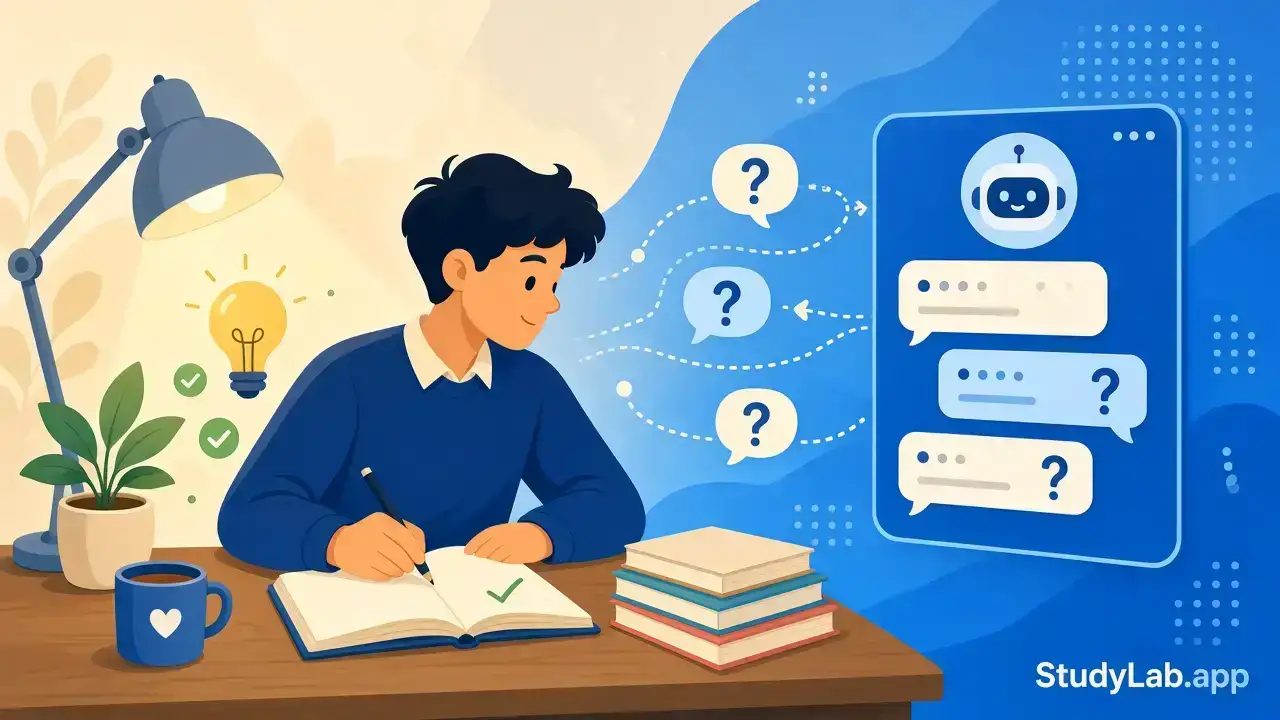
Be honest. At some point this semester you've pasted a homework question into ChatGPT, read the answer, nodded along, and moved on feeling like you studied. Almost everyone has. AI is now as much a part of student life as highlighters, and pretending otherwise is pointless.
Whether to use AI for studying is already settled. You will. What's still open is whether the way you use it leaves you knowing more or less than before. And that split is real. The same tool that can quiz you like a relentless tutor can also quietly do all your thinking for you while you watch.
The early brain research on this is genuinely interesting, a little alarming, and worth understanding before your next study sesh. Here's what it says, and the rules that keep AI on the right side of your learning.
The study everyone is talking about
In 2025, a team at the MIT Media Lab ran an experiment they titled "Your Brain on ChatGPT". They had 54 university students write essays in three groups. One group used ChatGPT, one used Google search, one used nothing but their own heads, all while wearing EEG caps measuring brain activity.
The ChatGPT group showed the weakest neural connectivity of the three, especially in networks tied to memory and engagement. They also struggled to quote from essays they had "written" minutes earlier, and reported the lowest sense of ownership over their work. The researchers called the pattern cognitive debt. The work got done, but the thinking that makes work stick never happened.
Now the honest fine print, because a study this viral deserves it. It's a preprint that hasn't finished peer review, 54 people is small, and writing essays isn't the same activity as studying for an exam. Treat it as an early warning sign, not a settled verdict.
But here's why it still deserves your attention. It fits a pattern psychologists already knew. Research on the Google effect showed years ago that when your brain knows information is a search away, it stops bothering to store it. AI turbocharges that deal. Google hands you sources to think about. ChatGPT hands you the finished thought.
The two modes, and why only one builds memory
Every AI study session runs in one of two modes, and everything below follows from the difference.
Answer machine mode. You ask, it answers, you read, you feel understanding happen. The problem is that decades of memory research show reading an explanation, even a brilliant one, is among the weakest ways to learn it. Recognition feels like knowledge. Exams test recall, and recall was never practiced.
Practice partner mode. The AI asks, you answer, then it corrects you. Now you're doing retrieval, and testing yourself is one of the most powerful study methods ever measured. Struggling to produce an answer before seeing it also triggers the generation effect, where self-made answers stick far better than read ones.
Same tool. Opposite direction of effort. In answer machine mode the AI does the retrieval and you do the reading. In practice partner mode you do the retrieval and the AI does the checking. Memory follows the effort, so the mode decides who learns.
Five rules for studying with AI
1. Answer first, ask second
Before you let AI explain anything, spend two minutes trying to answer from memory or work the problem yourself. Write your attempt down, even if it's half wrong. Then ask, and compare. Your errors become the most memorable part of the session, and the struggle primes your brain to hold the correction. Asking first skips the only part that was building memory.
2. Make it quiz you, not tell you
Flip the default direction. Paste in your lecture notes and prompt something like "Quiz me on this with one question at a time. Wait for my answer, tell me what I got wrong, and get harder as I improve." You've turned an answer machine into a practice partner in one prompt.
This is the single highest-value way to use AI for studying, and it's worth making frictionless. Purpose-built tools do it without the prompt engineering. Upload a PDF of your notes to StudyLab and it generates a full quiz from them, tracks which topics you keep missing, and lets you rerun your weak spots. The AI effort goes into making questions. The learning effort stays yours.
3. Explain it back and ask for holes
After studying a topic, type your explanation of it from memory and ask the AI to find what's wrong or missing. You get the benefits of explaining, which is the engine behind the Feynman technique and self-explanation, plus a critic that actually pushes back. "Poke holes in my explanation of osmosis" teaches you more than "explain osmosis" ever will.
4. Interrogate, don't accept
When you do want an explanation, stay in the driver's seat. Ask why each step follows, request a different example, ask what happens if a condition changes. And verify anything that will appear on an exam against your textbook or lecture notes, because AI still confidently invents details. An hour of interrogating one concept beats an hour of collecting ten smooth summaries you never questioned.
5. Let it build your materials, not your understanding
The best division of labor is AI on production, you on retrieval. Have it turn your notes into practice questions, flashcard pairs, summary tables to check your own summary against, or a study schedule for the next two weeks. That's the grunt work that used to eat whole evenings. What you don't outsource is the answering, the explaining and the struggling, because active recall only works when you're the one recalling.
The honest test of your AI habits
One question sorts every session. Who did the retrieval?
If you spent the hour reading AI output, the AI practiced and you spectated, and the MIT finding is probably your future. If you spent it answering, explaining and getting corrected, you used a better tutor than students five years ago could buy at any price.
There's also a timing rule worth stealing from the research. First contact with hard material is exactly when your brain benefits most from its own struggle. Wrestle with the lecture alone first, then bring in AI to test and patch you. AI last, not AI first.
FAQ
Does using ChatGPT actually make you learn less?
It can, in one specific pattern. The MIT study found weaker brain engagement and poor recall when AI wrote essays for participants, and offloading research points the same way. When AI quizzes you or critiques your answers instead, it's driving retrieval practice, which reliably improves learning. The mode matters more than the tool.
Is it cheating to study with AI?
Studying with it, no. Having it quiz you, explain a concept from your own notes, or critique your practice essay is study technique. Submitting its work as yours is cheating, and if a professor bans AI for an assignment, that's a hard no. When unsure, ask them directly.
What's the best AI prompt for studying?
Any prompt that makes you answer before you read. A reliable one is "Here are my notes. Quiz me with one question at a time, wait for my answer, correct me, and increase the difficulty as I go." Question-first beats explanation-first every time.
Should I stop using AI to explain things I don't understand?
No. A patient on-demand explainer is genuinely one of AI's best features. Just attempt the idea yourself first, interrogate the explanation with follow-up questions, and verify exam-relevant details against your course materials. Then test yourself on it later without the AI open.
The tutor or the spectator
AI isn't going to make your generation worse at learning. Passive habits will, and AI just makes passive feel productive. The fix costs nothing. Answer first. Make it quiz you. Explain things back. Keep the struggle, outsource the busywork.
Start tonight with one chapter. Upload your notes to StudyLab, take the quiz it builds, and see which questions catch you. That twenty minutes of being wrong and corrected will outlast every smooth explanation you read this week.