How to Study Anatomy When You Get 200 Slides a Week
Copying 200 anatomy slides a week and still retaining nothing? Colour-coding and highlighting are the problem, not you. Here is a weekly anatomy workflow built on what actually worked in A&P classrooms: self-testing, drawing from memory and spaced review.
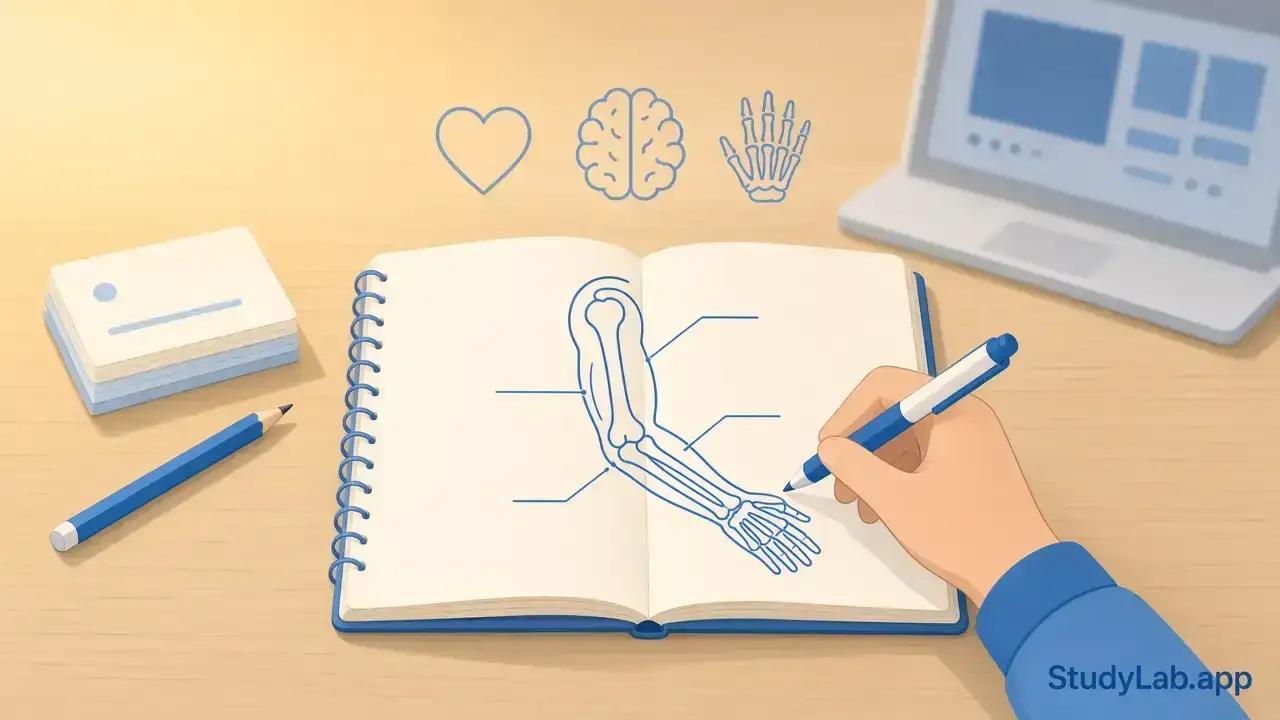
An anatomy student posted on r/GetStudying this week asking for help, and the setup will sound familiar to anyone in A&P. At least 200 slides of notes a week. A closed-book assessment every Friday, worth 70% of the grade, with the professor watching through the webcam. And a study routine that looks like hard work: copying the slides, colour-coding topics with different pens, going back to highlight, bolding key words, writing summaries at the end of each chapter.
"I end up mindlessly writing down the words on the slide and not really learning anything," they wrote. "I don't care how absurd it sounds, I'm all ears."
It doesn't take anything absurd. The routine above leans on highlighting and rereading, which learning researchers rate among the least effective study methods, and swaps in almost no recall. Here's how to study anatomy when the slides never stop coming.
Why anatomy is uniquely hard
Most subjects have a lot of material. Anatomy has a lot of material where every piece has a name you've never heard before, sits somewhere specific in three dimensions, and connects to half a dozen other pieces.
That creates three problems at once.
The vocabulary is brutal. Brachioradialis, sternocleidomastoid, zygomaticus major. Before you can learn what a structure does, you have to learn to hold its name in your head, and a single lecture can introduce dozens of them.
It's spatial. Knowing "the radial nerve" as a phrase is useless on an exam that shows you a diagram and asks what's at arrow C. Slides flatten everything into two dimensions and a bullet list, which is the opposite of how the exam tests you.
Recognition feels like knowing. When you reread a slide about the rotator cuff, every word looks familiar. That familiarity feels like learning, but it's not the same as being able to produce those four muscle names on a blank page. This is the illusion of competence, and anatomy is where it does the most damage, because there's so much to recognise.
Copying slides, colour-coding and highlighting all live inside that illusion. They feel productive because you're busy and the page looks great. None of them make you pull anything out of memory.
A 2019 guide in Clinical Anatomy, written by anatomists at Weill Cornell Medicine and elsewhere together with the cognitive psychologist John Dunlosky, put it bluntly. Anatomy students should avoid highlighting and rereading, and should use practice testing, spaced practice and successive relearning instead.
Techniques that work for anatomy
1. Stop copying the slides
The slides are your syllabus, not your notes. Your professor already wrote them. Copying them word for word is transcription, and your brain can do transcription without taking anything in.
If your professor posts the slides, print them three to a page or keep them open as a PDF. During lecture, write only what isn't on the slide: the example the professor gave, the "this will be on the exam" comments, the clinical story. That's a fraction of the writing and all of the useful part. The lecture slides guide goes deeper on turning slides into study material.
2. Test yourself, even if you only change one step
This is the single biggest change, and it has evidence from an actual A&P class. In a 2015 study in Advances in Health Sciences Education, John Dobson and Tracy Linderholm at Georgia Southern University had students in a university anatomy and physiology course study three sets of material three different ways. One set they read three times. One they read and then reread while taking notes. One they read, then recalled as much as they could from memory, then read again.
A week later, the read-recall-read material was remembered best. Rereading with notes did no better than plain rereading.
That's a tiny change. Same material, same three passes. The middle pass was just closing the book and trying to write it out. For a 200-slide week, it means every section you cover ends with the slides closed and a blank page in front of you.
3. Draw it from memory, badly
Anatomy is spatial, so your recall should be too. Take a blank page and draw the structure you just studied, the brachial plexus, the chambers of the heart, the bones of the wrist, from memory. Then label it. Then open the slide and check.
Your drawing will be ugly. That's fine. A 2016 study by Jeffrey Wammes, Melissa Meade and Myra Fernandes at the University of Waterloo ran seven experiments on what they called the drawing effect and found that drawing something beat writing it out for later recall, even when people were given less time to draw. Their explanation is that drawing combines meaning, a visual image and a physical action in one memory. The picture superiority effect post covers why ugly doodles work.
For anatomy, the move is blank-diagram practice. Screenshot the unlabelled version of a diagram from your slides or textbook, or cover the labels with sticky notes. Fill in every label from memory before you check.
4. Ask what each structure does, not just where it is
Names stick better when they're attached to something. For every structure, add one "so what" question. Where does this muscle attach, and so what movement does it produce? What does this nerve supply, and so what happens if it's damaged?
The biceps brachii flexes the elbow and supinates the forearm, which is why it's the muscle you use to turn a screwdriver. That's easier to remember than "biceps brachii" as a word on a slide, and it's the kind of connection that lets you answer exam questions you haven't seen before.
5. Save mnemonics for lists
Mnemonics are great for fixed lists that have no logic of their own. The five branches of the facial nerve (temporal, zygomatic, buccal, marginal mandibular, cervical) are a classic: "To Zanzibar By Motor Car." Cranial nerves, carpal bones and the layers of the scalp all have well-worn mnemonics.
But a mnemonic only gives you the order and the first letters. It doesn't tell you what the structure does. Use them for lists, and use the "so what" questions for everything else. The mnemonic devices post has more on building good ones.
6. Space it out and come back
With a weekly assessment it's tempting to learn each week's material, take the quiz, and move on. But anatomy builds on itself. The muscles you learned in week 3 are what the nerves in week 7 supply. And the final exam is cumulative.
The Clinical Anatomy guide recommends successive relearning, which means retrieving the same material to a correct answer across several spaced sessions, not just once. The successive relearning post walks through exactly how to do it.
A weekly anatomy workflow for 200 slides
Here's what a week can look like with a Friday closed-book quiz. Adjust the days to fit your schedule.
Before each lecture (10 minutes). Skim that lecture's slides. Just the headings and diagrams. You're building a map, not learning.
During lecture. Write only what isn't on the slides.
Same day (30 to 45 minutes per lecture). Go through the slides section by section. After each section, close it and blurt everything you can onto a blank page, drawing the structures where you can. Then check against the slides and mark what you missed in a different colour. Those misses are your flashcards.
Each evening (15 to 20 minutes). Review flashcards from the whole week so far, plus a handful from earlier weeks. The cards you get wrong come back tomorrow.
Wednesday or Thursday. One full self-test on the week's material. Blank diagrams, "so what" questions and practice questions, closed book, as close to Friday's format as you can manage. If turning 200 slides into questions sounds like a second job, uploading the slide PDF to StudyLab will generate a quiz from it.
After Friday's quiz. Note every question you got wrong and add it to your flashcards. That's your successive relearning list for the weeks ahead.
This takes less time than copying and colour-coding every slide, and almost all of it is retrieval.
FAQ
What is the best way to study for an anatomy exam?
Test yourself instead of rereading. A 2015 study in a university anatomy and physiology course found that adding one recall-from-memory step between two readings improved retention a week later, while rereading with notes didn't help. Combine that with drawing structures from memory and spacing your review across the weeks.
How do you memorize anatomy fast?
Fast memorization in anatomy usually comes from doing less writing and more recall. Skip copying slides. Close the book after each section and write or draw what you remember, then check. Use mnemonics only for fixed lists like nerve branches, and connect every structure to what it does.
Should I rewrite my anatomy notes?
Rewriting slides word for word is mostly transcription and does little for memory. If you rewrite anything, do it from memory: close the slides, write out the section, then check what you missed.
Is drawing helpful for studying anatomy?
Yes. A 2016 series of seven experiments found that drawing information beat writing it for later recall, even when the drawings were rough. For anatomy, draw structures from memory and label them before checking.
Start with this week's slides
Take tonight's lecture, just one. Close the slides after each section and blurt it onto a blank page, drawing the structures as you go. Check it, and turn every miss into a flashcard. If you'd rather start from ready-made questions, drop this week's slide PDF into StudyLab and quiz yourself on it before Friday.